

























































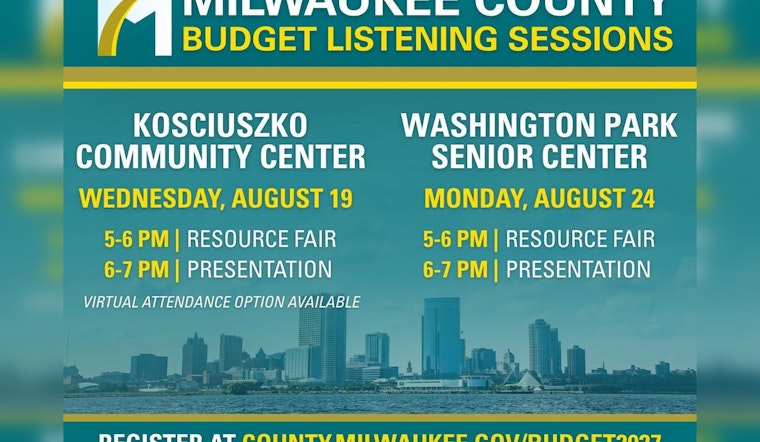
Milwaukee County will hold two public listening sessions in the final two weeks of August to gather resident input on the 2027 budget, as County Executive David Crowley's administration works through a mandated round of departmental spending cuts. The first session lands Aug. 19 at the Kosciuszko Community Center on South 7th Street, with a second gathering the following week at the Washington Park Senior Center on West Vliet Street.
According to a report from Urban Milwaukee, reporter Graham Kilmer detailed how the county's Budget Office will present the administration's spending priorities directly to residents at both meetings before the 2027 budget process moves forward. Residents will be able to weigh in on their own priorities before departments finalize their formal budget requests, which are due Aug. 13.
Why the County Says It's Short on Cash
Per the outlet's report, the administration says the primary challenge remains Wisconsin's state aid and shared revenue payments, which have failed to keep pace with rising costs. Inflation is pushing the price of continuing existing government programs beyond what the county expects to collect in revenue, prompting Crowley to ask departments to prepare for a collective $10 million across-the-board spending reduction.
The scale of the shortfall is laid out in the Milwaukee County Comptroller's five-year forecast, which projects 2027 expenditures of $1.367 billion against revenues of just $1.316 billion, a $50.8 million gap, according to the Milwaukee County Comptroller. The same forecast estimates an average annual structural deficit of $33.7 million through 2031, suggesting the pressure on next year's budget won't be a one-time event.
Operating Budget Director Daniel Laurila told the Milwaukee County Board's Committee on Finance last month that the directive traces back to state shared revenue failing to match inflation for more than a decade, according to Urban Milwaukee. It's a familiar squeeze for the county, which opened its 2025 budget cycle with a roughly $46 million gap of its own.
MCTS Bus System Riding Toward a $15.7 Million Cliff
The county's transit system faces its own reckoning. A June fiscal report cited by the Office of the Milwaukee County Executive puts MCTS's 2027 deficit at $15.7 million, largely because the federal pandemic relief money that has propped up operations will be fully spent by the end of 2026.
MCTS President and CEO Steve Fuentes has proposed cutting service by 25 percent in 2027 and redesigning the bus network, the outlet reported. MCTS remains one of the few major transit systems in the country without a dedicated local funding source, and a coalition of advocates led by MobiliSE has been pressuring lawmakers in Madison to block the cuts, warning that reduced service would cut off low-income riders from jobs and medical appointments.
How the County Is Paying Its Bills
Milwaukee County also projects a $12.3 million increase in the property tax levy, but most of that money is already spoken for. Roughly $9.1 million would cover debt service on major capital projects, including the Center for Forensic Science and Protective Medicine and the Nature & Culture Museum of Wisconsin, while $3.2 million is earmarked for general operations, according to Milwaukee County financial records.
A separate 2023 state law, Wisconsin Act 12, gave the county a 0.4% local sales tax that took effect in January 2024 specifically to manage legacy pension liabilities. County fiscal officers project that tax will fully cover annual pension liabilities and cut unfunded pension debt by $81.6 million through 2031, per the Wisconsin Legislative Reference Bureau. That revenue is legally firewalled from covering daily departmental operations, though, leaving this year's inflation-driven costs to be absorbed elsewhere.
Crowley has said decades of frozen state shared revenue have cost the county an estimated $250 million in inflation-adjusted local funding, even as the county's annual pension obligations have grown to $200 million, according to the Office of the Milwaukee County Executive. State revenue-sharing formulas have remained largely static for more than two decades.
A Billion-Dollar Repair Backlog Still Waits Its Turn
Beyond this year's operating squeeze, the Wisconsin Policy Forum warned in October 2025 that Milwaukee County faces a deferred capital repair and replacement backlog exceeding $1 billion, including the looming need to design a replacement complex for the county courthouse. Repeated operating budget squeezes, the group cautioned, risk pushing that maintenance further into the future.
The financial strain has already reshaped county leadership. Former Behavioral Health Services Administrator Mike Lappen was asked to step down in March following a December 2025 Comptroller projection of a multi-million-dollar shortfall in his division, according to Hoodline's earlier reporting, a shakeup that came amid a broader overhaul of county mental health care.
What Happens Next in the Budget Process
Crowley is expected to release his recommended 2027 budget at the end of September, after which the Milwaukee County Board of Supervisors will take over and begin its amendment process. Urban Milwaukee reports that the budget will likely be finalized and adopted in early November, leaving this month's two listening sessions as one of residents' few formal chances to shape the plan before it's locked in.





