

























































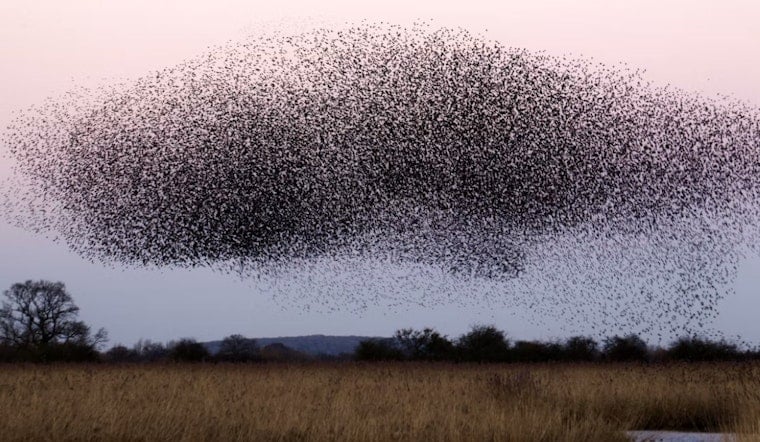
Roughly 170 million birds are expected to be aloft over the country overnight today into tomorrow, and Michigan's Upper Peninsula is bracing for some of the heaviest traffic of the night. Radar-based forecasts show about 3.8 million birds passing over Michigan Monday night alone, climbing to about 4.2 million Tuesday and topping 6 million by Wednesday night, as the state's fall migration season shifts into gear.
The numbers come from BirdCast, the migration forecasting tool produced by the Cornell Lab of Ornithology using real-time radar analysis of bird migration traffic, as reported by the Detroit Free Press. BirdCast maps receive support from NASA, Amazon Web Services, the National Science Foundation, the Leon Levy Foundation, and the Edward W. Rose Postdoctoral Fellowship. The system tracks how many birds flew over a given county the previous night and classifies local migration density as low, medium, or high, giving residents a rough sense of how much overhead traffic to expect.
Right now, the western Upper Peninsula carries the highest level of lights-out alert status in the state, according to the same BirdCast data cited by the Free Press, while the rest of the U.P. sits at medium alert. Most bird species migrate at night, using stars and darkness to navigate, and some fly as high as 15,000 feet as they move south. Michigan's birds have started or are about to start their annual journey, with some traveling as far as Central and South America before winter sets in.
Why Darkness Matters for Night Fliers
Ornithologists urge Americans to turn off nonessential lighting from 11 p.m. to 6 a.m. during peak migration periods, the Free Press reports, because bright lights can attract and disorient night-migrating birds, putting them at risk of potentially fatal collisions with buildings. Warblers are most likely to be among the species migrating during Michigan's peak window, according to the article. In Michigan, that broader danger is well documented: more than 250 species of night-migrating birds, including warblers, thrushes, and tanagers, rely on stars and lunar light to find their way, and bright artificial skyglow can cause them to circle buildings until they are exhausted or fatally struck, according to the Grand Rapids Audubon Club.
The stakes for these detours are steep. An August 2024 study found that building collisions kill well over 1 billion birds annually in the U.S., and that 60 percent of injured birds brought to wildlife rehabilitators ultimately die from their injuries, per the American Bird Conservancy. A separate 2014 study by the U.S. Fish and Wildlife Service and Smithsonian researchers found that high-rises account for under 1 percent of collision deaths, while low-rise commercial buildings cause 56 percent and residential homes cause 44 percent — a reminder that the danger isn't limited to downtown skyscrapers.
Michigan's Long History With Lights-Out Efforts
Michigan has been pushing lights-out awareness for two decades. The state established Safe Passage Great Lakes Days, running March 15 to May 31 and August 15 to October 31, urging property owners to extinguish non-essential lights overnight, a policy tracing back to a 2006 proclamation from then-Governor Jennifer Granholm, according to The Ann Arbor News. Guidelines specifically target upper-story commercial illumination, recommending that lights on the fifth floor and above be turned off between 11 p.m. and 6 a.m., when high-altitude migrants are most vulnerable.
The Detroit Bird Alliance launched the original Safe Passage Great Lakes campaign that same year, working with building managers to lower night lighting in urban centers, a program that has since expanded into chapters across Southeast and West Michigan. The MI Birds program, a joint venture between Audubon Great Lakes and the Michigan Department of Natural Resources founded in 2016, now organizes volunteers who monitor building collisions statewide and use that data to negotiate voluntary lights-out agreements with commercial property owners. Even so, participation remains almost entirely voluntary for private commercial real estate, according to Ann Arbor's own municipal reporting on the program.
Institutions have started leading by example. In October 2025, the Detroit Zoo began switching off its landmark water tower's up-lighting at 11 p.m. nightly through the end of the month specifically to prevent nocturnal bird disorientation during fall migration. In the Upper Peninsula, the Whitefish Point Bird Observatory sits at one of the most concentrated migration corridors in the country, where more than 340 bird species funnel past Lake Superior each spring and fall, according to Pure Michigan — geography that helps explain why the western U.P. is flagged for the heaviest alert status this week.
A Bigger Picture Behind the Nightly Numbers
BirdCast provides live and local migration alerts throughout the continental United States, with a dashboard hosted by the Cornell Lab that offers daily summaries of radar-based nocturnal bird traffic. Michigan's fall migration generally runs from August 1 through November 30, per the Free Press, with the true peak — when roughly half of all nighttime migration traffic passes through — arriving between mid-September and mid-October.
The nightly counts fit into a much larger and more troubling trend. A landmark 2019 study published in Science found that North America has lost 2.9 billion breeding adult birds since 1970, a 29 percent overall population decline, with warblers alone losing more than 600 million individuals over that half-century, according to the Cornell Lab of Ornithology. Against that backdrop, wildlife advocates say something as simple as flipping off a light switch during peak migration weeks can matter more than it might seem.





