

























































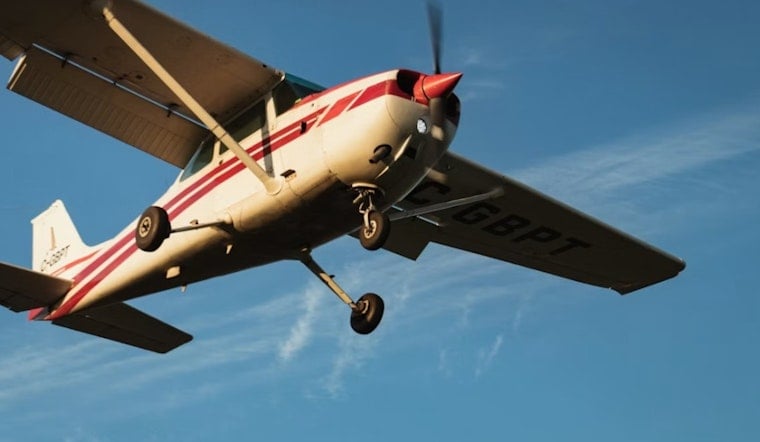
Eighteen small planes roared through the skies over Modesto in quick succession this week, each one flown by a woman racing toward a finish line 750 miles away in Central Oregon. The aircraft were competing in the Palms to Pines Air Race, an annual cross-country contest flown entirely by women that traces its roots back nearly a century.
The race, which runs over two days and is sponsored by the Los Angeles chapter of The Ninety-Nines, starts in Santa Monica and pushes north through California before organizers announce the winners in Central Oregon, according to KCRA. Modesto serves as one of the checkpoints along the route, with the race continuing on from Red Bluff, California, where the field makes its first stop. Some pilots fly straight through to Red Bluff, while others break there for lunch and refueling before pressing on.
At Modesto Airport, members of the San Joaquin chapter of The Ninety-Nines handled timing duties as planes streaked overhead. Lynne Orloff managed race times and penalties on the ground, while Dianne Cole monitored approaching aircraft from the airport tower, tracking each plane as it came into view.
A Farm Girl's Path to the Cockpit
Among the pilots flying through was Vicki Schwebach, who grew up in South Dakota and now lives in San Diego. Schwebach was introduced to flying by her father, and she recalled the moment that set her course: watching F-4 fighter jets scream over the family farm. Her father told her then that she, too, could fly.
Schwebach said she hopes her participation in the race shows young women and girls that there is a path to becoming pilots. Flying alongside her was teammate Claudette DeCourley, who has previously flown in the Palms to Pines race and now plans to become a pilot herself. DeCourley said the race supports women taking on an endeavor that many people do not think women can do.
Roots in a Century of Women's Air Racing
The Palms to Pines Air Race carries forward a tradition that stretches back to The Ninety-Nines, the international organization of women pilots founded in 1929, which has chapters across the United States and counted Amelia Earhart as its first president. Teams competing this year included groups with names like the Sparkettes, the Crimson Buccaneers, and Goldie's Girls, reflecting the camaraderie that has defined the event for generations.
That lineage connects to the broader history of women's aviation that Hoodline has previously chronicled through Wally Funk, the Mercury 13 pioneer and longtime Ninety-Nines member who died last month. The Palms to Pines route itself was born from a similar spirit: the race originated in 1969 when Claire Walters, one of only about 100 female flight instructors in the U.S. during the 1940s, was asked by a former flight student to organize a women's air race to his hometown of Independence, Oregon, drawing 34 teams to that first competition, according to the Los Angeles Times. Walters, who began flying at 17 in 1941 and ran a flight academy at Santa Monica Airport for 27 years, kept the race running consecutively for 40 years until her death in January 2010. The event went dormant for 13 years afterward until the Los Angeles chapter of The Ninety-Nines revived it in 2022, per the Piper Owner Society.
Precision Flying, Not Just Raw Speed
Unlike a straightforward speed contest, the Palms to Pines Air Race uses a handicapping system: each aircraft is assigned a target handicap speed, and pilots are scored on how much their actual ground speed exceeds that number through careful route planning and weather strategy, according to General Aviation News. Flying under daytime visual flight rules, competitors must choose their altitudes and routes to maximize wind advantages rather than simply flying as fast as possible. The full course spans roughly 750 statute miles from Santa Monica Airport to Madras Airport in Central Oregon, with compulsory fly-bys required at Modesto and Butte Valley airports along with a mandatory overnight stop in Red Bluff.
To enter as a primary pilot, aviators must hold at least a Sport Pilot Certificate and log a minimum of 100 total flight hours, though student pilots are allowed to participate as co-pilots or passengers, per the Los Angeles 99s chapter's race rules. The event's format echoes an even older precedent: the August 1929 Women's Air Derby, nicknamed the “Powder Puff Derby” by humorist Will Rogers, sent 20 female aviators flying 2,800 miles from Santa Monica to Cleveland, according to the National Aviation Heritage Area.
A Grassroots Push Amid Slow Industry Progress
The Modesto flyover comes as national numbers show women entering aviation in record numbers, even as the highest ranks of the profession remain far more male-dominated. Federal Aviation Administration statistics released in April show the active female pilot population in the U.S. topped 100,000 for the first time by the end of 2025, reaching 100,704 women, or 11.3% of all active pilots, up from 91,694 in 2024 and 58,541 in 2020, according to AVweb.
Yet that growth has not translated evenly up the career ladder. Women made up 16.4% of U.S. student pilots in 2025, but hold only 5.7% of Airline Transport Pilot certificates, the top qualification required to captain commercial airliners, according to AirAdvisor. Research cited by the outlet points to financial constraints and mentorship deficits as contributing factors to that slow advancement, a gap that grassroots events like Palms to Pines aim to help close by connecting pilots at every stage of their careers.
Modesto City-County Airport, known as Harry Sham Field, gave the race a fitting Central Valley waypoint. The airport opened in 1918 and holds the distinction of being the first municipally owned airport in the United States, according to Wikipedia; it moved to its current 435-acre site in 1929 and now operates two active runways. For pilots like Schwebach and DeCourley, the stop was just one leg in a two-day journey that organizers say is about more than the finish line in Central Oregon — it is a chance to keep expanding who gets to call themselves a pilot.



