

























































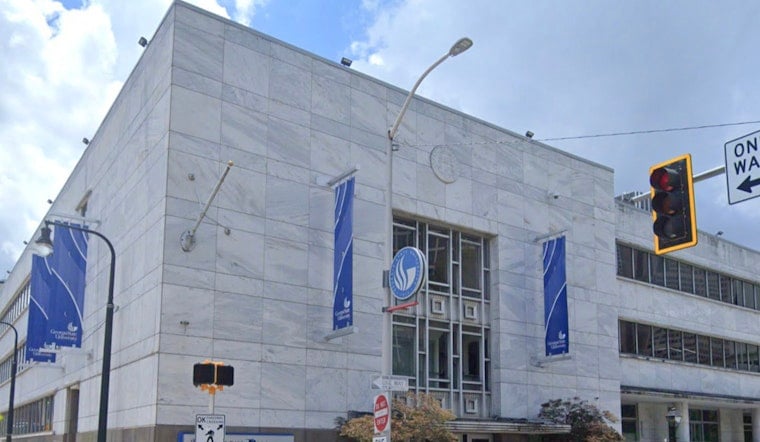
Most Georgia State University students take four to six years to finish a bachelor's degree. Ivanna Poliashenko did it in 14 months, earning a degree in mathematics with a statistics concentration at just 19 years old while tutoring other students, studying on MARTA trains, and squeezing in an independent study in abstract algebra just because she loved it.
An Unprecedented Timeline Built Overnight
Poliashenko attended Georgia State University in Atlanta across four semesters spanning June 2025 to August 2026, according to the New York Post. She had already covered a sizeable portion of her core coursework through Advanced Placement credits earned at Woodward Academy, an independent college-preparatory school in Metro Atlanta that offers 25 AP courses and earned Gold status on the national AP Honor Roll this year, according to Woodward Academy. Roughly 85% to 90% of the school's students score a 3 or higher on their AP exams, giving Poliashenko the credit base she needed to skip ahead.
She created her accelerated course roadmap overnight, calculating that her AP credits satisfied a large portion of core university requirements, per SaportaReport. Undergraduate Director Leslie Meadows helped her build the plan, and Department Chair Alexandra Smirnova approved it, allowing Poliashenko to take placement exams to test out of several mathematics prerequisites without earning college credit for them. Georgia State University itself, through that departmental flexibility, helped make the accelerated schedule possible.
Six Courses, Then Seven, Then Eight
The pace was relentless. Poliashenko took six courses in the summer of 2025, seven that fall, and then eight courses in spring 2026 after an administrative miscount of her degree requirements forced her to add an extra class to stay on track, the same report notes. A typical full-time undergraduate schedule consists of four courses per term, meaning she was carrying double the standard load during her most intense semester. She closed out her degree with six more courses in the summer of 2026.
Her days ran long. Poliashenko attended classes between 10:30 a.m. and 6:45 p.m., and she studied during train rides and until around midnight most nights, according to the Post's report. She also worked one and a half hours before attending classes each day, tutoring at Georgia State University's STEM tutoring center — a routine she plans to continue at the Panther STEM Tutoring Center even as she begins graduate school.
A Family of Mathematicians
Poliashenko's affinity for numbers runs in the family. She grew up in a Ukrainian household in Atlanta and spoke only Russian during the first few years of her life before entering local schools, according to 11Alive. Her father earned a Ph.D. in applied mathematics, her mother worked in computer science, her grandmother was among Ukraine's pioneering computer programmers, and her grandfather taught university mathematics — a lineage that helped cultivate her talents from early childhood, the station reports.
Poliashenko has said she loves mathematics, and that love pushed her past the minimum requirements of her degree. Although abstract algebra was not required for her statistics concentration, she completed a five-month independent study in the subject with Professor Florian Enescu, meeting with him once a week so he could guide her through material that normally spans two academic courses. The Georgia State University mathematics department also awarded her the V.V. Lavroff Calculus Award, given to students who earn a 4.0 GPA across all of their calculus courses.
From MARTA Study Hall to a Transit Fix
Poliashenko's daily commute became part of her academic routine rather than dead time between classes. She rode MARTA trains to Georgia State's downtown campus and converted that travel time into extra study hours, according to SaportaReport's account. That habit shaped a longer-term ambition: she wants to apply her statistics background toward improving accessibility and efficiency in Metro Atlanta's public transit system.
Georgia State ranks 125th nationally for its mathematics program, according to U.S. News & World Report, and the university's average four-year graduation rate stands at roughly 34%, with a six-year rate between 53% and 54%, per College Factual. Those numbers underscore just how far outside the norm Poliashenko's 14-month timeline falls at a university that retains about 78% of its first-year students but graduates most of them years later.
What Comes Next
Poliashenko has said Georgia State University supported her accelerated degree plan, and she has been accepted into the Georgia Institute of Technology's master's program in mathematics, keeping her in Atlanta as she works toward a doctorate. Georgia Tech's campus sits just minutes north of Georgia State in central Atlanta, per 11Alive's report. She has said she would be happy working as a professor or high school teacher down the line, and in the meantime she plans to keep tutoring and relaunch a personal blog dedicated to theoretical mathematics.





