

























































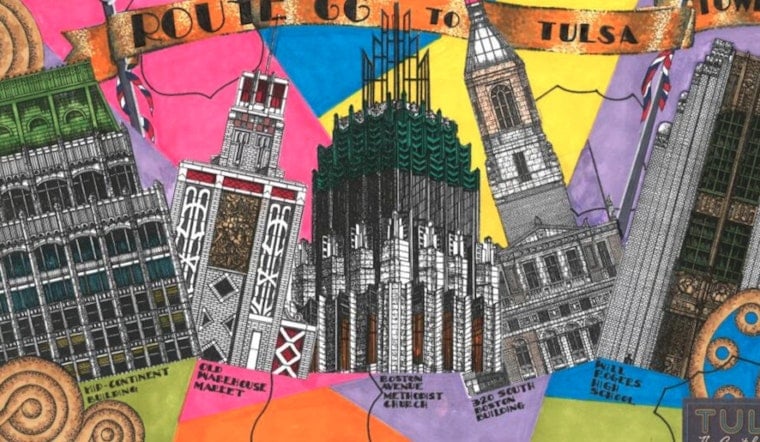
Tulsa has picked 21 local artists to turn 34 traffic control boxes along its 28-mile stretch of Route 66 into colorful public art displays, part of a citywide push to dress up the Mother Road ahead of its 2026 centennial. Vinyl wrap fabrication began this month, with installation expected to wrap up by September.
The selections were announced as part of a broader beautification effort, according to The Journal Record, which reported that the project aims to enhance wayfinding while celebrating artists connected to Route 66. More than half of the selected artists are from Tulsa itself, and 71% come from communities along the historic highway, underscoring how deeply local the initiative is meant to feel.
Among the artists tapped for the project are Rick Bartholomew, Daryl Bostick of Funksthetics Merchandise & Design, Gabriel S. Peguero-Damian of Theosis Santos, Aundria Braggs of Art by Aunj, Renee Corvin of Timeless Painting by Renee, Katrina Gemmil, and Destiny Minney. Also selected were Audie Case, Maci Gibson, Raymond Irwin of Ray Wolf Music & Art, Lillian Haley, Keely Lane, Kelly Morris of KP Colors, and Rebecca Henson. Rounding out the roster are Lori Joan Morgan, Makenzie Massey, Sonia Holchaf of Soniarita, Judit Hense, Liliana Rios-Garcia, Felicia Roberts, and Sarah Kraft of Kraft's by Sarah.
Federal Dollars Fund a Corridor-Wide Makeover
The traffic box wraps are funded through federal American Rescue Plan Act dollars earmarked specifically for Route 66 beautification, according to the City of Tulsa. That same pool of ARPA money has already paid for planting more than 100 street trees along the corridor and for increased street sweeping this year. Under the program's terms, each participating artist receives a $500 stipend per selected design, while the city covers materials, vinyl wrap fabrication, site preparation, and installation. Artists could submit up to four original designs apiece, and city officials capped total submissions at 160 during the open call.
Not everyone got just one design picked. Per 102.3 KRMG, Peguero-Damian and Lilian Rios-Garcia each had four designs selected, making them among the most represented artists in the project. While Route 66 iconography was encouraged in the call for submissions, guidelines also allowed modern and abstract artwork, which the station's report says resulted in a broader creative mix than a strictly nostalgic highway theme might suggest.
QR Codes Turn Boxes Into Digital Tour Stops
Every completed box will carry a standardized “Capital of Route 66” graphic featuring a QR code linking to the city's digital Route 66 Art StoryMaps, a self-guided tour that also highlights murals, sculptures, and roadside attractions along the corridor, per the city. Tulsa officially copyrighted the “Capital of Route 66” title in July 2024 after a two-year research and survey process, cementing branding tied to the city's 28 miles of original highway within its limits.
That branding traces back to 1926, when U.S. Highway 66 was created after Tulsa civic leader Cyrus Avery lobbied to route the road through the city via the 11th Street Bridge over the Arkansas River — a push that earned Avery the nickname “Father of Route 66,” according to the city. The traffic box project is managed jointly by Tulsa's Office of Public Art and Community Partnerships, the Planning & Neighborhoods Department, and Public Works, led by Public Art Director Ashanti Chaplin and Route 66 Commission Chair Christian Bengel. Both the Tulsa Arts Commission and the Route 66 Commission approved the installations.
Postcards, an Unveiling, and a Wider Centennial Push
Once installation is complete, the city plans to host an unveiling event, and Route 66 visitor centers will hand out postcards featuring the new artwork. The traffic box wraps join other corridor projects timed to the centennial, including Oklahoma's first musical road, funded by a $90,000 state revitalization grant Tulsa secured in December for a stretch of Southwest Boulevard Bridge slated for completion in March 2026.
Tulsa's ongoing public art funding also flows through the Vision Arts program, backed by the voter-approved Vision Tulsa tax extension, which distributes $150,000 annually across a 15-year, $2.25 million cycle, according to the city. Statewide, the Oklahoma Route 66 Centennial Commission has directed roughly $6.6 million a year into local corridor revitalization, murals, and public events leading into 2026, a pattern of investment playing out in other towns along the highway as well, including Yukon's recent Main Street makeover.





