

























































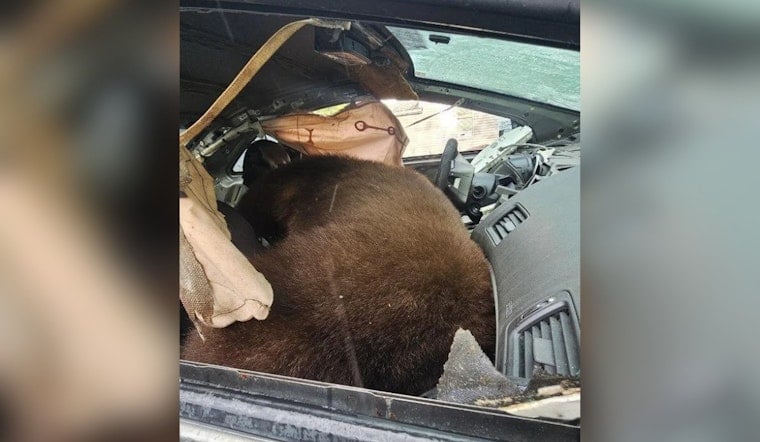
A black bear weighing about 250 pounds died after becoming trapped inside an unlocked car in central Colorado Springs, where the vehicle sat undiscovered for days in the summer heat. The bear had climbed inside searching for food but could not find its way back out, according to Colorado Parks and Wildlife.
Wildlife officials say the bear destroyed the vehicle's interior while trying to escape before it died, according to CBS Colorado. The outlet reported the animal had entered through an unlocked door and simply could not get back out once it was inside, a pattern wildlife officials elsewhere in the state have documented repeatedly this summer. It remains unclear exactly how many days passed before anyone found the car or whether local trash ordinances played any role before the bear died.
The death comes as Colorado Parks and Wildlife has logged more than 6,000 bear-sighting reports so far in 2026, a figure that wildlife officials say is roughly double the same period last year, per the station's report. Recent drought conditions have reduced natural food sources in parts of Colorado, pushing bears out of the mountains and into communities in search of a meal, the outlet noted. That statewide tally lines up with separate data reported by KRDO, which found Colorado Parks and Wildlife logged 6,129 bear sightings and conflict reports between January 1 and August 13, already surpassing the 5,299 reports tallied for the entirety of 2025.
Why Bears Keep Getting Stuck Inside Cars
This time of year, black bears enter a biological state called hyperphagia, in which suppressed hunger signals drive them to forage up to 20 hours a day and consume around 20,000 calories in search of enough fat to survive hibernation, according to the Gunnison Country Times. That relentless drive, combined with a sense of smell described by police in nearby Manitou Springs as roughly 2,100 times stronger than a human's, can pull bears toward chapstick, food wrappers, or anything else left inside a parked vehicle, the Denver Gazette reported.
Getting in is the easy part. Colorado wildlife officials have long noted that bears can manipulate external lever-style door handles to open unlocked cars, but often render the interior handles inoperable while clawing at the cabin trying to get back out, effectively trapping themselves inside, per earlier Denver Gazette reporting. Once the doors latch shut, there is little a bear can do on its own. In Manitou Springs on July 29, emergency crews had to free a bear from a vehicle after it caused extensive interior damage trying to break free. Weeks earlier, in Gold Hill, a trapped bear honked an SUV's horn through the night and deployed the driver-side airbag before a resident freed it using a rope tied to the door handle from a safe distance, according to KOSI 101.1.
A Locked Car Becomes a Death Trap
Unlike those cases, the Colorado Springs bear did not get a rescuer in time. The interior of a car parked in direct summer sunlight can climb 20 degrees Fahrenheit within 10 minutes and top 120 degrees in under an hour, according to the National Weather Service, which also notes that cracking a window offers almost no relief once a vehicle is sitting in full sun. For an animal trapped inside for days, those conditions would have proven lethal well before anyone found the car.
Colorado Parks and Wildlife has responded to the incident by renewing its public safety messaging, urging drivers statewide to lock car doors, remove trash and food from vehicles, and keep windows rolled up. The agency has also posted a Living with Bears section on its website aimed at educating residents about bear habits and how to avoid dangerous encounters between people and wildlife.
New Penalties and a Two-Strikes Policy
The Colorado Springs case surfaces just days after a new state law took effect, making it a misdemeanor to intentionally or negligently leave food or edible waste out in the open in a way that lures bears, with maximum fines rising from $2,000 to $5,000 for repeat offenders, according to Three Eagles Communications. The law, which took effect August 12, also eliminated the previous requirement that law enforcement issue a formal warning before citing violators.
Even bears that survive human contact face steep odds once they are captured. Under Colorado Parks and Wildlife's Administrative Directive W-2, a black bear captured or handled a second time for conflict or property damage must be euthanized under the state's two-strikes policy, according to the Colorado Bear Coalition. In 2025 alone, the agency relocated 52 black bears and euthanized 78 statewide as human-wildlife conflicts and food habituation escalated, per Newsweek.
Federal land managers are also responding to the pressure drought has placed on bear habitat. On August 13, the White River National Forest announced it would install additional bear-resistant storage lockers in backcountry and dispersed camping areas across multiple ranger districts, with officials citing drastically reduced late-summer berry crops as a driving factor, according to the U.S. Forest Service. The Colorado Springs bear's death adds a grim data point to a season already defined by record encounters between people, their vehicles, and animals desperate to eat before winter.





