

























































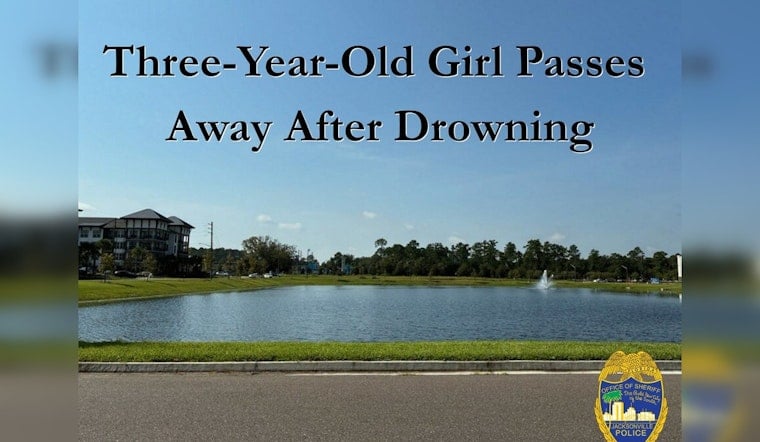
A three-year-old girl with autism has died after wandering from her home and drowning in a retention pond near the Waterside Townhomes at River City complex in North Jacksonville. District 6 Patrol officers with the Jacksonville Sheriff's Office responded to a call about a missing child with autism just after 7:30 a.m. Monday, and officers found the girl unresponsive in a nearby retention pond.
The Jacksonville Sheriff's Office, in a statement posted to its official X account, confirmed that its Crime Scene Unit and Homicide Unit detectives both responded to the scene, though the agency said foul play is not suspected at this time. According to the Jax Sheriff's Office, investigators are still working to determine how the child exited her home and the full circumstances surrounding the drowning. The sheriff's office said it is coordinating its investigation with the medical examiner's office and the Florida Department of Children and Families.
Waterside Townhomes at River City is a multi-family residential complex at 14119 River Station Lane near the River City Marketplace corridor, managed by Willow Bridge Property Company. The sheriff's office is asking anyone with information about Monday's incident to call 904.630.0500, email [email protected], or contact Crime Stoppers.
A Grim Pattern Less Than Three Weeks Old
Monday's drowning is not an isolated tragedy in Jacksonville. Less than three weeks earlier, seven-year-old Chace Brown, an autistic and non-verbal boy, wandered from his home in the city's Egret Creek neighborhood and was found dead in a pond in the Northside area following an hourslong multi-agency search, as reported by First Coast News. The back-to-back losses underscore a danger that public health researchers and state officials say is disproportionately claiming the lives of children on the autism spectrum.
Research from Columbia University's Mailman School of Public Health, published in the American Journal of Public Health, found that children with autism spectrum disorder are roughly 160 times more likely to die from accidental drowning than neurotypical children, according to the National Autism Association. The same research indicates that about 49% of children with autism attempt to wander or elope from safe supervision, and that accidental drowning accounts for 71% to 91% of all wandering-related deaths among autistic children under age 14.
Florida's Statewide Drowning Crisis
Florida set a state record in 2025 with 119 to 120 child drowning deaths, the highest total in the nation, and had logged at least 74 child drowning fatalities through late July of this year, putting the state on pace for another record-breaking toll, per WLRN Public Media. Data from the Florida Department of Children and Families reported in July found that roughly one out of every six child drowning deaths statewide involved a child diagnosed with autism.
Retention ponds like the one behind Monday's tragedy pose particular hazards because they are often built with steep slopes that drop off quickly into deep water. Under Florida Department of Environmental Protection standards, these stormwater basins require safety fencing only if their side slopes are steeper than a 4:1 ratio, leaving enclosure decisions largely up to slope engineering and local municipal codes, as Hoodline has previously reported in its coverage of a similar case involving a Tampa boy who drowned.
That regulatory gap stands in contrast to Florida's rules for residential swimming pools. The state's Preston de Ibern/McKenzie Merriam Residential Swimming Pool Safety Act requires all new residential pools built after October 2000 to include at least one approved safety barrier, such as an isolation fence, safety cover, exit alarm, or self-latching door, with violations treated as a second-degree misdemeanor under Florida Statute Chapter 515. No comparable statewide mandate exists for the retention ponds that dot apartment complexes and subdivisions across the state.
Why Supervision Alone Often Isn't Enough
According to the National Drowning Prevention Alliance and Florida legislative bill analyses, more than 70% to 80% of fatal child drownings happen during non-swim times, when children slip away undetected while parents or caregivers are handling routine household tasks. That statistic helps explain why officials continue to stress physical barriers and alarms rather than supervision alone as the more reliable safeguard.
U.S. Representative Debbie Wasserman Schultz announced in July that she had secured more than $30 million in federal appropriations for drowning prevention programs and is pushing to expand swim safety education and pool barrier awareness across Florida. The Jacksonville Sheriff's Office echoed similar guidance in its statement, urging parents to block children's access to water with fencing, alarms, locks, and other barriers, and to check nearby ponds, lakes, rivers, and pools first if a child goes missing, in addition to calling 911 immediately. The department also noted that swimming lessons, including programs designed for children with disabilities, can help reduce drowning risk, and stressed that drownings can happen in seconds.
Monday's death adds to a string of recent Florida cases involving autistic children and open water that Hoodline has covered in recent weeks, including the Tampa boy's drowning and a Lowell teenager's poolside CPR that saved a young child during a Florida trip. It also follows other Jacksonville-area retention pond drownings, including a case at Bennett Creek Apartments in May involving a two-year-old child. No further details about Monday's investigation, including how the girl left her home, have been released as the Jacksonville Sheriff's Office, the medical examiner's office, and the Florida Department of Children and Families continue their joint review.





