

























































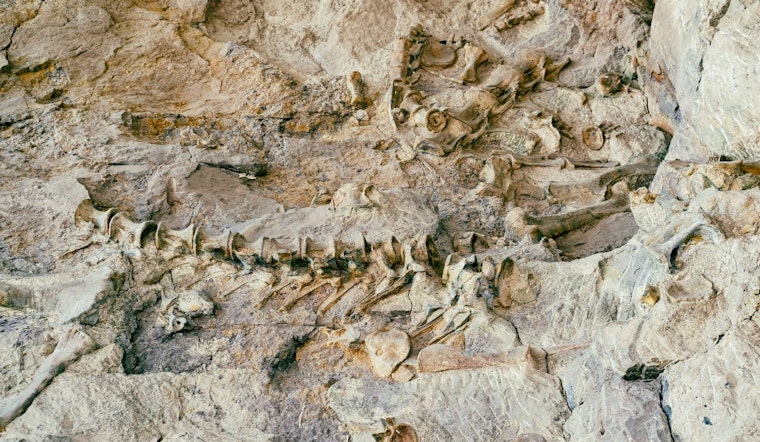
More than 500 Ice Age fossils came out of the ground beneath Wilshire Boulevard during construction of Metro's D Line extension, including the bones of ancient bison, giant ground sloths, and a juvenile mammoth nicknamed Hayden. Now that the subway's first section has opened, those specimens are scattered across two Los Angeles institutions, with most headed to drawers and archives rather than display cases anytime soon.
The Los Angeles County Metropolitan Transportation Authority recently offered a fresh look at the discoveries and where they ended up, according to KTLA. Metro shared a video highlighting finds from the D Line extension dig, documenting more than 500 fossils recovered during construction. Per the outlet, a paleontologist featured in that video described the specimens as spectacular and beautifully preserved, adding that some might eventually go on display.
The D Line extension opened its first section on May 8, with new underground stations at Wilshire/La Brea, Wilshire/Fairfax and Wilshire/La Cienega, KTLA reports. That project extended subway service west, and construction continues through Beverly Hills and Century City toward Westwood. The Wilshire corridor sits atop one of the densest concentrations of Ice Age fossils on the planet — the nearby La Brea Tar Pits alone hold more than 3.5 million to 4 million cataloged specimens representing over 600 species, per the La Brea Tar Pits/ResearchGate data.
Fossils Split Between Two Museums by Chemistry, Not Chance
The D Line extension contract designated asphalt-soaked fossils for the La Brea Tar Pits and Museum. In contrast, non-asphaltic sediment fossils were routed to the Natural History Museum of Los Angeles County, the station notes. That division exists because tar-encased bones require specialized chemical processing that dry sediment fossils don't need, according to Metro. In practice, though, the split turned out lopsided: construction crews found only a handful of bones actually preserved in asphalt, and most fossils are headed instead to the Natural History Museum.
That outcome caught scientists somewhat off guard. Researchers had expected to find large numbers of fossils preserved in asphalt near the tar pits, but the article notes that crews digging near La Brea recovered relatively few asphaltic specimens. A related twist reported separately by LA Metro's The Source found that Wilshire/Fairfax, despite sitting closest to the tar pits, yielded fewer fossils than the Wilshire/La Cienega station, which produced the highest number of fossil discoveries along the entire Section 1 alignment.
A Baby Mammoth and a Backyard Full of Ancient Bones
Among the unearthed fossils were the remains of ancient bison and giant ground sloths that inhabited the Los Angeles basin thousands of years ago, per the same account. The most memorable find was Hayden, a juvenile mammoth discovered during construction and named after actress Hayden Panettiere. Hayden was found outside the asphalt deposits, in dry sediment rather than dark tar. The Wilshire/La Cienega dig site also turned up giant ground sloth limb bones alongside its many other specimens.
The paleontologist featured in Metro's video pointed out that one animal recovered at Wilshire and La Cienega once lived in what is now someone's backyard in that neighborhood — a reminder that the Ice Age megafauna beneath the boulevard weren't confined to the tar pits themselves. Metro had begun documenting Ice Age specimens from the project as early as 2020, well before the line opened to riders.
Where the Fossils Are Headed Next
Some fossils recovered from Metro construction are now on exhibit at the Natural History Museum of Los Angeles County, including material tied to the museum's L.A. Underwater: The Prehistoric Sea Beneath Us exhibition, which explores a time when much of modern-day Los Angeles sat below the ocean. Most of the D Line's recovered specimens, however, will remain in scientific curation and analysis for years rather than going straight to public display.
The timing adds a logistical wrinkle. The La Brea Tar Pits and Page Museum closed to the public in July for roughly two years to begin a $240 million modernization project ahead of the 2028 Summer Olympic Games, according to the Beverly Press. That overhaul, the institution's first major renovation in nearly 50 years, has required staff to pack and relocate all 3.5 million to 4 million cataloged fossils in its collection to off-site storage — meaning even the asphaltic D Line specimens bound for La Brea are, for now, headed into boxes rather than onto shelves.
Decades of Digging Up Deep History
The D Line discoveries build on a long history of subterranean paleontology in Los Angeles. During construction of Metro's Red Line subway in the 1990s, monitoring teams recovered more than 2,000 fossils beneath the city, including 64 extinct species of marine fish — 39 of them previously unknown to science — along with mastodon tusks and ancient longhorn bison remains, according to a summary cited on Wikipedia. That earlier haul was significant enough that a 28-scientist team authored a 300-page report on the finds.
Throughout D Line tunneling between 2015 and 2026, paleontologists from Cogstone Resource Management monitored construction continuously, allowing crews to temporarily divert heavy equipment roughly 50 feet from active fossil finds so specimens could be extracted in plaster jackets without stopping the broader subway project, as reported by the Associated Press. That kind of monitoring exists because California law requires it: under Public Resources Code Section 5097.5, knowingly excavating or destroying vertebrate paleontological resources on public land without agency approval is a misdemeanor punishable by fines up to $10,000 and up to a year in prison.
Individual finds along the way underscored just how much prehistoric life once roamed beneath the boulevard. In April 2017, excavation at Wilshire and La Brea Avenue turned up a 20-inch forearm bone from an extinct Ice Age camel, along with an ancient sea otter humerus — the first carnivore fossil found during the entire extension project, according to Mass Transit. At Wilshire/La Cienega, crews also recovered the elbow bone of a duck-sized bird tens of thousands of years old that still showed quill knobs where feathers once attached — a level of preservation detail rarely seen outside a laboratory.
Section 1 of the D Line extension runs 3.92 miles along Wilshire Boulevard and was built under a $1.636 billion design-build contract awarded in 2014 to the joint venture Skanska-Traylor-Shea, according to Tunnel Business Magazine. Tunneling through that stretch required managing both underground methane gas and tar-soaked soils — the same asphaltic ground that trapped Ice Age megafauna over roughly 50,000 years and made the corridor a paleontological hotspot in the first place.





