

























































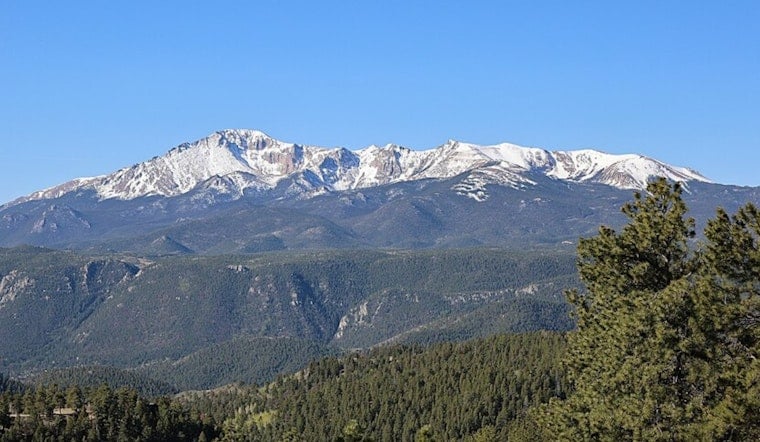
A 674-acre property just outside Woodland Park is set to become the largest public outdoor recreation destination in the area, after Palmer Land Conservancy announced its acquisition of Pinestone Ranch. The parcel is more than five times the size of Woodland Park's Avenger Open Space, and advocates say it could finally help fill in one of the most stubborn gaps in the decades-old Ring the Peak trail vision.
Palmer Land Conservancy described the purchase as its first project of this scale dedicated to future public access, according to Denver Gazette reporter Seth Boster. Throughout its nearly 50-year history, the land trust has focused almost exclusively on holding conservation easements on private land, making Pinestone Ranch's fee-simple purchase an unusual move for the organization. The price paid for the ranch has not been disclosed.
Rebecca Jewett, president and CEO of Palmer Land Conservancy, said trail access near Woodland Park is limited and often requires long drives for residents seeking to get outdoors. She said opportunities to create public open space at this scale along the Front Range are increasingly rare, and that decisions about Pinestone Ranch's future ownership will be worked out through conversations about broader regional goals.
Filling a Gap in the Ring the Peak Vision
The Ring the Peak Trail is a decades-old vision for a continuous loop circumnavigating Pikes Peak, first formally documented in a 1999 multi-use plan. The route currently covers roughly 50 completed miles, about 70 percent of its planned 63-to-67-mile loop, but major gaps remain unfinished on the southwestern flank near Cripple Creek and the northeastern flank near Ute Pass, according to the same Palmer Land Conservancy history of the project.
Chris Gonzales, founder of the nonprofit Teller Trail Team, said Pinestone Ranch could help fulfill the original Ring the Peak plan by serving as one of several city portals into the trail system. He acknowledged, however, that the ranch's long-term ownership remains uncertain, and his organization has said it seeks more local control over how trails in the region get developed.
Jerry Smith, a local outdoor advocate, envisions the property one day offering an extensive network of trails alongside wildlife habitat and scenic views. Jeff Webb, chair of the Woodland Park parks board, said the property has enormous potential; the Denver Gazette's headline on the acquisition attributed similar sentiment directly to sources close to the deal.
Who Pays, and Who Ends Up Owning It
Great Outdoors Colorado was essential to the acquisition, pledging major lottery-fund support toward the purchase, per the Gazette's reporting. Palmer Land Conservancy said it is now working with partners to determine the ranch's long-term ownership and stewardship, and in the meantime plans to hold the property and keep it closed to the public until that structure is settled.
That uncertainty echoes a pattern already visible in Woodland Park. The city acquired its first major open space parcel, the 120-acre Avenger Open Space bordering Pike National Forest, in April 2024 using a $500,000 Great Outdoors Colorado grant before placing a permanent conservation easement on the land held by Palmer Land Conservancy, according to the City of Woodland Park. Residents had pushed for that protection after discovering private property postings on trails they had used for years.
In October 2025, the Woodland Park City Council unanimously authorized an $11.89 million acquisition of the 360-acre Shining Mountain Golf Course, which includes 355 acres of course, event center, and undeveloped land, paying $3.18 million in municipal cash while receiving $8.69 million as a charitable land donation from the seller, as reported by Citizen Portal. That purchase secured open space and local water rights for the city.
A City Without a Dedicated Open-Space Fund
Advocates have doubted that Woodland Park or Teller County could acquire a property the size of Pinestone Ranch on their own, since neither government has a dedicated open-space sales-tax fund. That gap was made sharper in March 2025 when the Woodland Park City Council repealed a 1.09 percent local sales tax, removing an estimated $3.2 million in annual municipal revenue, as previously reported by Hoodline. Without that mechanism, regional open-space projects lean heavily on land trusts, Great Outdoors Colorado grants, and state-level backing rather than city budgets.
A municipal parks department survey found that 83 percent of participating Woodland Park residents identified acquiring more open space and developing trails as their top recreation priority, according to the Denver Gazette. That finding helped spur the formation of the Teller Trail Team, the nonprofit Gonzales now leads.
State Money Flows Toward a Regional Recreation Area
Governor Jared Polis has touted the Pikes Peak Recreation Area initiative, a state effort that Colorado Parks and Wildlife is working toward establishing across the mountain. In January, the governor announced a $2.5 million state grant funded by Colorado Parks and Wildlife and Great Outdoors Colorado, seed money intended to leverage up to $75 million in long-term state funding for regional outdoor infrastructure and land management, per SoCo Digest.
Colorado Parks and Wildlife is also considering increasing its presence across the Pikes Peak region more broadly. In May, the agency announced plans to assign dedicated wildlife officers, construct new campgrounds, and increase recreational management near sites like Rosemont Reservoir by late summer 2026, according to KRDO. The Pikes Peak Outdoor Recreation Alliance, the state-recognized Regional Partner for El Paso, Fremont, and Teller counties, coordinates the multi-agency trail, conservation, and recreation master plans that tie these local, county, and state efforts together under its Outdoor Pikes Peak Initiative.
For now, Pinestone Ranch sits at the center of that larger push, fitting into regional plans to elevate the Pikes Peak region as a natural, world-class recreation destination even as the exact path to public access remains unresolved. Whether Colorado Parks and Wildlife, Teller County, or another regional entity ultimately takes over management of the property will shape how quickly trail portals there can open to the public.





