

























































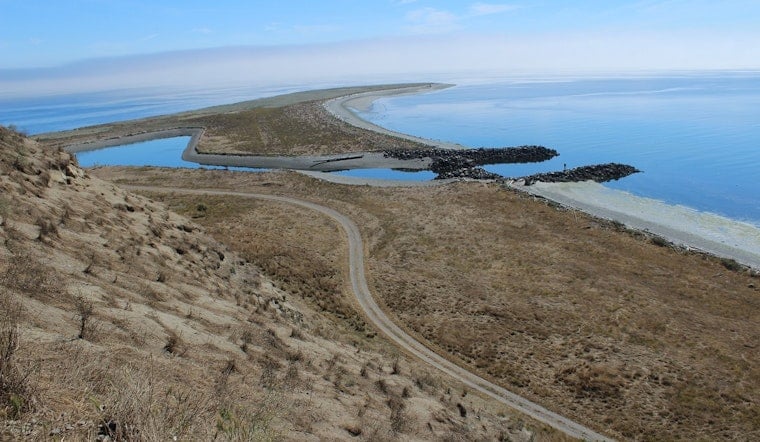
Marty Bluewater is 78 years old and the only human being who lives on Protection Island, a 379-acre national wildlife refuge tucked into the Strait of Juan de Fuca north of Discovery Bay. He has decided to weigh in on one of the Olympic Peninsula's most contentious land debates in years: he supports a plan to transfer the island, along with the nearby Dungeness National Wildlife Refuge, from the U.S. Fish and Wildlife Service into trust for the Jamestown S'Klallam Tribe.
Bluewater's stance, first reported by The Seattle Times, puts him at odds with other Olympic Peninsula residents who oppose the proposed transfers, even as the Sequim City Council has endorsed them. Bluewater paid $7,000 for his Protection Island property back in 1971, according to the Times, and later agreed to retain it only for the rest of his life — after he dies, it will belong to the refuge. The tribe wants Congress to hand over both refuges, which would continue to be preserved and managed as wildlife habitat, with the Bureau of Indian Affairs holding the land in trust for the tribe rather than the federal government.
The Jamestown S'Klallam Tribe already co-manages both refuges with federal wildlife officials under a 2024 agreement, which assigns habitat restoration and public education duties to the tribe. Tribal chairman Ron Allen, who has led the tribe since 1977 when it had no revenue and no reservation, has said the proposal reflects the tribe's traditional homelands, according to the Times. The tribe resecured federal recognition in 1981 and today runs an annual budget exceeding $100 million, and it now owns or controls about 2,000 acres across the region.
A Draft Bill Takes Shape in Congress
Draft federal legislation, titled the Jamestown S'Klallam Tribe Land Transfer Act of 2026, has been prepared with backing from U.S. Representative Emily Randall and Senator Maria Cantwell, according to Peninsula Daily News. That marks a shift from earlier reporting: the Seattle Times noted that Randall's office had said no transfer legislation had been drafted, while Randall herself said tribal leaders should be heard when the federal administration cannot be trusted, per the Times. Spokespeople for Cantwell and Senator Patty Murray have said both lawmakers are closely following the local discussion, though Murray has not commented directly on the proposed transfers.
The financial mechanics of the deal have already shifted once. To address a local revenue objection, the Jamestown S'Klallam Tribe agreed in May 2026 to pay Jefferson County roughly $26,000 annually to replace federal Payments in Lieu of Taxes that the county would otherwise lose if Protection Island leaves federal ownership, the Peninsula Daily News reported. Under the current proposal, both the federal government and the tribe would contribute funding for ongoing refuge management.
County Commissions Pump the Brakes
Despite that concession, local government support has wavered. In August, the Jefferson County Board of Commissioners formally retreated from issuing a letter of support for the transfer following intense community opposition, while Clallam County Commissioners requested a 30-day extension from the Bureau of Indian Affairs, according to the Port Townsend & Jefferson County Leader. The Seattle Times reported that both the Jefferson and Clallam county commissions have delayed action on the proposed transfers, and that petitions for and against the plan have collected more than 3,000 signatures combined.
Much of the community friction traces back to earlier disputes over tribal shellfish operations near Dungeness Bay. The tribe obtained permits from federal, state and county agencies to resume commercial oyster cultivation next to the Dungeness refuge after an earlier oyster farm had to shut down in 2005 because of upland pollution into Dungeness Bay, per the Times. Protect the Peninsula's Future and two other nonprofits sued Fish and Wildlife in 2023 over a related oyster farm dispute, and the tribe has since shifted from plastic bags to loose traditional seeding methods for its oyster cultivation. Community meetings have specifically addressed concerns about commercial shellfish harvesting expanding if the refuges change hands.
Why Protection Island Matters So Much to Birds
The ecological stakes explain the intensity of the debate. Protection Island hosts 72% of all nesting seabirds in Puget Sound and the Strait of Juan de Fuca, including an estimated 36,000 breeding pairs of rhinoceros auklets, one of North America's largest colonies for the species, according to the Encyclopedia of Puget Sound. The island supports tens of thousands of birds overall and contains some of the Salish Sea's last undeveloped habitat for burrow-nesting seabirds, the Times reported. Boats must stay 200 yards from the island's shores, which remain closed to the public under federal rules, and the transfer proposal would maintain that closure — unlike the neighboring Dungeness Spit, where the proposal would maintain existing public access.
Protection Island's protected status traces back to a nine-year grassroots campaign led by Audubon activists Zella Schultz and Eleanor Stopps, which persuaded Congress to allocate $4 million to acquire the land, according to The Jefferson County Beacon. Congress bought the island in 1982 and made it a national wildlife refuge that same year. Before that, in the late 1960s, Seattle real estate developers had subdivided the island into roughly 800 residential lots with plans for roads, a marina and an airstrip, a project that collapsed for lack of fresh water. Lorna Smith, who supported the island's preservation decades ago as a volunteer with the Seattle Audubon Society, is among those who have followed the site's history closely, per the Times.
A Century of Federal Protection at Dungeness
The Dungeness refuge carries its own long federal history. President Woodrow Wilson created the Dungeness National Wildlife Refuge by executive order in 1915 to serve as a protected preserve and breeding ground for native migratory birds, according to the U.S. Fish and Wildlife Service. Dungeness Spit, which stretches 5.5 miles into the Strait of Juan de Fuca, is recognized as the longest natural sand spit in the United States and draws roughly 80,000 visitors annually, per the Sequim Gazette. The Dungeness refuge itself covers 773 acres, far smaller in visitor traffic terms than Protection Island, which remains off-limits entirely.
Under the existing 2024 co-management agreement, the tribe requested $8 million from the federal 2027 budget to fund habitat restoration, invasive species management and camera surveillance across both refuges, according to Northwest Treaty Tribes. Tribal leaders argue that full trust status would let them invest sovereign resources beyond what federal budgets allow, and supporters point to the refuge transfer as a way to give the tribe more direct control over long-term preservation. Backers of the plan also cite a 2020 law that restored the 18,000-acre National Bison Range to the Confederated Salish and Kootenai Tribes, who took back full control of that land in 2022, as a precedent for returning federally held land to tribal management.
For now, the fate of the Jamestown S'Klallam Tribe Land Transfer Act of 2026 remains tied up in the same local political uncertainty that has stalled county endorsements. Bluewater's public support, as the refuge's sole human inhabitant, adds a distinctive voice to a debate that has otherwise split neighbors, conservationists and county officials across the Olympic Peninsula.





