

























































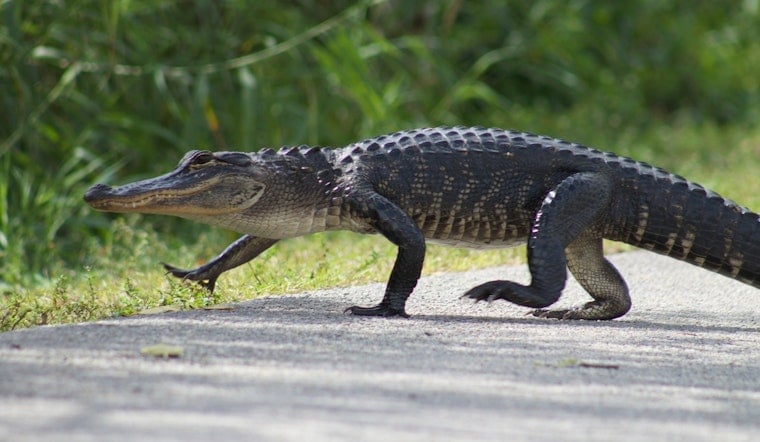
A Tampa hospital's emergency room got an unexpected visitor this week: an 8-foot alligator that had made its way onto the property before a Tampa Police officer and a licensed nuisance alligator trapper stepped in to escort it away. The Tampa Police Department shared the encounter on social media, quipping that the reptile was hardly a typical patient.
“This certainly wasn't your average ER patient!” the department said, according to WFLA. A Tampa police officer helped escort the alligator off the hospital's property, and a nuisance alligator trapper handled the actual removal of the animal from the grounds, per the same report.
The department used the moment to remind Floridians not to approach, feed, or tease alligators, and urged residents to give the animals space whenever they turn up somewhere they shouldn't be. Anyone who spots an alligator longer than four feet that appears to pose a threat is asked to call the Florida Fish and Wildlife Conservation Commission's nuisance alligator hotline at 866-392-4286, the outlet reported.
Why Hospitals and Highways Aren't Off-Limits to Gators
The hospital visit fits a pattern state wildlife officials have documented for years. The Florida Fish and Wildlife Conservation Commission defines a nuisance alligator as any animal at least four feet long that is believed to pose a threat to people, pets, or property — the same threshold cited in the hospital case. Once a trapper is dispatched under the agency's Statewide Nuisance Alligator Program, the outcome is rarely a trip back to the wild.
That's because relocated alligators frequently try to return to the spot where they were captured, creating hazards along the way, according to FWC. The agency has also noted that Florida's alligator population remains stable, so removing nuisance animals doesn't harm the species overall. Contracted trappers aren't salaried state employees — they earn their living primarily by processing and selling the hides and meat of the alligators they harvest, receiving only a nominal expense reimbursement from FWC per capture.
A Summer Full of Uninvited Reptile Guests
Tampa's medical center is only the latest unlikely address to host a wandering alligator this year. In March, Tampa Police and a contracted trapper responded to a 3:30 a.m. call after a homeowner heard splashing in a backyard pool and initially thought a burglar had broken in, only to find an alligator swimming laps, as reported by FOX 13. In April, Hillsborough County sheriff's deputies and an FWC trapper pulled a seven-foot alligator off North Dale Mabry Highway, a story Hoodline covered in its Dale Mabry gator standoff report.
FWC data shows why these calls keep coming. Florida is home to an estimated 1.3 million alligators spread across all 67 counties, and rapid population growth near lakes, rivers, and wetlands has only increased the odds that people and gators cross paths. Late summer adds another wrinkle: alligator eggs take roughly 60 to 68 days to incubate, with hatching typically running from mid-August into early September, following courtship in April and nesting in June and July — a seasonal rhythm that tends to stir up more movement and more sightings just as this Tampa case unfolded.
State Rules Aim to Keep Gators Wary of People
Florida law also plays a role in shaping these encounters. Under Florida Statute § 379.412, intentionally feeding or enticing a wild alligator is illegal, carrying a $100 civil fine for a first offense and the possibility of misdemeanor criminal penalties for repeat violations. The rule exists because feeding causes alligators to associate humans with food, raising the risk of dangerous run-ins later.
To reinforce that message, FWC launched its “GatorWise” public awareness campaign in June 2025 in partnership with 11 other southeastern state wildlife agencies. The initiative encourages residents to assume alligators could be present in any Florida body of water, a mindset that applies just as well to a hospital courtyard as it does to a backyard pool or a busy highway median.





