

























































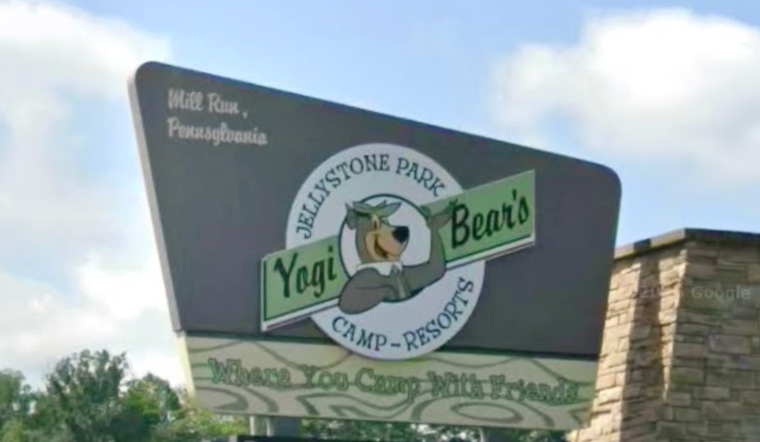
An 8-year-old boy was flown to a hospital Saturday after nearly drowning in the main pool at a campground in Fayette County, Pennsylvania. The incident was reported around 1:30 p.m. at Yogi Bear's Jellystone Park Camp and Resort in Mill Run, according to dispatchers.
The child was flown from the resort on Mill Run Road, according to WTAE, which first reported the dispatch call. As of the station's report, the extent of the boy's injuries had not been made public.
The near-drowning happened in the resort's main pool, one of two heated outdoor pools on the property. The Mill Run campground, about an hour south of Pittsburgh, spans 63 acres in the Laurel Highlands and includes an Upper Pool and Lower Pool along with water slides and the Yogi Bear's Wetlands water attraction, according to Jellystone Park Mill Run.
Rural Location Means Reliance on Air Transport
Fayette County's rural geography often forces emergency responders to fly critically injured patients rather than drive them to specialized care. The Laurel Highlands region regularly relies on air ambulances like STAT MedEvac to reach tertiary pediatric trauma centers in Pittsburgh, as Hoodline has reported in coverage of another Fayette County emergency.
This is not the first time a child has needed emergency air transport from a pool incident at this same resort. In July 2015, a young boy was airlifted to a Pittsburgh hospital after a swimming pool accident at the Mill Run campground, and he returned to camp the following day after staff carried out emergency protocols, according to WPXI. Resort management at the time cited privacy policies regarding the child's exact age while confirming that emergency procedures had been followed.
State Rules Govern Pool Safety and Staffing
Pennsylvania campground pools like the ones at Jellystone Park Mill Run fall under state health oversight. Public aquatic facilities in the state are regulated by the Pennsylvania Department of Health under 28 Pa. Code Chapter 18 and the Public Bathing Law, which require active health permits and strict water clarity standards, including the ability to see a 6-inch disc at a pool's deepest point.
Under 28 Pa. Code § 18.42, facilities that provide lifeguards must station at least one certified lifeguard for every 4,000 square feet of pool surface area, according to Cornell Law School. Certified lifeguards in Pennsylvania are required to hold valid credentials in lifeguarding, CPR, and first aid. It remains unresolved whether lifeguards were on duty at the main pool at the time of Saturday's incident.
A Pattern Seen at Other Jellystone Locations
Near-drownings at Jellystone Park franchises are not confined to Pennsylvania. In June, a 4-year-old boy was rescued from a near-drowning in a pool at a Yogi Bear's Jellystone Park in Larkspur, Colorado, after a teenage visitor alerted lifeguards and visiting medical doctors performed CPR, as Hoodline reported at the time. That Colorado case similarly involved immediate bystander notification followed by a hospital evaluation.
The Mill Run property has also seen other emergency responses in recent years. In August 2023, an EF-2 tornado with winds over 110 mph struck the campground, causing severe structural damage and injuring at least five campers, according to AP News. More recently, in June, emergency crews and Pennsylvania State Police deployed ground teams and drones at the resort to locate a missing 43-year-old employee whose maintenance cart had been found unattended; local volunteer fire departments and state police located the employee safe.
Drowning Risk Remains High for Young Children
Saturday's incident underscores a risk that public health data show is especially acute for young children. Drowning is the leading cause of unintentional injury death among U.S. children ages 1 to 4 and the second leading cause for children ages 5 to 14, with U.S. emergency departments treating an average of 8,111 nonfatal drownings annually, according to the Centers for Disease Control and Prevention.
For every child who dies from drowning in the U.S., seven to eight children require emergency department care for nonfatal drowning, and nearly 40% of those visits require hospitalization or transfer to specialized care, according to the National Drowning Prevention Alliance. Nonfatal drownings frequently result in severe brain injuries and other long-term health complications, and patients are often transferred to specialized pediatric centers to evaluate for secondary respiratory or neurological complications. Whether the 8-year-old's condition has since been updated, and whether state health authorities will launch a routine inspection of the resort following Saturday's incident, remain open questions.



