

























































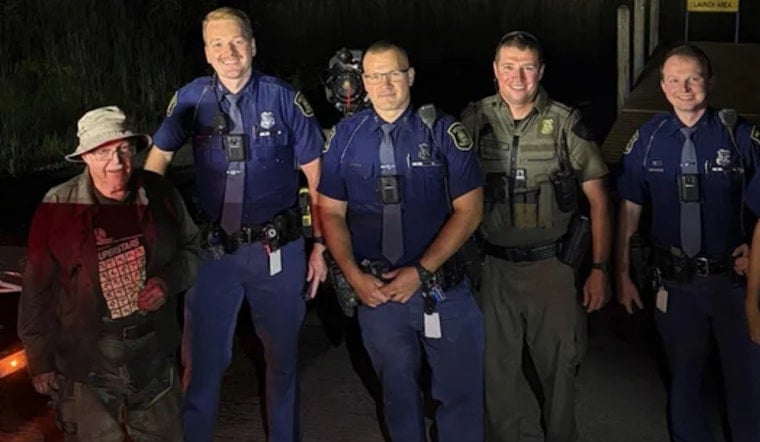
An 83-year-old fisherman went missing on Tawas Lake for nearly six hours last Thursday night, stranded without lights, a phone, or even his hearing aids until searchers finally spotted the flame of his lighter flickering in the darkness. He had set out around 6 p.m. in an aluminum boat loaded with fishing nets, and when he never came home, his wife raised the alarm that would trigger a multi-agency search across one of Iosco County's largest and most treacherous inland lakes.
The man had gone fishing at about 6 p.m., according to his wife, and when he failed to return, she reported him missing, as reported by CBS Detroit. The search began around 9:45 p.m., with the Michigan Department of Natural Resources dispatching a conservation officer and Michigan State Police placing an aviation crew on alert while also sending troopers from its West Branch post. His boat had no lights at all, and he had left home without a cell phone, a flashlight, or any other emergency equipment.
Voice And Lighter Flame Break Through The Dark
Michigan State Police say the search team combed Tawas Lake in complete darkness before finally making contact. Around 11:40 p.m., searchers heard the man's voice and then saw the flame from his lighter, according to the same account, pinpointing his location on the lake's north side nearly six hours after he had last been seen. His missing hearing aids had made it harder for him to hear rescuers calling out until they closed the distance, and the darkness meant sight was nearly as limited as sound.
When crews reached him, they found his boat stuck fast in tall, dense wild rice, and he was sitting inside it, uninjured but stranded. One rescue team member could not hide their surprise, asking him how he had managed to get all the way into the thick vegetation with his motor. His response was blunt: “Bad idea.”
A Borrowed Mud Boat Made The Difference
Standard patrol boats could not push through the shallow, weed-choked water where the man was trapped, so the DNR conservation officer turned to a shallow-water mud boat personally owned by an off-duty Oscoda Township police officer who was not even at the scene. That borrowed vessel let officers and troopers navigate the thick wild rice bed and reach the man where conventional craft would have run aground. He was brought back safely to shore once crews maneuvered him free.
Tawas Lake covers roughly 1,600 acres but reaches a maximum depth of only five feet, with water levels shifting alongside Lake Huron's long-term hydrological cycles, according to Huron Pines. That shallow basin also hosts Michigan's largest native bed of wild rice, or manoomin, which the Michigan Water Stewardship Program notes forms thick, tall vegetative stands across large stretches of the lake by late summer. Ecological groups and local tribes actively manage those wild rice beds, but the same dense late-summer growth that makes the habitat valuable also creates a serious hazard for motorized boats after dark.
Nighttime Boating Rules He Didn't Follow
Michigan law requires motorized vessels operating between sunset and sunrise to display red and green sidelights along with an all-around white light or stern light visible from up to two miles away, per ClickOnDetroit. The man's boat had none of that equipment. Michigan also requires anyone born after June 30, 1996, to complete an approved boater safety course and carry a certificate, though the same outlet notes older operators like the 83-year-old are exempt from that mandate.
The stakes of heading onto open water unequipped and unlit are not abstract. Michigan ranked as the seventh most dangerous state in the country for recreational boating in 2024, logging 82 accidents and 20 fatalities for a 24% fatality rate, ClickOnDetroit reported separately. Nationally, U.S. Coast Guard statistics compiled by the National Safe Boating Council show drowning accounted for 76% of recreational boating deaths in 2024, with 87% of drowning victims not wearing a life jacket.
In this case, the outcome was different. The man was found uninjured, and coordination between the DNR, Michigan State Police, and a private boat owner willing to lend his equipment in the middle of the night turned a search that stretched nearly six hours into a rescue rather than a tragedy.





