

























































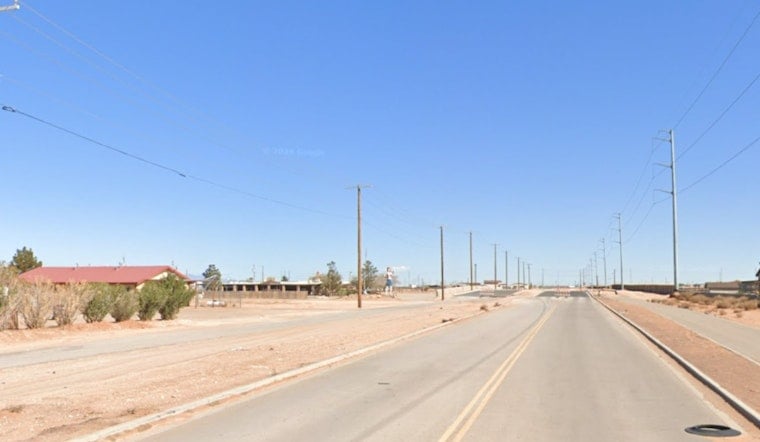
Along Mager Drive in East El Paso, between Bernard Lane and La Von Avenue, a 17-foot-6-inch fiberglass woman has been standing outside a hacienda-style property for years, largely unnoticed by the thousands of drivers who pass her every week. She weighs roughly 450 pounds, wears a custom-painted red vest, and sports repainted nails and shoes, along with a small mole on her right cheek. She is, by most measures, one of the rarest surviving pieces of American roadside advertising still standing.
The statue is known as a Uniroyal Gal, the female counterpart to the more widely recognized Muffler Man figures that once dotted highways nationwide, according to KLAQ. The El Paso figure recently drew fresh attention after a Reddit user, u/mentalbus8860, posted a photo of her to the r/elpaso subreddit, prompting a wave of comments from locals who either had no idea she existed or had long wondered about her origins, per the same report. One commenter reportedly described her as “nightmare fuel,” while others simply seemed startled that a nearly two-story-tall fiberglass woman had been hiding in plain sight along their commute.
A Rare Survivor From the Golden Age of Roadside Advertising
Uniroyal Gals are strikingly rare. Only about 10 to 12 of the original statues are believed to remain across the United States out of dozens manufactured in the 1960s, according to a report from American Giants. That makes them far scarcer than their male counterparts — the article notes that roughly 200 Muffler Men statues have survived nationwide, a testament to how much rarer the female figures have become over the decades.
The statues trace back to International Fiberglass, a Venice, California company formed in 1963 after boatbuilder Steve Dashew acquired Prewitt Fiberglass Animals and its molds, according to Wikipedia. The underlying giant-human mold itself dates back even further, to 1962, when sculptor Bob Prewitt created a towering Paul Bunyan figure for a cafe on Route 66 in Flagstaff, Arizona, per the same source. International Fiberglass produced the giant female figures in the mid-1960s specifically for the Uniroyal Tire & Rubber Company, which used them as promotional marketing figures hauled to local tire dealerships on mobile trailers, per American Giants.
From Tire Ads to a Bikini Statue Named Miss America
Uniroyal's promotional campaign wound down around 1970, and International Fiberglass responded by repackaging the mold for a new market. The company listed the statue in its catalog as “Miss America” for $3,150, offering a base bikini model with optional snap-on skirts and blouses that business owners could swap depending on how they wanted to use the figure, American Giants reports. That modularity is part of what gave Uniroyal Gals their staying power in local commerce long after the original tire promotion ended, and per KLAQ, the outfits businesses chose could vary depending on how each statue was being used.
The pop-culture terminology now used to describe these figures didn't emerge until years later. The term Muffler Men was coined in the 1980s and 1990s by the founders of RoadsideAmerica.com, who later popularized the label Uniroyal Gals in the late 1990s as roadside enthusiasts began documenting the surviving statues, according to The Philadelphia Inquirer. Roadside America has documented visits to El Paso's own statue since at least 2010 and lists her as worth a detour for travelers passing through, according to KLAQ.
El Paso's Statue Holds Up, Even as the Site Around Her Sits Quiet
El Paso's Uniroyal Gal has held up notably well over the years. She has remained in surprisingly good condition, per KLAQ, and a visitor report from 2020 also noted a painted Apple Watch on her wrist, one of several custom cosmetic touches unique to this particular figure. Her design was reportedly inspired by Jacqueline Kennedy, though that detail comes with the same degree of uncertainty attached to much of her local lore.
Field reports from visitors this month confirm she remains intact outside Adobe Hacienda Hall on Mager Drive, but the surrounding lot and the adjacent building show no signs of commercial activity, according to posts shared on Facebook. That leaves an open question about who currently owns or maintains the statue, since the venue she stands beside no longer appears to be operating. The property sits about a 30-minute drive from Downtown El Paso, tucked into a stretch of East El Paso that most residents wouldn't think to associate with a piece of national pop-culture history.
She's not the only Uniroyal Gal enthusiasts still track down. In Peoria, Illinois, a sister statue nicknamed Vanna Whitewall is famous in roadside-attraction circles for getting seasonal outfit changes, including being stripped back down to her original molded bikini each summer, according to Atlas Obscura. El Paso's statue doesn't get that kind of costume rotation, but her survival alone puts her in rare company. With only about a dozen of these figures left standing nationwide, the quiet lot on Mager Drive holds a piece of American advertising history that most people driving past have never noticed.



