

























































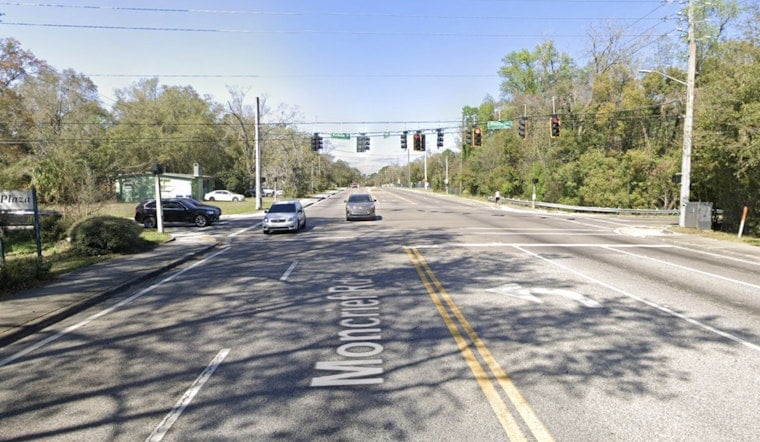
A Jacksonville woman in her mid-30s was killed Thursday morning when a southbound Amtrak train traveling 79 mph slammed into her eastbound Jeep SUV at the 6100 block of Moncrief Road near Restlawn Drive, just after 6:30 a.m. None of the 150 passengers and crew aboard the train, which was traveling from Chicago to Tampa, were hurt.
Jacksonville Sheriff's Office Sgt. Robert Hungerford said initial investigation shows the driver likely drove around lowered crossing arms before the train hit her vehicle, according to News4JAX. The crash marks Duval County's 118th traffic fatality of 2026, coming just hours after JSO reported the county's 117th traffic death, involving an elderly bicyclist struck on McCormick Road. The Florida Times-Union also reported on the crash Thursday morning, noting that JSO confirmed the crash and fatality and that additional details were expected following a forthcoming news briefing.
A Familiar and Deadly Pattern on Jacksonville Rails
This is not an isolated case. Five weeks earlier, on July 22, a 42-year-old Jacksonville woman died on the city's Westside at Roosevelt Boulevard and Timuquana Road after driving around lowered railroad crossing arms into the path of an oncoming Amtrak train, per the same station's report. Two fatal collisions with nearly identical circumstances — a driver bypassing active gates before being struck by an Amtrak train — have now happened in Jacksonville within the same summer.
The Moncrief Road crossing sits along CSX Transportation's Jacksonville Terminal Subdivision A Line, a corridor that handles roughly 18 daily trains and connects CSX's Moncrief Yard to regional freight and passenger networks, according to Federal Railroad Administration data. The crossing, designated DOT crossing #620753S, serves as a main trunk line in Northwest Jacksonville, an area already under scrutiny for other recent public-safety incidents along the same corridor.
Florida's Rail Danger Ranks Among the Nation's Worst
Florida ranked third nationally for rail trespassing casualties in preliminary 2025 data compiled by Operation Lifesaver, with 65 deaths and 86 total casualties, along with 120 highway-rail grade crossing collisions recorded statewide. A February 2026 Florida Senate Committee on Transportation analysis found that 88 percent of highway-rail grade crossing accidents in Florida between 2013 and 2022 involved drivers or pedestrians stopping on crossings, driving or walking around gates, or failing to stop.
Under Florida Statute § 316.1575, drivers approaching a railroad crossing must stop between 15 and 50 feet from the nearest rail when signals or lowered gates indicate an approaching train, and driving through, around, or under any closed or moving gate is explicitly illegal. The high rate of human-factor collisions has pushed state lawmakers to evaluate automated crossing detection technologies under proposed legislation such as SB 1310.
Fewer Crashes, More Deaths on Duval Roads
Duval County recorded 108 traffic fatalities through late July 2026, a higher death toll than the same point in 2025 even though overall crash volume fell by roughly 1,000 incidents. JSO officials attributed the trend to higher speeds on open roadway stretches, noting that traffic homicides occur more frequently on longer, higher-speed corridors rather than congested commuter intersections.
The city adopted its Vision Zero Action Plan in July 2025, setting a municipal goal to eliminate all traffic fatalities and cut serious roadway injuries in half by 2035. Thursday's crash, and the one on Roosevelt Boulevard five weeks earlier, underscore the challenge facing that goal along Jacksonville's active rail corridors, where a recent train strike in San Marco also left a person critically injured.





