

























































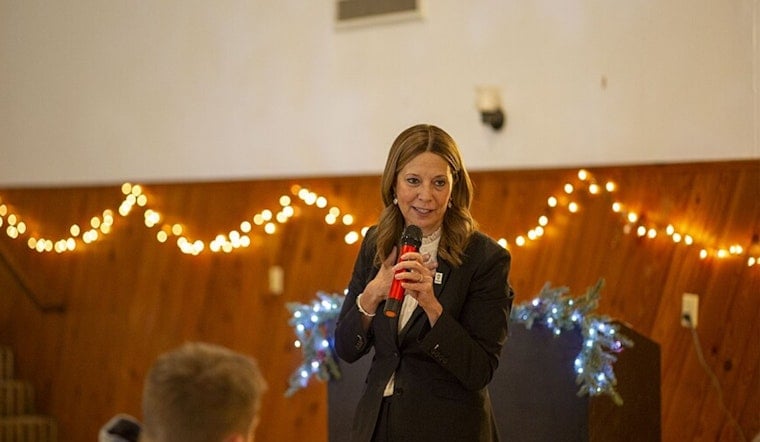
Ohio's Democratic nominee for governor, Dr. Amy Acton, says she supports keeping qualified immunity for police officers and would not stand in the way of local law enforcement working with federal immigration agents if she is elected in November. The comments, made during an appearance in Bexley, Ohio, put Acton at odds with civil-liberties advocates and put her in step with a stance long associated with law-and-order Republicans.
A Democrat Staking Out Police-Friendly Ground
Acton told reporters that Ohio officials will work with federal law enforcement to keep Ohioans safe, and that she would not block cooperation between Ohio police and federal authorities if she wins the governor's race, according to Cleveland.com. She also said people coming to Ohio should meet the same professionalism standards expected of public safety officers. The remarks come as U.S. Immigration and Customs Enforcement and other federal agencies have ramped up enforcement efforts in Ohio and nationwide since President Donald Trump returned to office in 2025.
Her position runs counter to policies in Cleveland, Columbus, and Cincinnati, where police have said they will not help federal officials enforce immigration laws, per the same Cleveland.com report. Acton also said she supports keeping qualified immunity — the legal doctrine that generally shields police officers and other government officials from civil lawsuits unless they violated a clearly established constitutional right — a position that puts her at odds with a grassroots push to eliminate it statewide.
Police Unions Split Their Endorsements
The stance appears calculated to shore up law enforcement support in a state where Democrats have not won the governor's mansion since Ted Strickland in 2006, according to MultiState. The Ohio Patrolmen's Benevolent Association endorsed Acton, while the Fraternal Order of Police of Ohio backed Republican nominee Vivek Ramaswamy in July, a split detailed by the Toledo Blade.
FOP president Jay McDonald said his members generally believe Republican candidates are more supportive of law enforcement than Democrats, per the seed report. Meanwhile, Daniel Leffler of the Ohio Patrolmen's Benevolent Association said Acton agrees with his union on qualified immunity. Acton has vowed to fully fund public safety officers and said her campaign is working closely with law-enforcement officers on using technology to protect Ohioans.
Qualified Immunity Fight Pushed to 2027
The qualified immunity question won't reach Ohio voters this fall. The Ohio Coalition to End Qualified Immunity announced in June that it failed to collect the required 413,487 valid signatures across at least 44 of Ohio's 88 counties ahead of the July deadline, pushing the proposed constitutional amendment to the November 2027 ballot, according to WBNS 10TV. The measure, known as the Protecting Ohioans' Constitutional Rights Amendment, would add Section 23 to Article I of the Ohio Constitution, creating a state civil cause of action, eliminating qualified immunity defenses, and establishing vicarious employer liability covering state and local employees as well as independent government contractors, per the Ohio Attorney General's office.
The path to the ballot had already been contentious. In April 2025, the U.S. Supreme Court refused to stay a federal court ruling requiring Ohio Attorney General Dave Yost to approve summary language for the citizen-led petition, after Yost had rejected it eight times, according to the Statehouse News Bureau. If approved by voters in 2027, the amendment could abolish qualified immunity in Ohio outright.
Flock Cameras and a KKK Comment Loom Over the Race
Acton stopped short of taking a firm position on Flock cameras, the AI-powered license-plate readers deployed in dozens of Ohio cities that Governor Mike DeWine has praised for helping solve crimes, per Cleveland.com. Civil-liberties advocates say the cameras enable broad surveillance of people not suspected of any crime, a concern amplified after internal police audits led Columbus to pause nationwide Flock data sharing in June and statewide sharing in July, following reports the department had logged over 15,000 system lookups referencing ICE, as reported by WOSU Public Media.
In Cleveland, the ACLU of Ohio told City Council in July that Flock Safety's default nationwide data sharing allowed outside agencies to run 273 searches of Shaker Heights camera data tied to immigration and protest monitoring, the organization said in testimony. Acton also addressed a separate controversy, saying her earlier comparison of masked federal immigration agents to the Ku Klux Klan was made out of context and referred to immigration raids in Minneapolis, a remark that drew criticism from Republicans, according to the seed report.
Pension Funding and Property Taxes Round Out Her Pitch
Acton also supports increasing local government contributions to police pension systems. The Ohio House passed legislation in December 2024 to raise municipal employer pension contributions for police from 19.5% to 24% over six years, though the Ohio Senate did not pass it before the legislative session ended, and city leaders warned the change would cost municipalities an estimated $80 million annually, according to the Ohio House. Acton's union allies say the change would mean Ohio cities and villages contributing tens of millions of dollars more per year to police pension funds.
Acton has said her administration would conduct a comprehensive overview of public safety and emergency-response efforts if she is elected, and she opposes a separate effort to abolish local property taxes in Ohio — a position that echoes her broader push for property tax relief detailed in earlier property tax proposals. The general election contest between Acton and Ramaswamy, who won their respective primaries on May 5, continues to sharpen around public safety, civil liberties, and municipal control as November approaches.





