

























































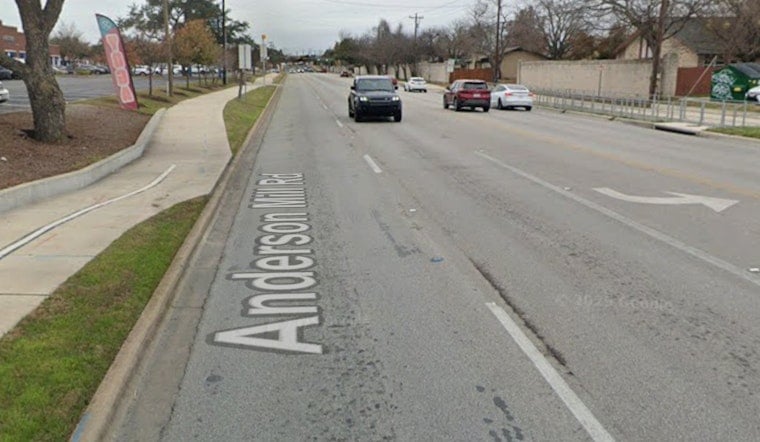
Austin police confirmed a traffic fatality in the 10300 block of Anderson Mill Road on Wednesday, adding another name to the city's grim 2026 count on one of Northwest Austin's busiest commercial corridors. The Austin Police Department announced the crash in a brief news release shortly before 5 p.m., offering no immediate details on the victim, the vehicles involved, or what caused the wreck.
The stretch of roadway sits in the 78750 zip code, a commercial thoroughfare lined with strip centers, convenience stores like Speedy Mart, and local eateries, according to Realtor.com. As reported by the Austin Police Department, the corridor serves as a key east-west arterial linking US 183 with RM 620, and it follows the department's standard practice of releasing rapid initial alerts before publishing fuller findings once next-of-kin notifications and scene reconstruction are complete.
Traffic Fatality in the 10300 block of Anderson Mill Rd. - https://t.co/yAYXlAUGTn pic.twitter.com/TMb4Bmycnr
— Austin Police Department (@Austin_Police) August 26, 2026
APD's Vehicular Homicide Unit is handling the investigation, as it does with all fatal crashes citywide, assigning a formal case number for entry into the Texas Department of Transportation's crash database. Anyone with information can reach investigators at 512-974-8111. Details about the vehicles involved, the identity of the victim, and the cause of the crash remain pending.
A Corridor Already Reshaped by Safety Upgrades
Anderson Mill Road is no stranger to municipal safety intervention. The City of Austin completed a project along the corridor between Spicewood Parkway and US 183 in December 2021, adding a continuous center turn lane, raised medians, extended right-turn lanes, and shared-use paths, according to city mobility data. That $7.26 million upgrade was one of seven corridor projects funded under Austin's 2016 Mobility Bond.
Despite those investments, the broader area around Anderson Mill Road continues to see major construction and traffic pressure. The Texas Department of Transportation has designed a $45 million intersection overhaul for nearby RM 620 and Anderson Mill Road, featuring overpass bypass lanes, turnarounds, and additional turn lanes, an intersection that frequently backs up more than a mile during peak hours. Just to the east, the $612 million 183 North Mobility Project entered its final year of construction in early 2025, per Community Impact, adding express lanes and reshaping frontage road access along the nine-mile stretch from MoPac to SH 45.
Speed Enforcement Push Came Weeks Before the Crash
The fatality lands just weeks after Austin police wrapped up a joint speed enforcement initiative with the state. APD partnered with TxDOT from July 18 through August 2 for Operation Slowdown, an intensive crackdown aimed at curbing deadly crashes; speeding is a contributing factor in roughly one-third of Texas traffic deaths and accounted for 1,247 statewide fatalities in 2025.
City data shows why officials have zeroed in on speed and road design. Corridors on Austin's High-Injury Network account for nearly 60% of all serious injury and fatal crashes, despite representing only 8% of city streets. A Mobility Outcome Report published by the city in March 2026 found that roughly 65% to 75% of Austin's traffic fatalities occur on state-owned roadways rather than city-maintained streets, underscoring a jurisdictional divide between city planners and TxDOT over speed limits and road design on the state's busiest arterials.
Part of a Long, Uneven Year on Austin Roads
Wednesday's crash adds to a running tally that has, so far, trended better than last year. Austin recorded 49 traffic fatalities in 2026 through mid-August, according to the city's Vision Zero dataset, down from 66 reported over the same period in 2025. Still, severe crashes remain concentrated on multi-lane commercial corridors and state-managed roads much like Anderson Mill Road.
The corridor has drawn scrutiny before. A pedestrian was killed near the same interchange in a March crash at the US-183 and Anderson Mill Road interchange, and Northwest Austin has seen other fatal wrecks this year, including a June crash on nearby FM 620 that marked the city's 35th traffic death of 2026. An October 2025 audit from the Austin City Auditor's Office found that while pedestrian collisions made up only 3% of crashes citywide between September 2021 and July 2025, about 28% of those crashes resulted in serious injury or death, a report requested by City Council to assess police crash response under the Lisa Torry Smith Act.
APD has not yet said whether pedestrian activity, speed, or impairment played any role in Wednesday's crash. The department's Vehicular Homicide Unit is expected to release additional details, including the victim's identity, once next-of-kin notification and scene analysis are complete.



