

























































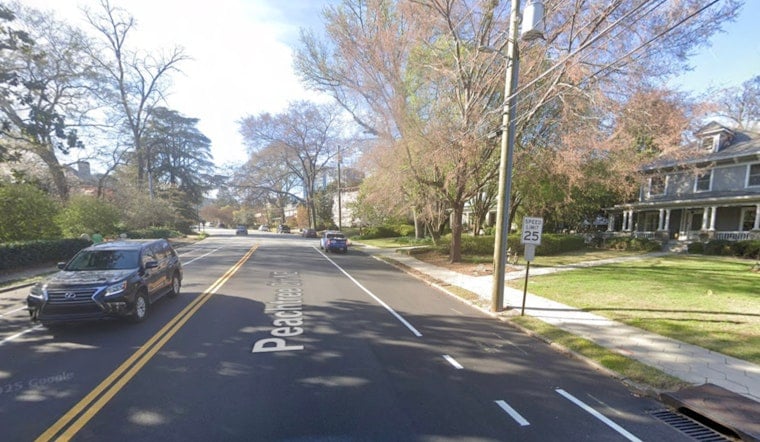
A proposal to designate Peachtree Circle in Ansley Park as Atlanta's newest local historic district has stalled in a City Council committee, after clearing multiple neighborhood and city review boards, because the councilmember overseeing it wants far broader buy-in from property owners before he will move it forward.
A Demolition Reignites an Old Fight
The renewed push traces back to January, when new owners demolished 205 Peachtree Circle, a century-old American Craftsman home on more than an acre, to make way for a larger house, according to Rough Draft Atlanta. The city had approved the demolition permit just before an interim moratorium took effect, and the teardown galvanized preservationists who had watched similar losses accumulate on the street for years. Ordinance Z-26-43, the resulting single-street historic overlay proposal, is now the subject of a fight over how much consent is enough before Atlanta imposes new zoning restrictions on private homeowners.
As reported by Axios, the Atlanta City Council Zoning Committee has held the legislation rather than advancing it, even though the proposal already has the backing of 40 property owners against opposition from roughly two dozen others. Councilmember Alex Wan, who represents Ansley Park, says he will place the ordinance on the council's agenda only if proponents secure agreement from two-thirds of property owners by September 8. Wan has framed the threshold as a personal policy standard he has applied for decades, not a legal requirement under city code, according to Rough Draft Atlanta's account of his reasoning. He has said there should be broad support from affected properties because a historic district would impose real limits on what owners can do with their own land, per Axios.
Why National Recognition Was Never Enough
Ansley Park has been listed on the National Register of Historic Places since 1979, but that federal designation carries no legal power to stop private owners from altering or tearing down their homes, Rough Draft Atlanta reports. Only a city-granted local historic overlay comes with teeth: under Atlanta's historic and landmark districts ordinance, property owners in a designated district must secure a Certificate of Appropriateness from the Atlanta Urban Design Commission before making exterior changes visible from the street or pursuing a demolition, per the same outlet. That ordinance also spells out maintenance requirements for buildings within a designated district, according to Axios.
Ansley Park itself was platted between 1904 and 1913 as an early-20th-century suburban development spanning roughly 275 acres, laid out with curving streets that followed the area's rolling terrain rather than a conventional grid, according to National Park Service documentation. Peachtree Circle served as one of the plan's primary western arteries. The street's preservation credentials run deeper still: in November 2013, advocates physically relocated the historic 1924 Georgian Revival Randolph-Lucas-Jones House two miles from Buckhead to a vacant lot at 78 Peachtree Circle to save it from demolition, a rescue chronicled by SaportaReport that ended with the relocated mansion earning a city historic landmark designation.
A Street With More History Than Most
Peachtree Circle counts 60 contributing structures reflecting architectural styles from 1888 to 1934, according to Axios, alongside 13 properties that fall outside that contributing category as modern builds or different architectural styles. The Ansley Park Civic Association's Zoning Committee found in its July review that Peachtree Circle holds a higher concentration of contributing historic structures than Ansley Park overall, and noted the street was previously included in a 2022 transit-oriented development study area — a detail the association says underscores the distinct redevelopment pressure it faces, per the association's own filing.
Before landing in committee limbo, Z-26-43 had cleared essentially every review body put in front of it. The Ansley Park Civic Association recommended approval in July, Neighborhood Planning Unit E endorsed it on August 4, and the Atlanta Zoning Review Board voted 6-0 in support, according to Rough Draft Atlanta. That unanimous municipal backing makes Wan's hold in committee the first real roadblock the proposal has hit.
Owners Push Back Over Property Values
Not every resident is on board. At the August 6 Zoning Review Board hearing, Peachtree Circle resident Drew Gandy asked for a 60-day continuance so opponents could fund an independent appraisal of how the designation might affect property values, but the board denied his motion, Rough Draft Atlanta reported. Gandy has said he previously supported a neighborhood-wide preservation effort but opposes the narrower single-street overlay. Axios reports that opposition among the roughly two dozen dissenting property owners centers on fears about property values and constraints on future renovations.
Robert Reed, assistant director of the city of Atlanta's Historic Preservation Studio, is among the officials tracking the proposal, per Axios. Supporters argue the designation would shield older, distinctive structures from demolition or major alterations, addressing the exact scenario that unfolded at 205 Peachtree Circle in January. Lisa Hoffman, who owns a home on the street, told Axios that historic properties explain Atlanta's development, its residents' lives, its architectural evolution, and the influence of past generations on the city, adding that lost historic places cannot truly be recreated.
A History of Failed Attempts
This is not the first time Ansley Park has tried to lock in historic protections. Since Wan took office in 2010, at least three attempts to establish a historic district across the entire neighborhood have failed amid community friction and legal threats, including a 2022 effort that collapsed after a property rights advocate filed suit, according to Rough Draft Atlanta. That history is part of why advocates shifted this time to a single-street approach targeting Peachtree Circle specifically, rather than seeking to designate all of Ansley Park at once.
David Mitchell, executive director of the Atlanta Preservation Center, described the choice facing the city as one between protecting Atlanta's built history or accepting development at any cost, per Axios. Mitchell has said residents of neighborhoods with distinctive character may want to protect that character for future generations. Joan Lyman, another voice in the debate, said Atlanta's rapid pace of change makes preservation efforts more important than ever, according to the same report. Wan has said he supports historic preservation initiatives generally, but the September 8 deadline now stands as the deciding factor for whether Z-26-43 returns to the council's agenda or joins the list of failed Ansley Park preservation bids.





