

























































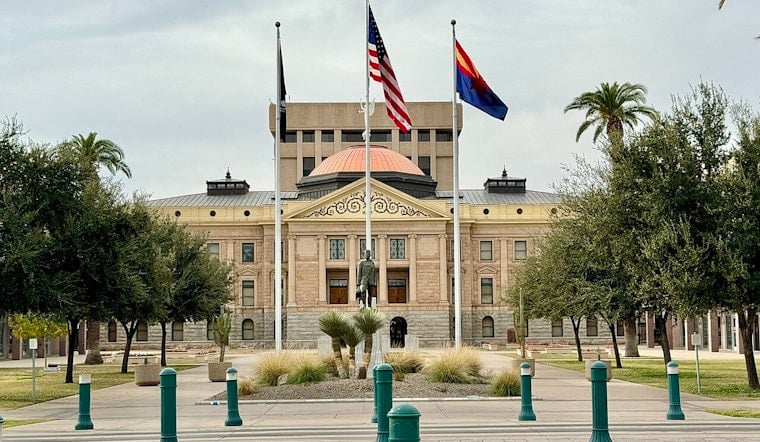
Eleven staff members at the Arizona House of Representatives lost their jobs this month after state budget cuts forced the chamber to trim roughly 10% of its workforce, including legislative analysts, security personnel and secretaries. An internal email confirmed the layoffs on August 6, and three additional employees were demoted from full-time status to seasonal help.
House sources said the layoffs resulted directly from the recent state budget cuts, as reported by Arizona's Family. House officials declined to comment on the record, treating the layoffs as a personnel matter, according to the same report. The cuts trace back to the new state budget that Arizona legislative leaders approved in June, which mandated a 2.5% operating reduction across nearly every state agency for the fiscal year.
That reduction was written into Senate Bill 1847, the $18.3 billion budget package Governor Katie Hobbs signed on June 13, according to the Arizona Capitol Times. The Legislature itself was not spared from the squeeze — the state House cut $544,000 from its budget, while the state Senate cut $450,000, though the Senate did not lay off any employees. The Governor's Office also saw reductions similar to the House, cutting $203,000, but did not lay off employees either.
Carpet and a Media Studio Amid the Cuts
Even as it eliminated positions, House leadership authorized $640,000 for a new media studio designed for lawmakers to record podcasts and produce promotional videos, per Arizona's Family's reporting. Leaders also signed off on aesthetic remodeling that included new carpeting on the House floor, along with upgrades to building security and equipment.
The layoffs sit alongside another Capitol-related expense: the Republican-controlled Arizona Legislature spent about $1.2 million on private attorneys and lawsuits last year, according to the same account.
Why the Budget Squeezed the Legislature
The 2.5% operating cut was one piece of a larger fiscal trade-off lawmakers accepted to pass the FY 2027 budget. To help fund $1.4 billion in state tax cuts over three years — achieved by fully conforming Arizona's tax code to federal changes, including eliminating state income taxes on tips and overtime pay starting July 1 — negotiators required across-the-board operating reductions at non-exempt state agencies, according to the Office of the Arizona Governor. Lawmakers explicitly exempted key healthcare and social-service entities from the cuts, including the Arizona Department of Health Services, AHCCCS and the Department of Economic Security, according to the AZ Public Health Association, a carve-out designed to protect administrative capacity for federal healthcare compliance.
The enacted budget nonetheless left the state with a projected structural surplus of $239 million and a $392 million ending balance, with general fund revenues growing 5.2% over the prior year, according to the National Association of State Budget Officers. Ongoing general fund spending totals $17.33 billion, alongside $952 million in one-time expenditures.
Part of a Broader Pattern of State Cuts
The House layoffs follow a pattern of workforce reductions tied to Arizona's shifting fiscal picture. The Department of Economic Security laid off approximately 500 employees, or 5% of its workforce, in July 2025 after federal grant eliminations gutted unemployment insurance funding, Hoodline previously reported. Those affected workers were given two weeks' notice before their termination date, per FOX 10 Phoenix.
Budget pressures have also rippled into public services outside the Capitol. Operating cuts in the FY 2027 spending plan led nonprofit operator Solari Crisis & Human Services to eliminate live human phone specialists for Arizona's 2-1-1 helpline as of Thursday, shifting callers to automated menus, Hoodline reported in its earlier coverage of the desert lifeline cut off by budget ax. That helpline had handled more than 700,000 live calls over the past decade.
Separately, the budget deal enacted a three-year moratorium on state tax incentives for new data centers, a compromise state negotiators projected would preserve tens of millions of dollars in general fund revenue while allowing ongoing construction to continue, according to FOX 10 Phoenix. Meanwhile, Arizona's universal Empowerment Scholarship Account voucher program is projected to reach $1 billion in state spending during the current fiscal year, a major cost driver that has squeezed operating budgets across state government, according to KAWC. In July, voter advocacy groups submitted more than 420,000 signatures for Proposition 212, a ballot initiative aimed at restricting universal ESA voucher spending and requiring State Board of Education oversight, per Ballotpedia.





