

























































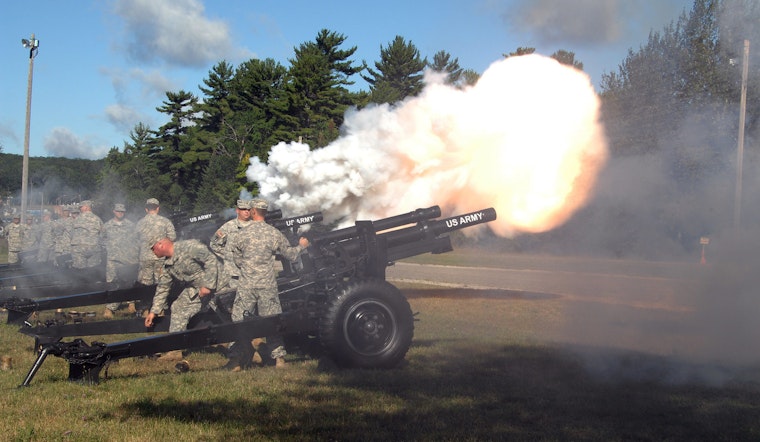
The U.S. Army has launched an online marketplace that lets private weapons companies request access to military test ranges and get an answer within 30 days, cutting a process that has historically taken 12 to 18 months. Army Secretary Dan Driscoll announced the change at Camp Grayling in Michigan, telling reporters that military testing red tape can drag on for months or years and that his goal is to break down barriers built up over the last 20 or 30 years.
According to The Oakland Press, the new portal opens five ranges to companies developing missiles, drones and other weapons: Dugway Proving Ground in Utah, the West Cibola Range at Yuma Proving Ground in Arizona, Camp Grayling in Michigan, Camp Shelby in Mississippi, and the Multidomain Training Area in Morocco, which is part of the Africa Multidomain Training and Experimentation Center. As reported by Breaking Defense, Maj. Gen. Patrick Gaydon noted that the West Cibola site had previously seen only limited commercial testing before this expansion. Gaydon commands the Army Test and Evaluation Command, which oversees proving grounds across 17 states covering roughly a third of all Army land.
How the Fast-Track Portal Works
Companies using the new system must fund their own testing with Internal Research and Development money rather than relying on an existing government contract, and each participating firm is assigned a single concierge contact to handle scheduling, per Breaking Defense. That structure lets uncontracted vendors onto proving grounds that were previously difficult to access at all. Driscoll said the Army wants to invite industry to innovate and invest alongside soldiers, and that the service intends to purchase weapons that make troops more lethal and safer.
The barrier the Army is trying to remove is well documented. Data from the Army Applications Laboratory found that access to military test ranges is the second-largest obstacle to defense innovation for commercial tech firms, trailing only reliable transition funding, since non-traditional vendors often lack access to the specialized airspace and electromagnetic spectrum needed for long-range and electronic-warfare testing.
California Startup Becomes First to Use the Program
Covenant Industries, a California-based defense startup, became the first company to use the new program, testing its Anthem cruise missile at the Multidomain Training Area range complex in Morocco on Thursday. The company had already live-fire tested the Anthem system in July at the Army's Project Convergence Capstone 6 exercise, which, as described by the Washington Times, stress-tested AI battlefield tools and Next Generation Command and Control systems across 1,000 square miles of Fort Irwin desert in triple-digit heat. Covenant Industries executive Abby Denburg said the company demonstrated both the Anthem missile's performance and a repeatable testing pathway, and the firm plans to begin manufacturing line deliveries by early 2027.
The push for faster testing comes as the Pentagon works to increase weapons-production tempo by incentivizing smaller companies, according to the Associated Press report carried by The Oakland Press. Advanced missiles and interceptors can cost millions of dollars apiece, and officials are eager to field lower-cost, commercially produced alternatives more quickly.
Stockpiles Strained by Middle East Fighting
The urgency traces back to sustained combat use. An analysis from the Center for Strategic and International Studies found that intense Middle East air defense operations, including Iran's launches of Shahed drones against American forces, have diminished U.S. stockpiles of advanced interceptors such as Patriot and THAAD missiles, estimating Patriot inventories fell below 1,000 and THAAD interceptors dropped to roughly 250. CSIS reported the shortfall could force the United States and Middle Eastern allies to take greater risks to conserve their air defenses. Military reports cited by CNN indicated U.S. forces expended nearly 80% of pre-war THAAD interceptor stockpiles during the fighting, prompting the Trump administration to request $95 billion for munitions procurement in its fiscal year 2027 defense budget, including funding for more than 3,000 Patriot missiles and 800 THAAD interceptors.
President Donald Trump said some munitions remain in virtually unlimited supply while others are tighter, though he did not offer more specifics about the state of U.S. munitions supplies, per the Associated Press. Driscoll struck a more confident tone, saying the United States has a larger arsenal than any nation in history and will end up with an even larger one built on new, different and layered defenses.
Driscoll's Ukraine Connection
Driscoll brings a distinctive background to the effort. He served as a key U.S. interlocutor during Russia-Ukraine peace negotiations last year before those talks stalled, and he has said watching Ukraine move quickly to produce new weapon systems amid Russia's invasion motivated his drive to cut U.S. procurement red tape. That framing places the range-access overhaul within a broader Army modernization push that Hoodline has tracked through rapid vehicle prototype testing initiatives and ongoing debate over electronic-warfare testing capacity.
Camp Grayling, the Michigan site where Driscoll made Thursday's announcement, is the largest National Guard training facility in the country, spanning 148,000 acres with 337 square kilometers of restricted military airspace and hosting the annual Northern Strike exercise. Whether smaller defense firms can sustain the cost of live-fire testing without guaranteed government contracts, and whether prototypes like the Anthem missile can clear broader supply-chain hurdles on the way to mass production, remain open questions as the fast-track program gets underway.





