

























































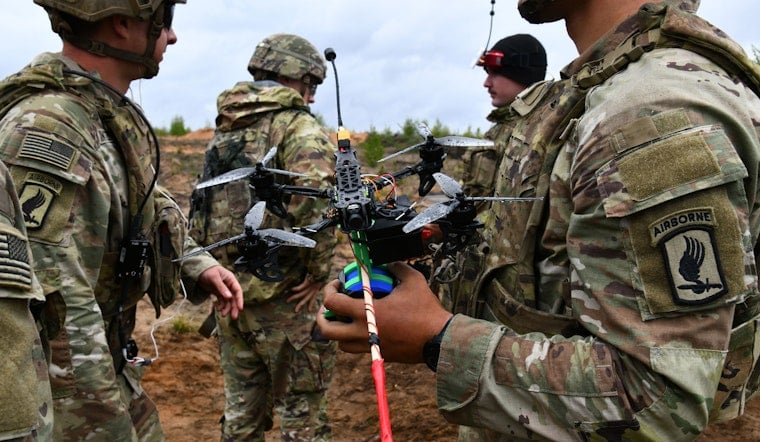
The U.S. Army is shutting down a specialized 600-soldier drone-warfare battalion built in Europe just last year, ordering the unit back to conventional airborne infantry duty even as the service pushes to put small drones in the hands of every regular infantry squad. The unit, formed from soldiers of the 173rd Airborne Brigade and based in Italy and Germany, was designed as a dedicated force deployable wherever drone expertise was needed, modeled in part on Ukraine's battlefield innovations.
The battalion was formed in November 2025 using roughly 600 soldiers from the 173rd Airborne Brigade, and was formally established the following January as the 3rd Battalion, 504th Parachute Infantry Regiment, according to reporting cited by The Independent. Acting Army Chief of Staff Gen. Christopher LaNeve ordered the battalion to refocus on its airborne infantry mission, according to two U.S. officials cited in that reporting. The unit is currently taking part in the Saber Junction exercise in Hohenfels, Germany, running through August and September, before it fully reverts to standard airborne infantry duties, per details reported by The Wall Street Journal.
A Unit Born From Ukraine's Battlefield Lessons
The battalion was tasked with studying dedicated unmanned-systems forces, including Ukrainian units, and feeding back lessons to accelerate American drone capability, per the Independent's reporting. Ukraine pioneered many of the drone-warfare tactics the unit was meant to study, and became the first nation to stand up a standalone military branch for uncrewed warfare when it created its Unmanned Systems Forces in June 2024 — a force that evolved into dispersed FPV strike cells inflicting an estimated 33,000 Russian casualties per month by late 2025, according to the Army War College. Soldiers with the 173rd Airborne Brigade began experimenting with drones and unmanned warfare nearly a year ago, working on artificial intelligence and jamming-resistant systems along the way, the Independent reports.
Much of that work took shape at a first-person-view drone lab the brigade's Bayonet Innovation Team stood up in May 2025 at Caserma Del Din in Vicenza, Italy, where soldiers engineered custom drones capable of air-to-air intercepts and of dropping live M67 fragmentation grenades, according to Army.mil. Joshua Gaspard said in May 2025 that soldiers were excited to work with FPV drone systems, per the Independent's reporting. During the DEFENDER 25 Swift Response exercises that same month, paratroopers also tested aerial drone resupply of blood products to field medical stations, aiming to sustain life-saving care when enemy drone surveillance blocked traditional vehicle evacuations, Army.mil reported. The lab's reach extended beyond Europe: in July 2026, a delegation from the Ghana Armed Forces visited Caserma Del Din to study the brigade's drone production line, marking what was described as a first-of-its-kind bilateral partnership to model West African drone manufacturing on the tactical designs developed there, according to PublicNow.
Leadership Shakeup Preceded the Shutdown
The battalion's dissolution follows a leadership overhaul at the top of the Army. Defense Secretary Pete Hegseth ousted Gen. Randy George as Army Chief of Staff in April, according to the Independent, after George had advocated accelerating drone-system development and distributing unmanned systems to regular soldiers alongside then-Army Secretary Dan Driscoll's broader Army Transformation Initiative launched the prior year. Gen. Christopher Donahue, the commanding general of U.S. Army Europe and Africa who co-championed the European drone battalion, abruptly relinquished command and retired on July 2, 2026, amid Hegseth's restructuring, as Hoodline reported in its earlier coverage of Donahue's departure.
LaNeve, who previously served as George's deputy and commanded the U.S. Eighth Army in South Korea before becoming Hegseth's top military adviser at the Pentagon in March 2025, was nominated by President Trump in October 2025 to become Army vice chief of staff, per the Independent's account. LaNeve has framed the broader reshuffling around a message that the next war will not resemble the last one and that soldiers must adapt faster using advanced technologies, the Independent reports. A memo from LaNeve stated the Army must be disciplined, lethal and relentless — though that memo did not mention drones specifically, according to the same reporting.
Drones Still Headed to Every Squad, Army Says
Army officials maintain the phaseout of the dedicated battalion does not mean retreating from drone warfare. Under the Transformation in Contact initiative, every regular infantry squad is required to be equipped with low-cost small unmanned aircraft systems and loitering munitions by the end of fiscal year 2026, according to the Army War College. In May and June 2026, the Army expanded its procurement portfolio to vendors including AeroVironment, Mistral, Quantum Systems, Anduril and PDW to rapidly supply company- and platoon-level reconnaissance drones to combat units, Army.mil reported. The specialized battalion is expected to deliver its exercise findings and its past year of lessons to the Army, and a third U.S. official told the Independent that the unit's future was expected to be reevaluated after a culminating event; those exercises will inform Army force design and future experimentation.
Not everyone is convinced the shift is the right call. Michael O'Hanlon of the Brookings Institution publicly criticized the phaseout in August, telling reporters that “Ukraine has essentially revolutionized the close fight” and warning that any setback in Army drone experimentation would be “deeply regretful and dangerous,” according to reporting cited by the Wall Street Journal. The stakes are underscored by recent battlefield realities: Iranian Shahed drones have downed a U.S. Army helicopter and killed American troops, while Iranian drone attacks have forced the U.S. military to expend advanced interceptors defending ships and bases, according to the Independent. Ukrainian President Volodymyr Zelenskyy said in March that Ukrainian officials were helping five Middle Eastern and Gulf countries counter Iranian drone attacks, as the United States and European countries have also sought Ukraine's support on the same threat.





.jpg)