

























































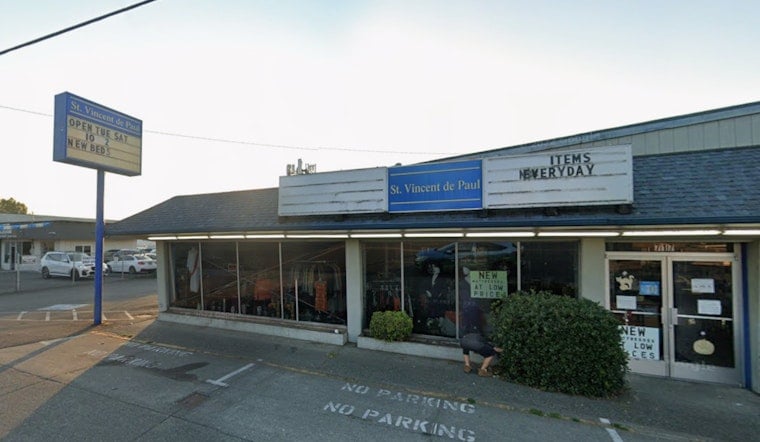
A sealed bag of baseball cards selling for $3.49 at a St. Vincent de Paul thrift shop in Auburn led a grieving friend to a discovery no one expected: the identification card of Jesse Sarey, the 26-year-old former foster child fatally shot by Auburn police officer Jeffrey Nelson in 2019. Cesar Rodriguez, a close friend of Sarey’s, noticed the card inside the bag and eventually arranged to return it to Elaine Simons, Sarey’s foster mother, who has spent years fighting for accountability in his death.
According to KIRO 7 News Seattle, the discovery came together through a strange chain of coincidences. A TikTok user posted a five-second video reporting that the thrift shop was selling Sarey’s ID inside a sealed bag of baseball cards — for $3.49, and on Sarey’s birthday, no less. Friends alerted Simons to the video, but by the time someone tried to buy the item on her behalf, it had already sold. Rodriguez ended up buying the bag himself, telling the outlet he did it because Sarey “was his buddy.”
Thrift shop workers could not explain how the card ended up there, and its path out of storage remains unexplained. The store sits about four miles from where Sarey was killed, and Sarey’s personal belongings from the criminal trial were believed to be held in evidence, according to the same report. Rodriguez said he believes Sarey intended for the card to be found, telling KIRO 7 that Sarey never wanted people to forget him.
A Foster Mother’s Long Fight for Answers
Rodriguez eventually met Simons in person for the first time when he returned the card to her. Simons, who became an activist seeking justice for Sarey after his death, said she has been relentlessly on a mission to do right by him and called for accountability over how his ID ended up in a stranger’s hands, per the same account.
Sarey struggled with mental health, addiction, and homelessness after aging out of foster care, and he was killed during a scuffle with Nelson in Auburn, Washington, in 2019. Surveillance video from the May 31, 2019 shooting outside Sunshine Grocery showed Nelson punching Sarey repeatedly, shooting him in the abdomen, clearing a jammed shell casing from his firearm, and then shooting Sarey in the forehead three seconds later while Sarey lay on the pavement, according to FOX 13 Seattle. Prosecutors emphasized that Nelson ignored de-escalation protocols and failed to wait for backup.
A Landmark Conviction Under Washington’s Police Accountability Law
Nelson’s case became a legal test of Initiative 940, the 2018 voter-approved measure that removed Washington’s old requirement that prosecutors prove an officer acted with malice to secure an on-duty murder conviction, as reported by KING 5 News. Before the initiative passed, Washington was the only state in the country with a malice standard for police use of deadly force. Nelson was convicted of murder in June 2024, marking the first time an officer in Washington state had been convicted of murder for an on-duty shooting.
In January, King County Superior Court Judge Nicole Gaines Phelps sentenced Nelson to 16 years and eight months in prison for second-degree murder and first-degree assault, ordering the 200-month murder sentence and 123-month assault sentence to run concurrently, the Associated Press reported. During sentencing, the judge openly criticized Auburn Police Department leadership for enabling Nelson’s violent behavior and maintaining an internal culture that defended misconduct, according to PubliCola. Phelps noted Nelson had a recorded history of escalating violence against people who disrespected his authority.
A Pattern of Deadly Force Jurors Never Heard
Jurors in Sarey’s murder trial were legally barred from hearing that Nelson had shot and killed two other men during his time with Auburn police: Brian Scaman during a 2011 traffic stop and Isaiah Obet in 2017, per the Associated Press. The City of Auburn paid $1.25 million in 2020 to settle a lawsuit over Obet’s death, and King County prosecutors formally declined to file criminal charges against Nelson in that case earlier this year, even though a May inquest jury voted 4-to-2 that Nelson caused Obet’s death by criminal means, the Renton Reporter reported. Prosecutors determined the evidence was insufficient to disprove Nelson’s self-defense claims.
Pretrial evidence prepared for the murder case also included an independent expert’s review, conducted by former Seattle Police Chief Jim Pugel, that identified 17 separate instances where Nelson used excessive force during his career, including deployments of K-9 attack dogs, Tasers, and chokeholds. That analysis, detailed by the Renton Reporter, was kept from the trial jury. Separately, the City of Auburn agreed to pay Sarey’s family a $4 million civil settlement to resolve a wrongful-death lawsuit, a payout negotiated while criminal proceedings were still pending, according to FOX 13 Seattle.
Nelson Now Appealing His Conviction From Out of State
In May, the Washington State Department of Corrections transferred Nelson from maximum-security custody in the state to an undisclosed out-of-state prison facility under an interstate compact agreement, with corrections officials citing safety and security concerns, per the Federal Way Mirror. Nelson’s attorneys filed an appeal in March seeking to overturn his murder and assault convictions, alleging flaws in the trial, and that appeal remains pending in state court, KING 5 News reported.
For Simons, none of that legal history explains how her son’s ID card ended up wedged in a stack of baseball cards at a thrift shop four miles from where he died. The mystery remains unresolved, but for Rodriguez, the coincidence carried its own meaning — a small, strange reminder that Sarey, in his words, never wanted to be forgotten.





