

























































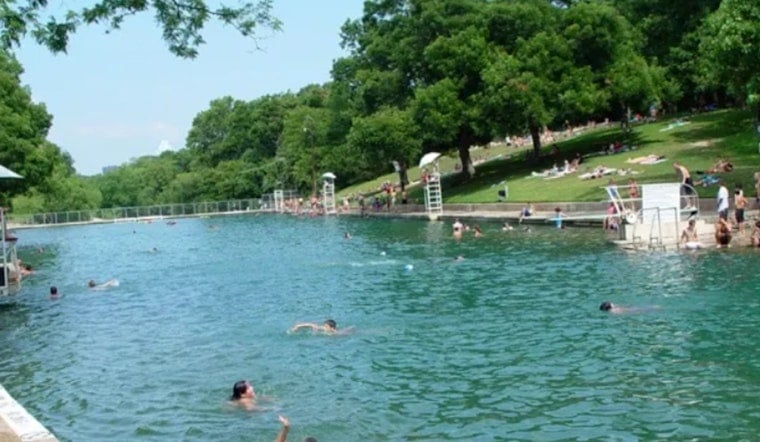
Austin Parks and Recreation will begin repairing the historic stone retaining wall along the eastern edge of Barton Springs Pool starting Sept. 8, a project that requires removing 37 trees whose roots and growth have spent decades pushing against the century-old structure. Five sections of the wall are already showing signs of structural failure, and the pool will remain open under normal hours throughout the work.
The wall dates to 1917 and is a contributing element to the Zilker Park Historic District, listed on the National Register of Historic Places, according to CBS Austin. The station reports the project includes an engineering assessment, structural repairs to the wall, and removal of plants and trees that have been compromising its stability. Vegetation and tree growth have added pressure to the wall over the years, and Austin Parks and Recreation plans to complete the work in phases running until early 2027.
The trees slated for removal include 26 hackberries, five American elms, three mulberries, two pecans, and a single ligustrum, per the same report. Repair work will be fenced off for safety, though officials say it will not disrupt pool operations. Notably, no new trees will be replanted in the area once the repairs wrap up, since keeping vegetation away from the wall is meant to prevent the same kind of root pressure from building up again.
A Wall Built for the Depression-Era Pool
The retaining wall is part of a larger network of stone masonry and terraced work at Barton Springs Pool that architect Charles Page planned in 1933, built by the Civilian Conservation Corps and Civil Works Administration during the Great Depression, according to The Cultural Landscape Foundation. The upper and lower dams that established the pool's current channel were constructed between 1929 and 1932. Zilker Park itself traces back to philanthropist Andrew Jackson Zilker, who began deeding the 350-acre property to the City of Austin in 1917, with the land formally designated as Zilker Park in 1934, per the City of Austin.
The Zilker Park Historic District, which includes the pool and its 1917 masonry structures, was added to the National Register of Historic Places on May 23, 1997, according to the National Park Service. That designation covers a period of significance spanning 1917 to 1947, meaning repairs to the wall must maintain the original stone masonry design rather than simply patch or replace it.
Tree Removal Complicated by Endangered Species Protections
Any construction at Barton Springs Pool has to account for the Barton Springs salamander, a subterranean, lungless species that relies entirely on clear spring water from the Edwards Aquifer. The U.S. Fish and Wildlife Service designated the salamander as federally endangered on April 30, 1997, according to the U.S. Fish and Wildlife Service, which means all municipal maintenance around the pool must comply with strict Habitat Conservation Plan protocols to limit runoff and habitat disruption. Barton Springs itself ranks as the fourth-largest natural spring outlet in Texas, discharging unchlorinated water through four primary spring openings that feed from the Edwards Aquifer, per the Save Our Springs Alliance — an aquifer that also serves as the primary drinking water source for more than 1.5 million Central Texas residents.
This is not the first time tree health has forced the city's hand at the pool. In October 2023, crews removed “Flo,” a nearly 100-year-old pecan tree that had leaned over the water since at least 1928, after brittle cinder fungus decayed the tree's base near a 1946 retaining wall, according to 6AM City. That episode showed how vegetation pressure can compromise the pool's stonework long before a wall reaches the point of visible structural failure.
Latest in a String of Repairs at the Historic Pool
The wall project follows other recent infrastructure headaches at the three-acre pool, which reaches depths of up to 18 feet and draws nearly 800,000 visitors annually, according to the Austin Parks and Recreation Department. In August and September 2024, the pool closed for several weeks after crews discovered two large holes in an abandoned 1940s-era pipe under the dam, creating hazardous underwater suction, as Hoodline reported at the time. That emergency response involved Austin Water, Parks and Recreation, and Watershed Protection working together to fix the aging plumbing.
Nearby, the Joan Means Khabele Bathhouse at Barton Springs Pool partially reopened in late October 2025 following a multi-million-dollar renovation that updated restrooms, showers, and plumbing systems, according to AustinTexas.gov. The 1947 structure was renamed in 2024 to honor the civil rights activist who integrated the pool in 1960. Together, the bathhouse renovation and the incoming wall repairs point to a broader wave of capital investment across the historic pool grounds.
That investment is happening even as citywide park funding tightens elsewhere in Zilker Park. Austin Parks and Recreation reported in October 2025 that erosion mitigation projects across the park have faced budget limitations after remaining funds from a 2018 municipal bond package were exhausted, according to the Austin Monitor. Previous emergency erosion repairs along Barton Creek cost the city $6 million following major flooding in 2018.





