

























































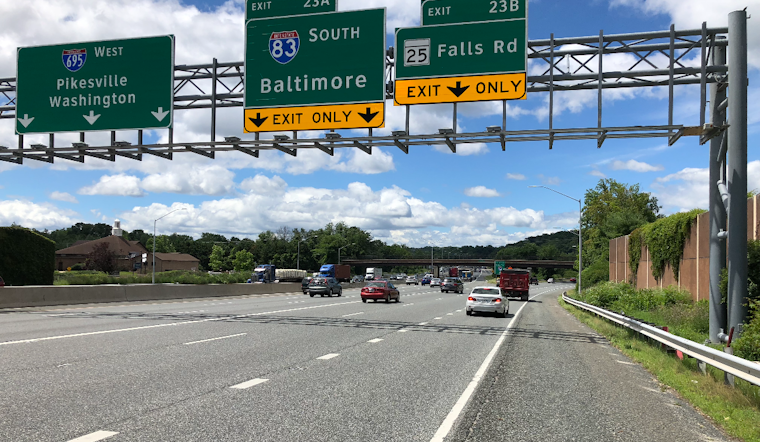
Maryland is spending $184 million to turn part of the Baltimore Beltway's shoulder into a part-time traffic lane, and plenty of drivers who use I-695 every day aren't sold on the idea. The project promises shorter commutes across some of the state's most congested stretches of highway, but for people like Phoebe French, who says she already feels unsafe on I-695 because of heavy traffic and inattentive drivers, an extra lane raises more questions than it answers.
The design-build effort, formally using what engineers call Part-Time Shoulder Use, or PTSU, allows the shoulder to open as an additional traffic lane during heavy congestion and then return to its normal role as an emergency shoulder outside peak travel times, according to WBFF. The Maryland State Highway Administration expects the project to save drivers time during heavy congestion, and officials say the redesigned traffic pattern is meant to encourage slower speeds and improve enforcement along the corridor. French, for her part, tries to avoid I-695 as much as possible and has openly questioned whether an additional lane will actually improve safety rather than just add more cars to a road she already distrusts.
She's not alone in her skepticism. Baltimore County resident David Witte has raised concerns about how the new lane configuration will function alongside the concrete barriers already lining much of the work zone, while fellow driver Rowland Hinds has said a lane that isn't available full-time may not deliver the traffic relief officials are promising, per the same WBFF report.
A Project Born From Tragedy
The stakes behind the skepticism trace back to March 2023, when a work zone crash on I-695 killed six construction workers, an attribution the State Highway Administration itself has confirmed. Concrete General, Inc., the Gaithersburg-based design-build contractor now responsible for engineering and constructing the Beltway modifications, was performing median shoulder work at the time of the crash and employed five of the six workers who died, according to ENR.
The National Transportation Safety Board released its final report on the crash in October 2024, concluding it resulted from two vehicles traveling faster than 120 mph and an unsafe lane change, rather than any defect in the contractor's safety setup, ENR reported. Driver Lisa Lea was later sentenced in January to 30 years in prison after pleading guilty to six counts of vehicular manslaughter, while co-driver Malachi Brown received an 18-month sentence that was later converted to home detention, as detailed in Hoodline's coverage of the sentencing. NTSB toxicology reports indicated Lea had THC and a muscle relaxant in her system at the time of impact, according to CBS News.
New Rules of the Road
That tragedy prompted the State Highway Administration to redesign its traffic patterns and pushed state lawmakers into action. Governor Wes Moore signed the Maryland Road Worker Protection Act in April 2024 to expand automated speed camera placement and increase penalties in highway work zones, incorporating recommendations from a work zone safety task force chaired by Lt. Gov. Aruna Miller, according to MDOT SHA.
Under a tiered fine system that took effect January 1, 2025, work zone speed camera violations now range from $60 to $500, doubling to between $120 and $1,000 when workers are present, up from a previous flat $40 penalty, MDOT SHA says. Speed limits in active I-695 construction zones drop from 55 mph to 45 mph whenever contractor crews are on site, enforced by automated speed camera vehicles equipped with blue flashing lights as part of the state's SafeZones system, which remains active throughout the 38-mile corridor. Separately, WBFF reports that drivers who misuse the shoulder lane could face charges including reckless driving, negligent driving, failure to obey a traffic control device, or unsafe passing, with citations for improper shoulder use running more than $110. Maryland State Police also conduct weekly special traffic enforcement operations in the I-695 construction zones, working day and night shifts, per the same outlet.
Digital Signs Will Guide the Shoulder's Status
Drivers will know when the shoulder is open or closed by watching for overhead digital signage: a red X appears when the shoulder is closed to traffic, WBFF notes. That kind of signaling reflects Federal Highway Administration guidance that left-shoulder freeway PTSU systems require overhead digital gantries, a standard Maryland tested first on a smaller scale. Maryland previously ran part-time shoulder use along a 4-mile stretch of US 29 in Montgomery County, restricting that shoulder to transit buses bypassing signal queues during weekday peak hours, according to the Federal Highway Administration. Turning a Beltway hard shoulder into a dynamic general-purpose lane represents a considerably larger operational shift than that earlier bus-only experiment.
The I-695 project began design and construction in 2020 and stretches from the I-70 interchange to Route 43 near White Marsh Boulevard, covering 38 miles of construction and traffic pattern changes meant to address six of Maryland's 15 most congested roadway segments. MDOT SHA has said the redesign follows industry-standard guidance and requirements and maintains that part-time shoulder use is safe, even as it acknowledges the project has caused significant disruptions for drivers along the corridor.
What's Left to Build, and When
MDOT SHA has broken the $184 million project into two phases. The stretch between I-70 and I-83 is expected to open for part-time shoulder use by late summer 2027, while the segment from I-83 to Route 43 is expected to follow by late summer 2028, according to CBS News. The second phase required shifting travel lanes onto the outside shoulders to create median work zones, the same report notes. WBFF adds that the project as a whole will not be fully finished for another two years.
In the meantime, MDOT SHA scheduled recurring overnight single-, double-, and triple-lane closures between 8 p.m. and 5 a.m. along I-695 between US 40 and Windsor Mill Road through the summer to repave shoulders and apply permanent lane markings, allowing crews to reconfigure shoulder geometry while avoiding peak daytime traffic. The broader approach relies on what engineers call Transportation Systems Management and Operations strategies, including dynamic speed limits, electronic lane signals, and ramp metering, aimed at increasing corridor capacity without acquiring new right-of-way, per MDOT SHA. For drivers like French, Witte, and Hinds, the payoff of all that engineering and enforcement won't be clear until the shoulder lanes actually open for traffic in 2027 and 2028.



_at_Exit_23_(Interstate_83_SOUTH,_Baltimore,_Maryland_State_Route_25-Falls_Road)_on_the_edge_of_Towson_and_Mays_Chapel_in_Maryland.jpg)