

























































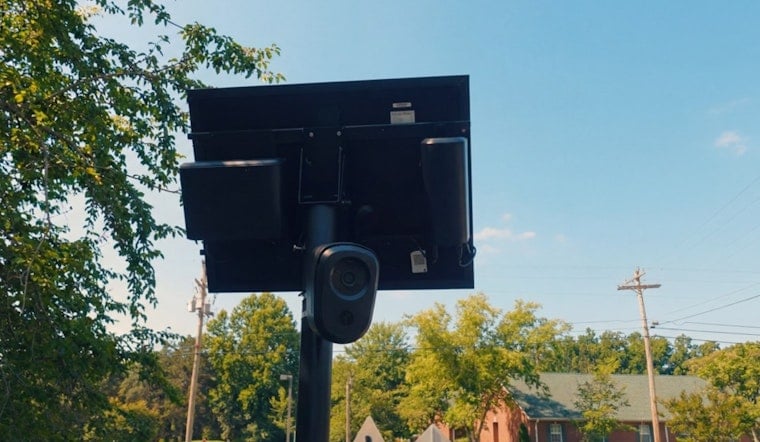
Bexar County Sheriff Javier Salazar tried to calm public anxiety over his department's use of Flock Safety license-plate readers on Tuesday, telling a town hall crowd in Stone Oak that the cameras are a narrow crime-fighting tool even as critics brand the growing network a mass-surveillance dragnet. The sheriff's appearance came as residents in the area were still reeling from a string of luxury-home burglaries that drained homeowners of millions in cash, jewelry and watches.
Salazar spoke at a public safety town hall hosted by District 9 Councilwoman Misty Spears, according to the San Antonio Current. Salazar answered only pre-approved audience questions during the event, the outlet reports, and he did not explicitly address civil-rights concerns that have been raised about the Flock system.
Town Hall Follows $5 Million Stone Oak Burglary Spree
Spears called for the broader public safety review after a string of burglaries hit The Estates at Champions Run and other parts of Stone Oak between February and July, with thieves bypassing security systems and safes, according to Texas Public Radio. FoxSA has reported that the burglary spree resulted in more than $5 million in stolen cash, jewelry and watches. Bexar County Sheriff's Office deputies say Flock cameras can help track people responsible for burglaries and assaults, a capability the department has pointed to in the wake of the Stone Oak break-ins.
The sheriff's office began its contract with Flock Safety in May 2025, per the same San Antonio Current report. Bexar County now has more than 500 Flock cameras in use, according to DeFlock, a crowdsourced tracker of the camera network's footprint.
What The Cameras Can and Can't Show
Salazar's office says the cameras provide only limited information — they do not reveal the identity of the person to whom a vehicle is registered, per the report. Instead, the system can show that a searched license plate passed a given camera roughly two hours earlier, and it can flag vehicles that resemble a search; in one example described in the report, a search for a white Mustang with a red racing stripe returned a list of 10 similar-looking cars.
Texas anti-gang deputies also use Flock cameras to track people connected to gang-related activity, the outlet notes. Separately, Bexar County Commissioners Court records show the county approved a procurement item on April 28 for precinct tools and hardware tied to its Flock Safety vendor relationship, according to Bexar County filings.
Civil Liberties Groups Push Back
Online critics, including an Instagram user posting as @mike.87tx, have argued the cameras violate the Fourth Amendment. The Electronic Frontier Foundation and the ACLU have each criticized Flock's technology for creating what they describe as a passive mass-surveillance grid that tracks non-criminals without authorities seeking warrants, civil rights groups say. The ACLU has warned the camera network could reveal details such as who someone's doctor is, their religious affiliation, visitors to their home, and their attendance at political meetings or protests.
Those concerns aren't hypothetical. An October 2025 investigation by the Electronic Frontier Foundation found that Texas deputies queried Flock's database during an out-of-state abortion investigation, challenging the vendor's claims that searches are restricted to missing-persons and stolen-property cases. Under Texas Department of Public Safety standards, ALPR metadata uploaded to the state database by outside agencies is retained according to each submitting agency's own policy, capped at a maximum of one year, according to the Texas Department of Public Safety.
A Statewide Fight Over Flock Cameras
Texas is Flock Safety's largest market in the country, with more than 20,000 of the company's cameras installed statewide as of August, according to the Texas Tribune. That growth has fueled fights well beyond San Antonio: the San Antonio Police Department, unlike the sheriff's office, has said it has no plans to install fixed Flock cameras on city streets, relying instead on mobile plate readers mounted on patrol vehicles, as Hoodline reported in December.
In neighboring Kendall County, commissioners approved a $258,305 Flock Safety contract in October 2025 using grant funding, prompting a petition that has drawn nearly 900 signatures demanding a pause on the network's expansion, Hoodline reported in a report on the Boerne camera petition. Farther south, the San Marcos City Council voted in December to terminate its own Flock Safety contract over legal risk and data-privacy concerns, instructing staff to look at non-ALPR traffic-monitoring alternatives instead, according to a separate Hoodline report on that council vote.
Transparency fights have played out in court and in Congress, too. The Texas Attorney General's Office ruled in July that the city of Conroe was legally required to release basic contracts and operational records tied to its Flock system, per the Houston Chronicle. And in Washington, U.S. Rep. Keith Self of Texas introduced H.R. 9716 in July, legislation that would require federal agents to obtain a warrant before accessing local and state ALPR data, according to the Collin County Journal.





