

























































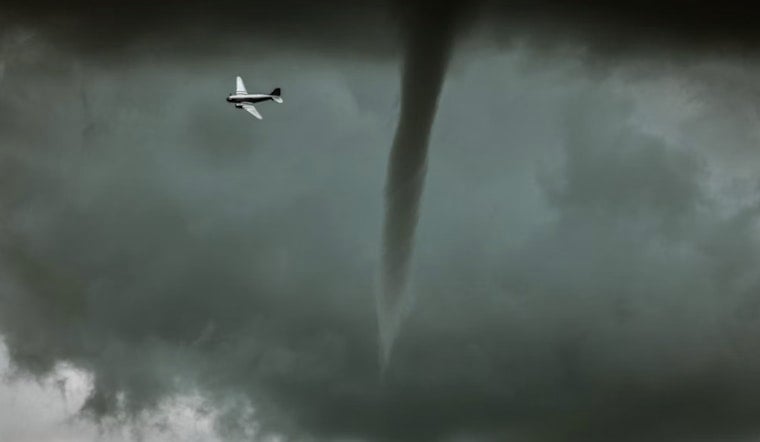
A family boat outing near St. Augustine's Salt Run took an unexpected turn Friday afternoon when Stephanie Warren and her five siblings spotted what appeared to be a waterspout forming just off the water. The group was out celebrating their mother Pamela Kaufman's 77th birthday when Warren noticed the rotating funnel and captured it on video, sharing the footage afterward with local station News4JAX.
Warren was not the only one who saw something spinning over the water that day. According to News4JAX, a viewer named Shannon separately captured a possible waterspout near the St. Augustine Historic District, submitting the image through the station's SnapJAX feature. Other viewers also reported seeing the potential waterspout and shared photos through the same crowdsourced tool.
How SnapJAX Helps Confirm Fast-Moving Weather
SnapJAX is the crowdsourced photo and video submission feature built into the News4JAX Weather Authority app, letting residents across Northeast Florida send real-time weather media straight to newsroom meteorologists. That kind of viewer-supplied documentation matters for events like this one, since crowdsourcing plays a key role in confirming transient coastal weather that often comes and goes before official instruments can catch it, per the News4JAX Weather Authority app listing.
Salt Run itself is a sheltered, 1,600-acre tidal lagoon tucked between Anastasia Island and Conch Island, adjacent to Anastasia State Park, according to the Florida Department of Environmental Protection. The narrow, protected waterway is a favorite for kayakers, paddleboarders, and recreational boaters during the summer months, which meant plenty of potential eyes on the sky Friday.
Fair-Weather Spin-Up or Something More Serious?
A waterspout is defined as a rotating column of air that makes contact with a body of water, distinct from a funnel cloud, which is a rotating column of air that never reaches the surface. The National Weather Service separates waterspouts into two categories: fair-weather waterspouts, which build upward from the water surface under developing cumulus clouds and account for roughly 85% of sightings, and tornadic waterspouts, which form downward from severe thunderstorms, according to the National Weather Service. It remains unclear which type formed near Salt Run on Friday.
Coastal Florida and the Florida Keys see the highest concentration of waterspouts in the country and among the highest anywhere in the world, with NOAA data showing that roughly 75% of reported Florida spouts occur during the wet season between May and September. National Weather Service Jacksonville meteorologists attribute many of the region's brief summertime funnel clouds to collisions between Atlantic sea breezes and inland thunderstorm boundaries, which can generate localized rotation without a full supercell thunderstorm developing.
What Happens if a Funnel Moves Toward Shore
Under National Weather Service protocols, forecasters issue a Special Marine Warning for a waterspout that stays over open water, but that warning automatically escalates to a full Tornado Warning if the funnel moves toward or touches land. Marine warnings are aimed at vessel operators, while tornado warnings trigger land-based sirens and indoor shelter advisories. It is unknown whether Friday's Salt Run sighting ever prompted such an escalation.
The National Weather Service also advises boaters who encounter a waterspout to steer at a 90-degree angle relative to the funnel's apparent motion rather than trying to outrun or approach it, since the spin can capsize small watercraft or throw off dangerous localized wind gusts. Statistically, most Florida waterspouts form during the afternoon, with 68% of observed sightings occurring between noon and 8 p.m. Eastern, according to National Weather Service historical storm records — a window that lines up with the timing of Friday's Salt Run report.
Recent History Shows Real Risk When Spouts Reach Land
St. Johns County has already seen what can happen when a waterspout does move onshore. In May 2025, a waterspout came ashore near Matanzas Avenue and destroyed a lifeguard tower, toll booths, and portable restrooms along the beach, according to a St. Johns County Marine Rescue post, forcing emergency crews to temporarily close lifeguard towers and clear debris from the sand. That same month, survey teams from National Weather Service Jacksonville confirmed a separate waterspout pushed onshore and strengthened into an EF-0 tornado with peak winds of 85 mph in northern St. Johns County, damaging homes and crossing Interstate 95 over a 1.6-mile path.
Whether Friday's Salt Run sighting reached that level of intensity, or ever touched land at all, is not addressed in the available reporting. What is clear is that late-summer Florida afternoons remain prime conditions for these sudden spin-ups, and Warren's family is only the latest to catch one on camera during an otherwise ordinary day on the water.





