

























































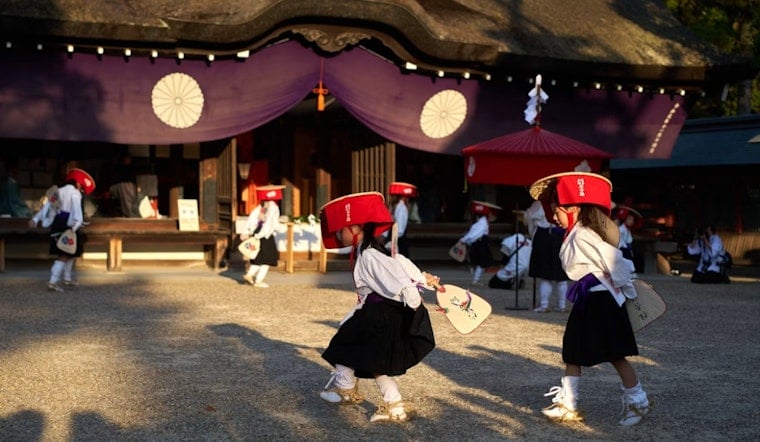
Taiko drums, open-to-everyone dancing and food trucks will fill the grounds of Cranbrook Japanese Garden in Bloomfield Hills on Saturday as the MI Bon Summer Festival returns to Oakland County for another year of free, family-friendly programming rooted in centuries-old Japanese tradition.
The festival runs from 2 p.m. to 8 p.m. tomorrow at the garden, according to ClickOnDetroit, with cultural booths exploring Japanese history and the customs of Obon rounding out the day alongside the drumming and dance. Festival co-creators Kyoko Johnson and Noriko Maidens joined Local 4 Live on Friday to talk through what visitors can expect, per the same report.
At the center of the celebration is Bon Odori, the dance ClickOnDetroit describes as being at the very heart of Obon. Per festival tradition, the dance originated in the late 1400s as an act of gratitude from a Buddhist monk after he freed his mother from suffering, and the outlet notes that the broader Japanese tradition behind it has brought families together every summer for more than 500 years.
An Ancient Ritual With Deep Local Roots
Obon itself is a Japanese festival rooted in Buddhist tradition that honors loved ones who have died, and it is believed to involve the spirits of the dead returning each summer to visit the living, according to the same ClickOnDetroit report. That spiritual core sits alongside a distinctly Michigan touch: in 2021, Johnson and Maidens composed “Michigan Ondo,” an original song and dance piece created specifically for the local festival that blends regional Michigan themes with traditional Japanese folk dance styles, according to the Cranbrook Center for Collections and Research.
The Great Lakes Taiko Center launched the first MI Bon Summer Festival on August 7, 2021, as a community project that initially limited attendance to members and guests because of COVID-19 precautions, the center's records show. It grew out of virtual and outdoor practice groups formed during the pandemic before expanding into the major public gathering it is today.
A Historic Garden Setting
The one-acre Cranbrook Japanese Garden, established in 1915 by Cranbrook founders George Gough Booth and Henry Wood Booth, is recognized as one of the oldest public Japanese-style strolling gardens in North America, centered on a lily pond connected to the River Rouge watershed. Its historic pedigree was reinforced in 2018, when Cranbrook received a restoration grant from Japan's Ministry of Land, Infrastructure, Transport and Tourism to begin a multi-phase rehabilitation led by Sadafumi Uchiyama, curator emeritus of the Portland Japanese Garden — Cranbrook was one of only six gardens worldwide selected for that grant that year, according to Michigan Gardener.
Attendance has climbed sharply in recent years, growing from roughly 500 visitors in 2023 to more than 800 attendees annually since, per the Cranbrook Center. Tickets remain free but require advance registration to help manage crowd capacity, the center notes.
Corporate and Community Support Behind the Scenes
The festival's central yagura tower, the structure around which Bon Odori dancers gather, is provided by Tokyo Rope Mfg. Co., Ltd. and draped in traditional red-and-white kōhaku maku cloth lent by the Japan Business Society of Detroit, the Cranbrook Center reports. Co-presenter Great Lakes Taiko Center, founded in 2009, is an arts and culture collective in Southeast Michigan dedicated to teaching and performing Japanese taiko drumming, and it supports several regional ensembles including Raion Taiko and Godaiko Drummers, according to Michigan Business.
Should weather force organizers indoors, the rain contingency site is the gymnasium at Brookside School Cranbrook — the historic building where the Japanese School of Detroit first opened to Metro Detroit families in 1973 with just 23 students before expanding across the region, according to the Japan America Society.
That deep institutional connection reflects Oakland County's broader ties to Japan. Surveys by the Consulate-General of Japan in Detroit report that the county is home to nearly half of Michigan's total Japanese national resident population, a concentration driven by long-standing Japanese automotive research and manufacturing facilities that have made Japan the county's top foreign investor nation. Festival exhibits and demonstrations are supported by a coalition of regional cultural groups, including the Japanese American Citizens League Detroit chapter, Ikebana International Detroit Chapter 85 and the Ann Arbor Bonsai Society, which the Cranbrook Center says host live pruning demonstrations, flower arranging and educational booths throughout the day.





