

























































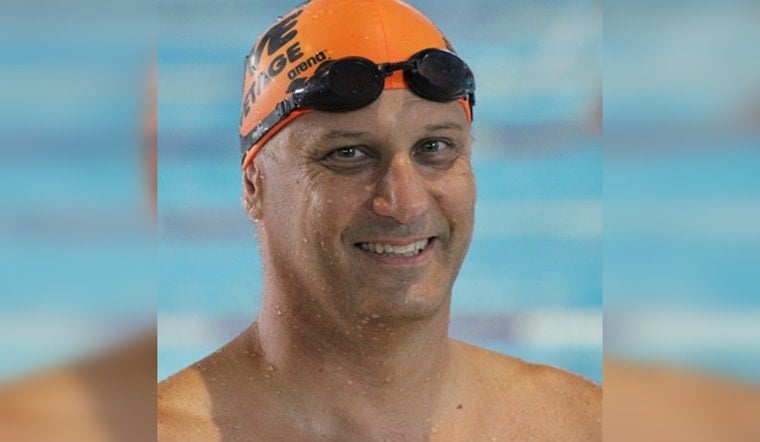
A 62-year-old marathon swimmer known in open-water circles as the King of Prison Island Swimming spent a recent outing stroking his way from four former Boston Harbor prisons to the mainland, fighting shoulder tendinitis so severe that by the final leg he said he could no longer turn his arms properly. Jacques Tuset swam from Deer Island, Peddocks Island, Georges Island, and Long Island, tracing routes past sites that once held Confederate prisoners of war, Italian POWs, and, centuries earlier, interned Native Americans.
Tuset has completed prison-island swims at 67 islands across six continents, according to The Boston Globe, which followed him through the Boston Harbor circuit. His resume includes four completed swims from Alcatraz, a crossing of the Strait of Gibraltar, a swim across the English Channel, a loop around Manhattan, and a swim with sharks off Devil's Island. He has also swum from islands tied to Al Capone and Nelson Mandela, who spent 18 years imprisoned on Robben Island, per the Globe's account. Tuset was accompanied on the Boston swims by his adult children, Lilou and William, while an escort vessel captained by John Forgione trailed him displaying a dive flag and caution sign.
Shoulder Pain and a Coyote Detour
The swim from Deer Island to Point Shirley in Winthrop covered 2.1 miles, a distance Tuset completed in under 40 minutes, the Globe reported. Deer Island's prison, demolished in 1992, once held roughly 1,500 inmates over more than a century of operation, according to the same account. The island's industrial transformation continued after the demolition, with the site becoming home to the Massachusetts Water Resources Authority's wastewater treatment plant, a $3.8 billion project that began primary operations in 1995 and now treats sewage for 43 Greater Boston communities, according to a local history account posted on LiveJournal. Before the plant existed, millions of gallons of raw sewage were discharged into the harbor daily, per the same account — a detail that underscores how far the water has come since Tuset's era of prison-island swimming began.
Conditions during the outing included water in the low 80s with smooth surf, though the harbor water itself measured 66 degrees, and Tuset described conditions overall as so-so, the Globe reported. He changed his entry point for the Long Island swim after encountering a coyote, according to the same account. Massachusetts Open Water Swimming Association officials enforced rules prohibiting any supporting contact with the swimmer throughout the outing — a standard the nonprofit sanctioning body has upheld since its founding in 2012 to train independent observers and enforce traditional open-water rules, per MOWSA.
Georges Island to Fort Warren's Dungeon
Tuset swam 0.9 miles from Georges Island to Hull High School, passing near Fort Warren, which held Confederate prisoners of war during the Civil War, the Globe reported. Built between 1833 and 1861, the fort held approximately 2,200 Confederate soldiers and officials, including Confederate Vice President Alexander H. Stephens, who was confined in a cell in the fort's dungeon in 1865 following the Confederacy's collapse, according to the Massachusetts Historical Society. Tuset also swam through Hull Gut, known for its strong current, and past the Boston police firing range on Moon Island, the Globe noted.
His swim from Peddocks Island covered 0.5 miles to the Nut Island fishing pier and took 21 minutes, according to the Globe's reporting. Peddocks Island's Fort Andrews operated as a World War II prisoner-of-war camp housing roughly 1,300 Italian POWs, who joined the Italian Service Units in 1944 after Italy's surrender to Allied forces and worked loading military cargo at Boston's port, according to the National Park Service.
A Final, Painful Push to Orchard Beach
The last leg, from Long Island to Orchard Beach in Quincy, spanned 1.8 miles. By that point, Tuset said his shoulders were really hurting and that he could not turn anymore, but quitting on the last leg was not an option, the Globe reported. He said he was really happy with the swim once it was finished, and added that he plans to keep swimming forever, according to the same account. Long Island itself carries its own layered history: Native Americans were forcibly interned there during King Philip's War in the 1670s, alongside similar internment on nearby Deer Island, where colonial authorities held between 500 and 1,100 Christianized Native Americans in the winter of 1675 to 1676, with hundreds dying from exposure and starvation, according to the National Park Service. Survivors were later released or sold into slavery in the West Indies, per the same source. Access to Long Island today remains restricted to boat travel after the City of Boston demolished its 3,450-foot bridge in October 2014 due to structural deterioration, an event that forced the emergency evacuation of a 450-bed homeless shelter and multiple drug treatment facilities on the island, according to CommonWealth Beacon.
Swimming for a Cure
Tuset began his prison-island swims in 1999 after friends had two children born with choroideremia, a rare genetic disease that causes blindness, the Globe reported. He uses the swims to raise money and awareness for vision loss research. Choroideremia is an X-linked retinal dystrophy affecting roughly 1 in 50,000 to 100,000 people, caused by mutations in the CHM gene that prevent production of Rab Escort Protein-1, leading to progressive cell death in the retina, according to MedlinePlus. The disease progresses from night blindness to tunnel vision, per the Globe's account, primarily affects males, and currently has no approved cure, according to MedlinePlus.
Tuset's standing in the sport was formally recognized in 2018, when he was inducted as an Honor Swimmer into the International Marathon Swimming Hall of Fame for his pioneering achievements in marathon swimming and prison-island swims, according to the Daily News of Open Water Swimming. He had completed dozens of marathon swims and channel crossings before ever attempting Boston Harbor, the outlet reported. His Boston outing also echoed a swim he once replicated under the same currents and time of night as the 1962 Alcatraz escape, and he has previously swum six hours without food off South Africa, according to the Globe.
The broader discipline Tuset has come to define, sometimes called the Triple Break challenge, was conceptualized by marathon swimming pioneer Ned Denison to encourage open-water swimmers to cross between famous island prisons such as Alcatraz, Robben Island, and Spike Island and the mainland, according to Openwaterpedia. Boston Harbor has its own century-old marathon swimming pedigree, home to the Boston Light Swim, an 8-mile race established in 1907 and recognized as the oldest open-water marathon swimming event in the United States, running from Little Brewster Island past several harbor islands to South Boston, per Openwaterpedia's entry on the race. Tuset's harbor outing, chronicled by Pulitzer Prize winner Stan Grossfeld for the Globe's As I See It photo column, turned four sites once defined by confinement into a single afternoon of hard-won, open-water freedom.





