

























































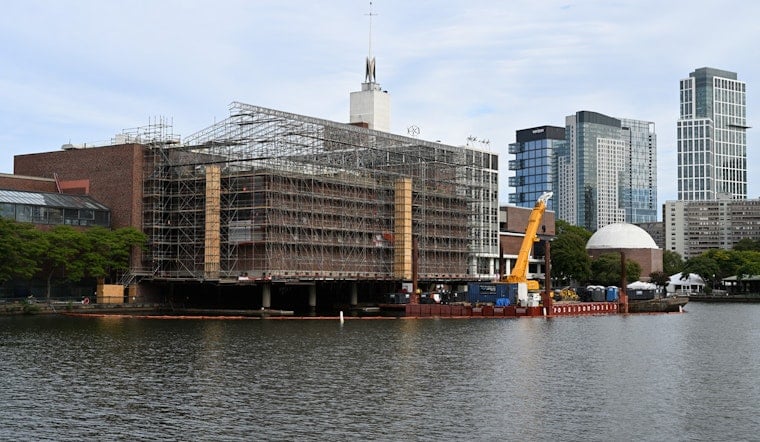
Boston's Museum of Science is tearing down the windowless brick walls of its 1960s Cahners Theater and replacing them with 40 feet of glass overlooking the Charles River. The William and Charlotte Bloomberg Public Science Common, a 10,000-square-foot performance and presentation space, opens to the public on October 10, and museum leaders are billing it as the institution's new centerpiece for engaging visitors with science and technology.
According to The Boston Globe, whose reporter James Sullivan got an early look at the space, the new wing offers a 270-degree view of downtown Boston and Cambridge institutions across the river. The double-skinned glass envelope replaces a theater that architecture firm LeMessurier describes as a windowless, brick-masonry box, and the transformation gives museumgoers sightlines to both skylines that flank the Charles River Dam, per LeMessurier.
Tim Ritchie, who has served as the museum's president since 2020, described the ambitions behind the project in stark terms, telling the Globe that “the intellectual capital of the world is around us” in a city he called likely the most science-rich in the history of the world. Ritchie also said the museum's mission is to be globally significant, and that “we owe people exposure to science at the pace that science is changing.” He added that the institution is, in his words, in the business of having people love and trust science.
A Room Built to Do Almost Anything
The space itself is designed for flexibility rather than a single use. It includes movable walls, LED video screens, and retractable seating, and can be configured to run two concurrent events at once, according to facts reported by the Globe. Evan Delgaudio, the museum's technical director, said simply that “the room is performing great.”
Architectural firm William Rawn Associates built in acoustic partitions and retractable seating that let the venue flex from roughly 300 to 700 guests, and the room is fully soundproofed, allowing it to host high-tech presentations, artistic performances, and public programming without interference between simultaneous events. The museum says it plans to present a wide range of public programming there, including shows of all kinds.
North America's First Deep Space Installation
Perhaps the wing's most technologically striking feature is its 3D projection mapping system known as Deep Space, developed by the Austrian company Ars Electronica. The Bloomberg wing marks the first installation of the Deep Space technology in the United States, combining 3D projection mapping, LiDAR tracking, and a spatial audio system into what Vivo Performing Arts describes as an interactive, multi-sensory environment. The wing also features advanced sound and lighting technology to support the system.
The Deep Space concept itself dates back to January 1, 2009, when it debuted at the Ars Electronica Center in Linz, Austria, and has since expanded to sites including Singapore, Sinaloa, and Pristina, according to Ars Electronica. Boston's installation now joins that international network as its first foothold in North America.
Bloomberg's Roots in Medford and a Family Legacy
The wing is named in honor of Mike Bloomberg's parents, William and Charlotte, and Bloomberg Philanthropies donated $155 million toward the renovation. It is not the first time the Bloomberg family name has been attached to the museum: in 2016, Mike Bloomberg donated $50 million to establish the William and Charlotte Bloomberg Science Education Center, and he also helped fund a renovation of the museum's Hayden Planetarium in 2011.
Bloomberg's connection to the museum traces back to his childhood in nearby Medford, Massachusetts, where he attended free Saturday morning science lectures at the institution, according to Bloomberg Philanthropies. Bloomberg has cited those youthful visits as a catalyst for his inquisitive mind. He is expected to attend the museum's celebration of the new wing on October 28, a date the museum has designated as a day of celebration.
Built Over an Active Dam, Engineered for Carbon Neutrality
Because the museum spans the Charles River Dam between Boston and Cambridge, construction crews couldn't rely on typical land-based access. Builders instead used interior gantry cranes and barge-based material delivery to get equipment and supplies to the site, a logistical challenge tied to the museum's unusual perch over an active waterway.
Structural engineering firm LeMessurier designed the wing's roof using a hybrid of steel girders and cross-laminated timber decking topped with solar arrays, a choice meant to advance the museum's commitment to reach carbon neutrality by 2035. State finance authority MassDevelopment issued a public notice in May regarding up to $7 million in conduit bond financing to help cover final equipment and construction costs for the project.
Part of a Broader Pivot
The Public Science Common will also serve as the operational headquarters for three newly launched initiatives — the Center for Life Sciences, the Center for the Environment, and the Center for Space Sciences — tying the physical renovation directly to the museum's educational programming. The museum, which addresses fields including artificial intelligence, robotics, bioengineering, and human genome sequencing, traces its own history back to 1830, when it was established as the Boston Society of Natural History. It opened at its current riverside location in 1951 and took on its familiar name in 1939.
The Bloomberg gift arrives amid a broader wave of megadonor investment in American science museums. Kenneth C. Griffin donated $125 million to Chicago's Museum of Science and Industry in 2019, a gift that led that institution to change its name in his honor. Boston's Museum of Science first announced plans for the Public Science Common project back in 2024, when Hoodline reported on groundbreaking plans to replace the Cahners Theater with the new interactive wing. Two years later, that vision is set to open its doors on October 10.





