

























































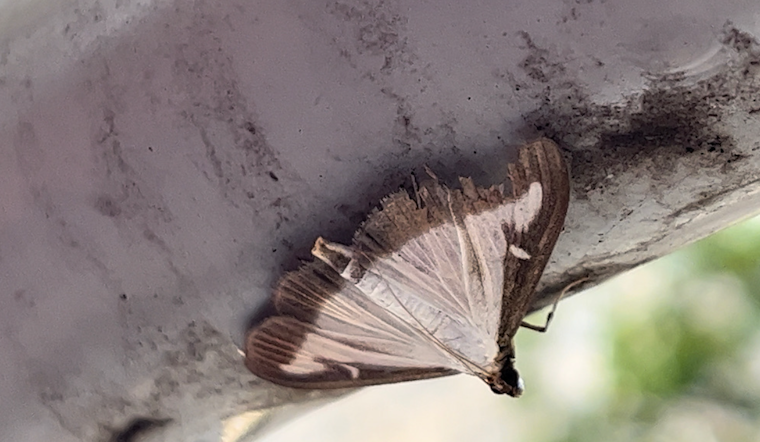
A caterpillar capable of killing a boxwood hedge in as little as one or two months has spread across Maryland, Virginia, and Delaware, prompting quarantines in as many as eight Maryland counties alone and putting homeowners across the mid-Atlantic on alert. The box tree moth, an invasive pest native to East Asia, has already forced regulators to restrict plant shipments out of infested areas, and entomologists say the insect is nowhere near finished spreading.
Maryland has quarantined six to eight counties to date, according to WTOP, which reports that agriculture officials in the state confirmed the moth in Caroline, Cecil and Queen Anne's counties after previously quarantining Allegany, Frederick, Garrett and Washington counties. Kent County was added to the list because of its proximity to already affected areas and to Delaware, where the pest has also taken hold. Virginia declared its own quarantine covering Clarke and Frederick counties and the city of Winchester, and the box tree moth has now been spotted in Maryland, Virginia and Delaware alike, the outlet reports.
Entomologist Mike Raupp told the station that the box tree moth is spreading very rapidly and that it can leave declared quarantine zones despite the restrictions meant to contain it. He recommended that homeowners examine their boxwood plants frequently and said they should inspect their shrubs immediately, since boxwoods are common throughout residential landscaping across the region and have no preventive treatment available before an infestation takes hold, per the same report.
How the Moth Kills a Hedge So Fast
The pest's lethal trick is a two-stage attack. Once caterpillars have eaten all the leaves on a boxwood, mature larvae strip and feed on the outer bark of the stems, girdling the branches, according to USDA APHIS. That bark-stripping is what turns a green shrub into a dead one, and WTOP reports that infested plants can become completely dead within just one or two months.
Females complicate the timeline further: they lay egg clusters of 5 to 30 on the undersides of leaves, and in warmer climates like Virginia's, the pest can produce up to five overlapping generations in a single year, according to the Virginia Department of Agriculture and Consumer Services. That rapid reproduction leaves homeowners only a short window to intervene before populations explode within a single growing season.
Spotting the Difference Between a Moth and a Fungus
Identifying an infestation correctly matters, because the damage can look similar to a common fungal problem. Box tree moth larvae can be identified by silk webbing and dark green caterpillars marked with black and yellow stripes, per WTOP, and browning in a boxwood's canopy can be an early indicator of the pest's presence. The Piedmont Master Gardeners note that the distinction from fungal boxwood blight is that blight causes leaves to drop entirely, while box tree moth caterpillars instead leave skeletonized leaf midribs clinging to stems alongside silken webbing and fecal frass — misidentifying the two can lead homeowners toward ineffective chemical treatments.
The good news is that light infestations caught early are often treatable with caterpillar-targeting insecticides, including the biological control Bacillus thuringiensis, or Bt, according to WTOP. Early detection can allow homeowners to save infested boxwood plants before the bark-girdling stage sets in, while heavily infested shrubs may ultimately need to be removed and destroyed altogether.
Why Quarantines Alone Cannot Stop the Spread
Containment is difficult by design, since box tree moths are strong fliers. Adults can disperse naturally across a radius of 3 to 6 miles per year, and under favorable conditions, natural flights have occasionally covered up to 20 miles, according to the University of Georgia Extension. Human transport of infested nursery stock remains the primary driver of long-distance spread, which is why quarantine zones restrict the movement of boxwoods and related plant material in the first place, per WTOP.
The regional pattern bears that out. Delaware agriculture officials first confirmed the moth in Kent County in July 2024 and documented its spread across the county border into New Castle County by September 2025, according to the State of Delaware. Virginia's own intrastate quarantine, declared in Clarke and Frederick counties and the city of Winchester, was followed by a federal quarantine that USDA APHIS established on March 31, 2026, restricting interstate movement of boxwood plants from those same areas — though compliance agreements still allow certified nurseries to ship under strict inspection and treatment protocols.
What's at Stake for the Region's Landscapes
The economic exposure is significant. Boxwood sales total roughly $140.9 million annually nationwide, making it the top-selling broadleaf evergreen ornamental shrub in the U.S. nursery industry, according to research published in APS Journals. Boxwoods are also woven into some of the region's most recognizable landscapes, including Mount Vernon, Dumbarton Oaks and the National Arboretum, per WTOP's report.
Maryland officials are urging residents to double-bag the remains of severely infested plants and place them in the trash rather than compost or discard them loosely, WTOP reports. If boxwoods are stripped bare, the caterpillars have been documented turning to secondary landscape species such as burning bush and holly once their preferred host is exhausted, according to New Jersey's Department of Agriculture, which confirmed its own infestation in Cape May County in June to protect the state's $9.8 million boxwood nursery and landscape industry. Homeowners who suspect box tree moths on their property should report findings to their state's agriculture department, whether in Virginia or Maryland, according to WTOP. Hoodline previously reported on a similar defoliation crisis hitting Cincinnati hedges this spring, underscoring how far the pest has already traveled beyond the mid-Atlantic.





