

























































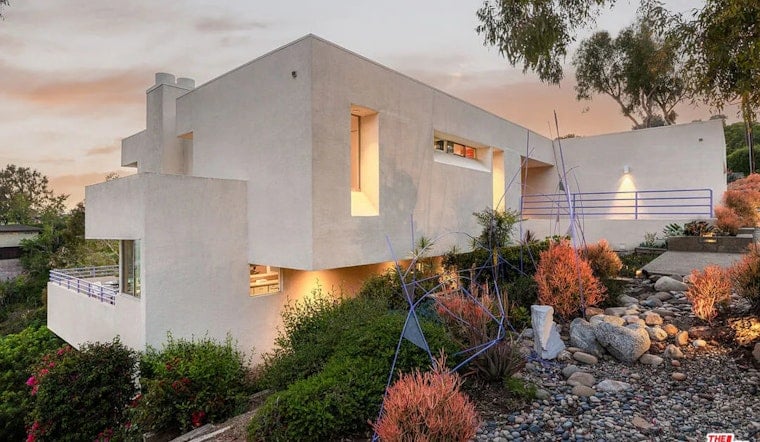
A rare piece of Southern California Late Modernism has hit the Brentwood market for $3.75 million — a 1978 passive-solar home that architect Martin Gelber designed for himself, lived in for four decades, and never returned to after the 2019 Getty Fire forced him and his wife to flee in the middle of the night. The 3,700-square-foot residence at 12268 Canna Road sits in the Crestwood Hills enclave, and its listing marks the closing chapter of a story that stretches from Gelber's early training under modernist master A. Quincy Jones to his widow's decision, years later, that she could no longer live in the house they had rebuilt together.
Gelber, who was born in North Hollywood and later admitted to USC's architecture school, designed the home around passive solar principles long before that kind of environmental thinking was standard practice, according to Cultured Magazine. Skylights were used to exhaust warm air, deep exterior fins were built to temper the western sun, and the home's orientation was designed to capture breezes — all reducing the need for air conditioning, per the same account. The design was significant enough that it became the first home in California to receive a federal energy tax credit for passive solar design, a designation made possible under the Energy Tax Act of 1978, according to a Zillow listing for the property.
The home's two-level layout centers on public spaces set beneath a custom 18-foot Clear Heart Redwood ceiling, with an oculus-lit staircase, floor-to-ceiling glass walls, two fireplaces, a bar, and wraparound decks looking out over canyon, city, and Pacific Ocean views, according to Sotheby's International Realty. Architect John Lautner praised the residence in 1984, per Cultured Magazine's reporting, and the interiors were furnished with pieces by Charles and Ray Eames, Marcel Breuer, and Mies van der Rohe. Gelber maintained a studio under the same roof, and his wife, Dr. Michela Gelber, a psychiatrist, met with patients in the home's office.
A Home Built for a Modernist Life
Gelber forged professional relationships with Richard Neutra and Gregory Ain and worked in A. Quincy Jones's office before designing his own home, a lineage that connects the property directly to the architects who founded Crestwood Hills itself. The neighborhood began in the late 1940s as the Mutual Housing Association, a postwar cooperative experiment started by four returning veterans and musicians who hired Jones, architect Whitney R. Smith, and engineer Edgardo Contini to build a utopian modern hillside community, according to the Crestwood Hills Association. Gelber believed architecture should enrich the joy and drama of living, and that a house could be functional, ecological, and beautiful at once, per Cultured Magazine.
That philosophy played out socially as well as architecturally — Martin and Michela Gelber hosted parties at the home attended by up to 200 people, according to the same report. Gelber's professional standing extended well beyond his own residence. He served as president of the Los Angeles chapter of the American Institute of Architects in 1984, was elevated to AIA Fellow in 1996, and co-founded the AIA|LA Masters of Architecture lecture series at LACMA with architect Bernard Zimmerman in 1999, according to his obituary. He also taught at Los Angeles Pierce College for 45 years and, decades before LEED certification existed, curated the 1964 exhibition Project Environment USA to educate the public on architecture's environmental impact.
Wildfire's Long Shadow Over Crestwood Hills
Fire has repeatedly reshaped this hillside community. Nearly 50 of the neighborhood's original A. Quincy Jones-designed cooperative homes were destroyed in the November 1961 Bel-Air/Brentwood Fire, according to Wikipedia, making surviving examples of the era's modernism increasingly rare. Fire returned to the area in October 2019, when the Getty Fire — sparked by a tree branch blowing onto DWP power lines along the 405 Freeway — burned 745 acres, destroyed 12 homes, damaged five others, and forced the mandatory evacuation of more than 7,000 residences, according to the Los Angeles Times.
The Gelbers' home was among the properties damaged in that fire, and the couple was forced to evacuate in the middle of the night. Martin Gelber's health declined sharply afterward, and he died on December 2, 2019, at age 82, according to his obituary. Michela Gelber undertook a painstaking restoration of the residence, rebuilding every detail to its original form, per Cultured Magazine's account. But after the work was finished, she decided she could not move back into the home she and her husband had shared for so long — a decision that now leads to the property's sale.
A Late Modern Legacy on the Market
The listing describes the roughly 17,227-square-foot, or 0.396-acre, lot as home to a four-bedroom, three-bathroom residence with an unfinished basement, according to Zillow's listing. Real estate marketing from MBGF AIA frames the home as an intact example of Southern California Late Modernism, a category made scarcer by decades of hillside fires in the Santa Monica Mountains. For architecture enthusiasts and preservationists, the sale represents a rare chance to own a fully restored, historically certified piece of 1970s design — one built by a man who spent his career arguing that houses could be both environmentally responsible and full of life.
Gelber's other notable residential work includes the 1973 Dr. Melvin Schapiro House in Encino, a 4,000-square-foot three-pavilion home built around a prominent oak tree, which earned him a 20-plus-year design award from the San Fernando Valley chapter of the AIA in 1994, according to the Los Angeles Times. With the Canna Road listing now active at $3.75 million, the Brentwood home stands as perhaps the fullest expression of the ideas Gelber spent his career refining — and a reminder, in a neighborhood shaped twice by fire, of how fragile that legacy can be.





