

























































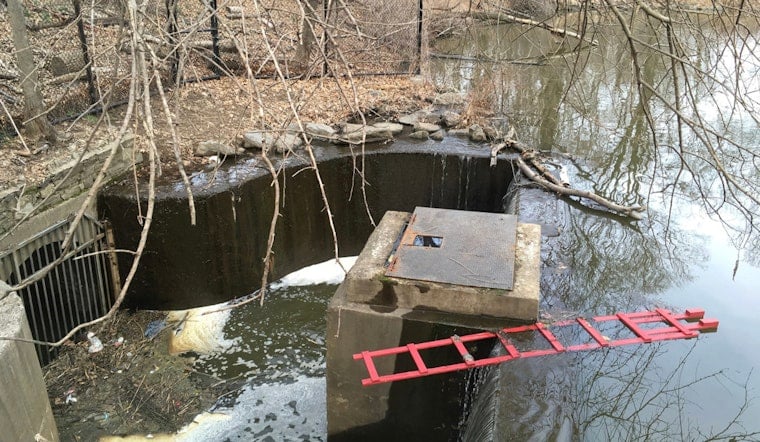
Construction crews are set to break ground this fall on a project that will pull a Bronx stream out from beneath more than a century of concrete, sending Tibbetts Brook back into daylight for the first time since 1912. The New York City Department of Environmental Protection awarded a $149.5 million construction contract in June for the daylighting effort, one of the largest single green infrastructure investments the city has ever made.
The stream, which now runs largely unseen through a storm drain beneath Van Cortlandt Park and the surrounding streets, was dammed in the 18th century to form the park's lake and then buried in a concrete sewer culvert in 1912 as development pushed north through the Bronx, according to research from the University of Michigan School for Environment and Sustainability. Eric Sanderson, a landscape ecologist who maps how the city's landscape has changed over time, told Bloomberg that the buried stream is mostly channeled into the storm drain today, a workaround that leaves rainwater with nowhere natural to go.
“Rainwater still has to go somewhere,” Sanderson said, per Bloomberg's report. That reality became painfully clear in 2021, when the remnants of Hurricane Ida drenched parts of the northeastern United States and dumped rain at a record hourly rate nearly double what the old sewer system was designed to handle, according to Bloomberg. The resulting flooding left cars submerged under five feet of water on the nearby Major Deegan Expressway in the Bronx.
A Century in the Pipes, A Plan Since the 1990s
The push to free Tibbetts Brook did not start with Ida. Local civic organizations, including the Bronx Council for Environmental Quality and the Van Cortlandt Park Alliance, have advocated for daylighting the stream since the late 1990s, according to the Bronx Times. The proposal was folded into the Van Cortlandt Park Master Plan in 2014 before city agencies formally adopted it into green infrastructure planning in 2018, the outlet reports.
Turning that decades-old advocacy into an actual construction contract required the city to first secure the land. In June 2024, New York City completed an $11.2 million purchase of an abandoned railroad corridor from freight carrier CSX Transportation, acquiring the property needed to unearth the stream after years of negotiation between the city and the railroad, according to NYC Parks. The project will divert the waterway into a new manmade stream channel instead of routing it through the city's sewer system, per Bloomberg's reporting.
Getting the water all the way to the Harlem River required one more piece of the puzzle. The Metropolitan Transportation Authority finalized a permanent easement in June allowing a 28,632-square-foot underground conduit beneath Metro-North Railroad property, resolving what NYC DEP describes as the last major right-of-way hurdle between Van Cortlandt Park and the river outfall.
Millions of Gallons Diverted From the Sewer System
The stakes go beyond a single flooded expressway. On dry days, Tibbetts Brook currently dumps an estimated 4 million to 5 million gallons of clean freshwater daily into the municipal sewer system, where it gets piped unnecessarily to the Wards Island Wastewater Resource Recovery Facility for treatment, NYC DEP data shows. Diverting the brook out of that network is projected to cut combined sewer overflows into the Harlem River by 220 million to 228 million gallons annually, according to NYC Parks.
Those overflows happen because heavy cloudbursts currently force raw sewage and stormwater directly into local waterways once the city's combined sewers exceed capacity, per the Van Cortlandt Park Alliance. Removing the brook's daily volume from that system is meant to buy the aging pipes breathing room during the next major storm.
A New Greenway Alongside the Water
The daylighting work will also reshape the land above it. The project includes a new linear park built along the acquired rail bed, extending the Putnam Greenway and connecting Van Cortlandt Park to the 750-mile Empire State Trail, according to NYC Parks. The new multi-use path is expected to close a long-standing gap in the regional pedestrian and cycling network near West 230th Street.
State money has helped push the project across the finish line. Governor Kathy Hochul awarded a $10 million State Green Resiliency Grant to the effort in October 2024, funded by the 2022 Clean Water, Clean Air, and Green Jobs Environmental Bond Act, according to the Riverdale Press. Nearly $27 million of a $60 million statewide grant allocation went toward New York City resilience initiatives overall, the paper reported.
Bloomberg's Fola Akinnibi frames the Tibbetts Brook project as a test case for how cities adapt to a changing climate, moving away from the assumption that buried pipes alone can handle whatever storms arrive next. Similar Bond Act funding is backing comparable work elsewhere in the region, including efforts to reopen East Blind Brook in Westchester's flood mitigation push to expand natural floodplain storage.
For Bronx residents who have watched Broadway and the Major Deegan flood repeatedly in recent years, the payoff of unearthing a stream buried since 1912 will not be visible until fall, when construction is expected to begin in earnest.



