

























































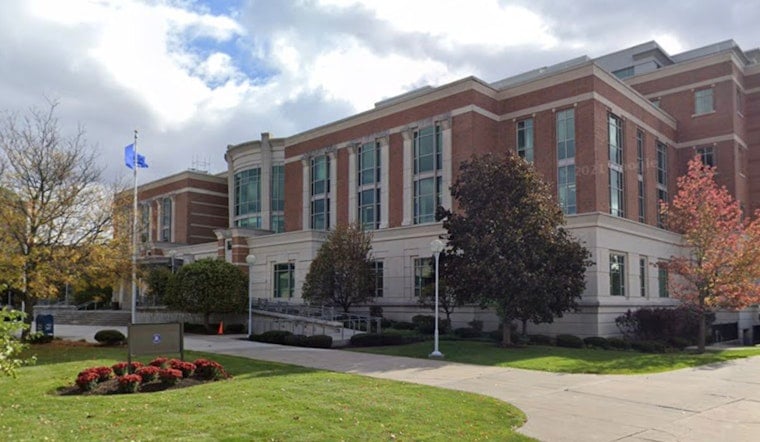
A 39-year-old Bronx woman accused of walking into a Wethersfield bank and fraudulently withdrawing $3,500 nearly two years ago was extradited from New York on Tuesday to face a string of felony charges. Precious Mills was transported to Wethersfield police headquarters after waiving extradition, and she was scheduled to be presented at New Britain Superior Court on Wednesday.
According to Newport Dispatch, Wethersfield police began investigating Mills after receiving information from the Glastonbury Police Department, which had arrested her for a similar incident in Glastonbury on December 6, 2024. That same day, the Wethersfield Police Department’s detective bureau determined that Mills had made a fraudulent withdrawal from the M&T Bank branch in town, according to police information cited in the report.
The bank sits at 1310 Silas Deane Highway, a stretch of Route 99 that serves as Wethersfield’s main commercial corridor and runs roughly five miles west of Glastonbury across the Connecticut River, according to M&T Bank. The two towns’ proximity along that corridor helps explain how the same suspect could allegedly strike both locations in a single day before authorities connected the cases.
From Rikers Island to a Connecticut Courtroom
The case sat until the New York Port Authority Police Department notified Wethersfield police on August 7 that Mills was in its custody and would be incarcerated at Rikers Island, per the same account. She was taken into custody there and, on Tuesday, waived extradition rather than wait for a formal governor’s warrant.
Under the Uniform Criminal Extradition Act adopted by both Connecticut and New York, an out-of-state detainee can sign a written waiver before a judge to consent to direct transfer, a process that requires judicial advisement of constitutional rights, according to Justia. New Britain Superior Court granted full extradition, clearing the way for Wethersfield police to take custody of Mills directly.
Once back in Connecticut, Mills was charged with larceny in the third degree, two counts of forgery in the second degree, two counts of identity theft in the third degree, and two counts of criminal impersonation. She was held on $10,000 bond.
What the Charges Could Mean
The larceny charge alone is a Class D felony under Connecticut General Statutes Section 53a-124, carrying a maximum sentence of five years in prison and a fine of up to $5,000, since the alleged theft falls in the $2,000-to-$10,000 range, per Justia. Each forgery count under Section 53a-139 carries the same potential five-year, $5,000 exposure, as does each identity theft count under Section 53a-129d.
The two criminal impersonation counts are lesser Class A misdemeanors under Section 53a-130, each punishable by up to one year in jail and a $1,000 fine, according to Justia. Taken together, the stacked charges give prosecutors significant leverage even though the underlying withdrawal totaled $3,500. First-time non-violent offenders facing Class D felonies in Connecticut can sometimes apply for Accelerated Rehabilitation, a pretrial diversionary program that suspends prosecution and can lead to dismissal upon successful completion, though it remains unclear whether Mills would qualify or seek that route.
A Broader Pattern of Identity Fraud
Investigators have not said publicly whether Mills acted alone or as part of a larger identity theft operation, nor how the credentials used in the alleged scheme were obtained. The case lands amid a stretch of elevated identity fraud risk in Connecticut, which ranked fourth highest nationwide for reported identity theft incidents per capita in 2023, according to Federal Trade Commission data cited by ConsumerAffairs.
Nationally, bank fraud complaints made up 114,608 of the reports submitted to the FTC’s Consumer Sentinel Network in 2024, per WalletHub. Fueling that trend, 3,158 data breaches occurred nationwide that same year, according to Identity Theft Resource Center figures reported by AARP, exposing the kind of consumer financial credentials that can later surface in physical bank fraud schemes.
Wethersfield’s coordination with the Glastonbury Police Department, New York’s Port Authority Police Department, and New York correctional authorities underscores how far a local bank case can stretch once a suspect crosses state lines. Hoodline previously covered a multi-state chase involving a Wethersfield resident, another example of the town’s police department working across the Connecticut-New York border on criminal cases.





