

























































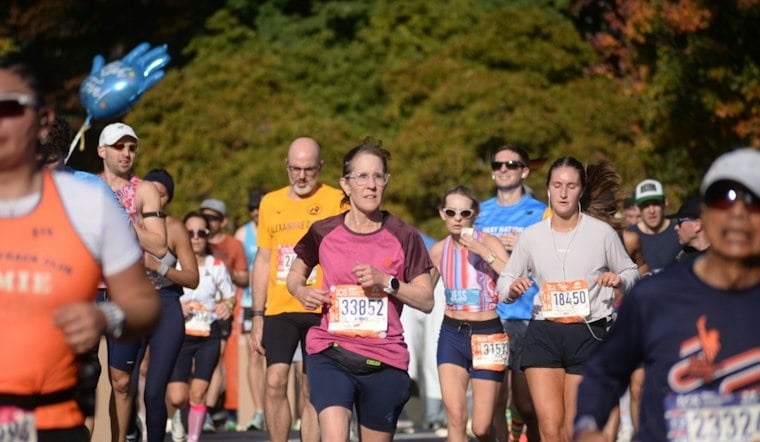
Rachel Apa was two miles from the finish line of her first marathon when she collapsed near Mile 24 in Central Park, close to 85th Street. The 24-year-old, a former Division I field hockey player at Bucknell University, had trained for months for the 26.2-mile course through New York City. Hours later, she was dead.
According to The New York Times, Apa’s father, Steve Apa, said the cause of death was rhabdomyolysis, a rare muscle condition that can be brought on by exertion. He described his daughter’s death as “unfathomable,” and told the paper she had been in “perfect health, perfect shape” heading into the race. Rhabdomyolysis occurs when muscle tissue breaks down and disintegrates, a condition the Cleveland Clinic says affects roughly 26,000 people in the United States each year, according to the New York Post.
Apa had set out to complete the marathon as part of the Parkinson’s Champions team, running in honor of her late grandfather, who died in 2022 after battling the disease. She had said her grandfather was her role model and that he had encouraged her to stay active and embrace challenges, the Post reported.
A Day of Texts Between Father and Daughter
Steve Apa tracked his daughter’s progress through the marathon’s tracking app and texted her encouragement throughout the race, the Post reported. At Mile 18, Rachel texted back a single word: “Ow.” By Mile 19, her reply was “Ow ow.” When she reached Mile 23, her father sent her a text reading “final stretch.”
Her mother, Michelle Apa, had captured her daughter smiling and running at Mile 14 in Queens earlier that day, the Times reported. Michelle was waiting for Rachel at Mile 25 — a mile she would never reach. Instead, Rachel collapsed in Central Park, and a spectator identified by the Post as hospital social worker Michaela Nicholas ran to assist her. Apa received CPR at the scene before being rushed to Mount Sinai, according to the Post. Steve Apa said his daughter died that night, at 9:40 p.m.
Medical Resources Along the Marathon Route
New York Road Runners, which organizes the marathon, says it works closely with CrowdRx, the FDNY Emergency Medical Services, SeniorCare EMS and medical volunteers to staff the course, according to the organization's runner health and safety guidance. The group stations medical personnel at the start, the finish, and at every mile marker from Mile 3 onward, and it offers water and Gatorade at fluid stations along most of the course. NYRR also tells runners who feel weak or unwell not to feel compelled to finish the race.
Apa’s collapse was not the only serious medical episode along the course that day. Police said a 44-year-old man suffered a medical episode near Fifth Avenue and East 90th Street, also close to the marathon’s 24th mile, around 2 p.m., as reported by Patch. That runner was taken to NewYork-Presbyterian/Weill Cornell Medical Center and remained in critical condition, per the outlet's report.
How Rare Are Marathon Medical Emergencies?
Serious medical events during long-distance races are statistically uncommon but not unheard of. NYRR Medical Director Matt Friedman has said one in every 50,000 runners at a half or full marathon will suffer a serious cardiac event, and that 65% of those events occur in the race’s final quarter, according to the Brooklyn Paper. That outlet also reported that two runners have died during or immediately after the RBC Brooklyn Half Marathon since 2022, including 32-year-old David Reichman, who died from a suspected cardiac arrest just past the finish line, and 31-year-old Charles Rogers, who suffered cardiac arrest around Mile 8 and died at Maimonides Medical Center despite lifesaving efforts. The Brooklyn Paper noted that an ECMO machine was stationed at the finish line of the 2025 TCS New York City Marathon but was not used.
This year’s race, held Sunday, drew around 60,000 runners at the start and finished with 61,146 total finishers, according to the Post, which reported that New York Road Runners said the event broke the world record for largest marathon for the third consecutive year. Sweden’s Andreas Almgren won the men’s race in 2:06:01, while Kenya’s Sheila Chepkirui, 35, won the women’s race for the second time, finishing in 2:24:36 after also winning in 2024. The men’s marathon world record remains 2:04:58, set by Ethiopia’s Tamirat Tola in 2023. Fans lined 1st Avenue in Manhattan to cheer runners through the course. The Post reported that the marathon had not recorded a death since 2024 before Apa’s collapse this year.



