

























































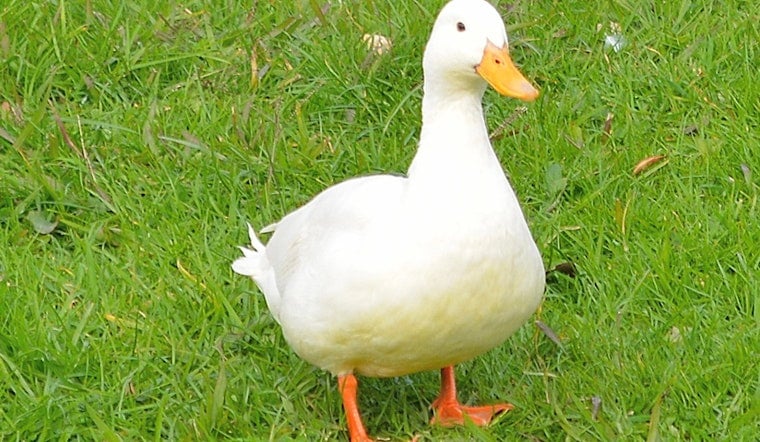
Barley the golden retriever had been sluggish and mopey for months, sapped by the very medication that stopped her seizures, when a four-day-old duckling named Louie waddled into her family's Brookhaven backyard and, somehow, brought her back to life. Today the two are virtually inseparable, wrestling, chasing each other, and napping together in a friendship that has turned into a viral sensation for the Cannarelli family of Suffolk County, New York.
Barley was diagnosed with canine epilepsy in February 2024 at age 5 after a series of seizures, according to The Washington Post. The anti-seizure medication the Cannarelli family put her on stopped the seizures, but it left her severely lethargic, according to CBS News, whose correspondent Steve Hartman reported on the story. Owner Tori Cannarelli said the once-active dog started sleeping constantly, losing what the family describes as her personality and her spunk.
Louie's own story began with a Facebook post. An elementary school teacher on Long Island was looking to rehome two ducklings hatched in a classroom, one of which had died on its first night, and Justin Cannarelli responded in May 2024, according to the same Washington Post report. Justin, who owns a local garden center, initially sought a duck to keep there rather than in his home. Tori Cannarelli has said she never expected to own a duck, let alone for him to become a long-term member of the household, per CBS News.
A Bond That Overrides Instinct
Golden retrievers are bred to retrieve waterfowl, which typically means dogs view birds as prey rather than playmates. But canine behaviorists note that dogs can override that instinct through early, positive exposure that builds gentle social bonds with domestic birds, according to PetGuide. That appears to be exactly what happened between Barley and Louie, who built a friendship that now includes play-chasing, wrestling, and relaxing side by side, with Louie occasionally pecking at his much larger companion.
The family says Barley gradually regained her personality and her smile as the bond with Louie deepened. Justin and Tori Cannarelli's two children, Cameron and Charlie, have watched the friendship unfold at home, and Cameron has theorized that Barley effectively stretched her own joy by befriending the duck, according to CBS News. The Cannarellis documented the relationship on the Instagram account @duckandadog, launched in August 2024, which had grown to more than 200,000 followers by July 2026 as clips of the pair playing racked up millions of views, according to the International Business Times.
Why the Side Effects Happen
The lethargy Barley experienced is a well-documented consequence of the drugs used to control seizures in dogs. Anti-epileptic medications such as phenobarbital, imepitoin, and levetiracetam frequently cause sedation, lethargy, loss of coordination, and mood changes while a dog's brain adjusts to suppressed neurological activity, according to VCA Animal Hospitals. Veterinary behavior research has separately found that social and environmental enrichment, including bonds with companion animals, can help counter apathy and stress in chronically medicated pets without interfering with necessary treatment, per Veterinary Partner.
Barley's medication continues to control her seizures, and her bond with Louie has not changed that treatment, only her demeanor while on it. The Cannarellis' experience lines up with what that research describes: a non-pharmacological source of stimulation that seemed to lift a medicated dog's mood without any change to her prescription.
A Duck With Deep Long Island Roots
There's a regional echo to Louie's arrival that goes back more than 150 years. American Pekin ducks were first brought to Long Island in 1873, founding a commercial farming industry that once produced more than seven million ducks annually in Suffolk County, according to Modern Farmer. Brookhaven itself sits in that same Suffolk County landscape, where suburban residential properties still border what used to be agricultural land.
Louie's path into the Cannarelli household also touches a more contemporary, less settled debate. Classroom hatching projects like the one that produced Louie have drawn scrutiny from New York state lawmakers, who have repeatedly introduced legislation such as Assembly Bill A142 to ban live animal hatching in public schools over animal welfare concerns, according to the New York City Bar Association. Animal rescue organizations on Long Island have noted that these programs often end with domestic ducklings abandoned in local waterways or brought to municipal shelters that aren't equipped for waterfowl, according to Humane Long Island, since Pekin ducks cannot fly or survive in the wild if left unadopted.
Louie avoided that fate because a teacher sought a home for him and a garden center owner said yes. What started as a short-term plan for the garden center became a permanent spot in the family home, and eventually a friendship with a golden retriever that neither Cannarelli anticipated when they brought him through the door.




.jpg)