

























































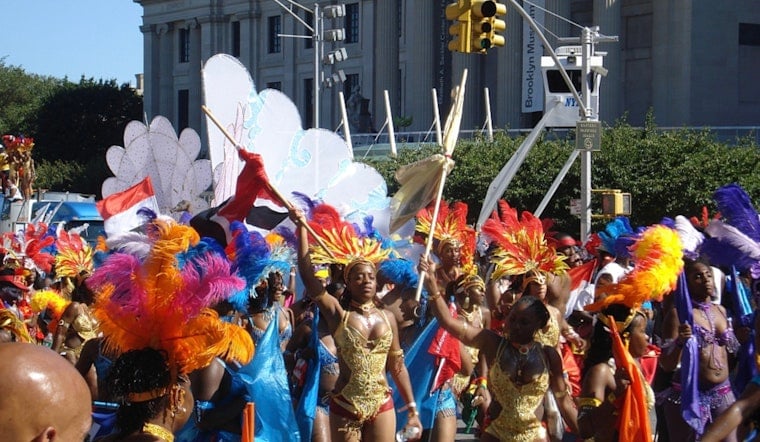
Brooklyn's Caribbean community is once again preparing to take over Eastern Parkway, as the West Indian Day Parade is expected to return to Crown Heights on Labor Day, September 7, 2026. The parade is one of New York City's largest annual celebrations, and this year's edition arrives at the tail end of a full week of Carnival festivities that kick off September 3.
As of August 28, the West Indian American Day Carnival Association had not yet posted the official 2026 start time, parade route, or street-closure plan, according to FOX 5 New York. The station reports it will update its coverage once organizers and city officials release that timing, route, transit, and security information. Traditionally, though, the parade travels along Eastern Parkway through Crown Heights toward Grand Army Plaza, and public transit is likely to remain the easiest way to reach the parade area once this year's closure plan is finalized, per the same report.
The scale of what's coming is hard to overstate. New York City officials estimate the parade and its accompanying Carnival events draw between 1 million and 1.5 million spectators and participants to Central Brooklyn over Labor Day weekend, according to NYC.gov, with attendees traveling in from Canada, Europe, and across the Caribbean. Then-NYC State Assembly Member Brian Cunningham said in 2023 that the parade nets roughly $300 million in annual economic revenue for the city, generated through hotel bookings, food vendors, flag sales, and regional travel, making it one of the largest economic parade events in North America, per CBS News.
From Harlem Costume Parties to Eastern Parkway
The parade's roots trace back to Caribbean Carnival costume parties Jessie Wardell and friends held in Harlem in the 1930s, the earliest known street activity following in the 1940s, per FOX 5 New York's account of the West Indian American Day Carnival Association's history. After city officials revoked Harlem's Carnival street permit in 1964 following a disturbance, Trinidadian organizer Carlos Lezama, who became president of the organization in 1967, helped secure a permit five years later, in 1969, to permanently relocate the celebration to Eastern Parkway in Brooklyn, according to CUNY NYCdata. Lezama went on to lead the organization for decades. FOX 5 New York's report separately credits Rufus Goring, according to WIADCA, with bringing Carnival to Brooklyn in the 1960s.
That Brooklyn home makes cultural sense given who lives there now. Data from the NYC Department of City Planning shows foreign-born Caribbean residents account for more than 35 percent of the population in neighborhoods like Crown Heights and East Flatbush, establishing Central Brooklyn as the natural cultural center for the celebration.
J'Ouvert's Pre-Dawn Rituals and the Week's Lineup
Before the parade itself, the pre-dawn J'Ouvert festival covers revelers in paint, powder, oil, and mud, a tradition that evolved from 19th-century Trinidadian Canboulay post-emancipation harvest celebrations, according to The World from PRX. Canboulay merged Afro-Creole drumming and dancing with European pre-Lenten carnival customs after emancipation in 1838, and the ritual's symbolism of liberation and ancestral rebirth still anchors Carnival day today.
This year's Carnival week, which the West Indian American Day Carnival Association hosts in the run-up to the parade, begins September 3 with Blocko Mania at the Brooklyn Museum from 7 p.m. to 1 a.m., FOX 5 New York reports. The SOCA Fest music festival follows at the same venue on September 4, running from 8 p.m. to 3 a.m. On September 5, the Junior Carnival Parade is set to meet at St. John's Place and Kingston Avenue at 9 a.m., while Youth Fest and Junior Carnival events take place at the Brooklyn Museum that same day.
Panorama's Steel Pans and the Mas Bands Behind the Costumes
Also on September 5, gates open at 6 p.m. for the New York Panorama, the annual steel-pan competition that WIADCA calls the largest of its kind in North America. The competition, which begins at 7 p.m. and is separate from the Labor Day parade itself, brings together steel bands competing for the title of champion, according to FOX 5 New York's rundown of the schedule.
The parade's signature costumed performers, known as mas, short for masquerade, refer to bands and performers wearing elaborate outfits built from feathers, fabric, and beadwork, with roots in carnival traditions shaped by African folklore, emancipation celebrations, and Caribbean cultural expression. But that tradition faces real economic strain: participation among registered mas bands fell from 35 in 2017 to just 18 in 2024, according to Documented, driven by escalating costume material costs and operational challenges that have made it harder for local mas camps to engage younger generations in traditional band design. East Flatbush-based nonprofit Sesame Flyers International, which has operated since 1983 and reaches more than 5,000 local residents annually through youth programming, runs one of the major mas camps still handcrafting sequined and feathered costumes, per City Lore.
A Bigger Security Footprint Along the Route
The celebration's growth has come with an equally massive law enforcement presence. According to NYPD statements reported by Newsday, the police detail assigned to J'Ouvert and the parade is the department's largest security deployment of the year, exceeding what's assigned for New Year's Eve in Times Square or the Fourth of July. Recent years' operations have relied on 13 designated security entry checkpoints with handheld metal-detector wands, skywatch surveillance cameras, and aerial drone monitoring, security measures that have intensified in response to past isolated shootings near Eastern Parkway.
Those safety concerns aren't hypothetical for Brooklyn. Hoodline previously reported on a shooting that wounded six along Eastern Parkway during last year's parade, and on a 10-year sentence for a 2023 shooting tied to the celebration. This year, organizers and city officials have yet to release the security plan that will govern how those checkpoints and surveillance measures are deployed along the 2026 route.
New Single-Nation Parades Join the Tradition
The traditional multi-nation parade now shares the Central Brooklyn calendar with newer, single-nation celebrations. Earlier this month, Hoodline covered Brooklyn's first-ever Jamaica Rising Day Parade, and days later reported on the city's first Trinidad and Tobago Independence Parade in Flatbush, part of a broader trend of single-nation Caribbean diaspora marches emerging alongside the historic Eastern Parkway procession. The Brooklyn Museum also hosted a 5,000-person indoor Caribbean Carnival kickoff event earlier this month, ahead of the full slate of Carnival week programming.
For now, the exact route, start time, and street closures for the September 7 parade remain unconfirmed, with FOX 5 New York noting it will update its reporting once WIADCA and city officials finalize those details. What's certain is that Eastern Parkway will once again become the center of gravity for Caribbean New York, drawing crowds that organizers and city planners alike describe as among the largest of any annual event in the five boroughs.




