

























































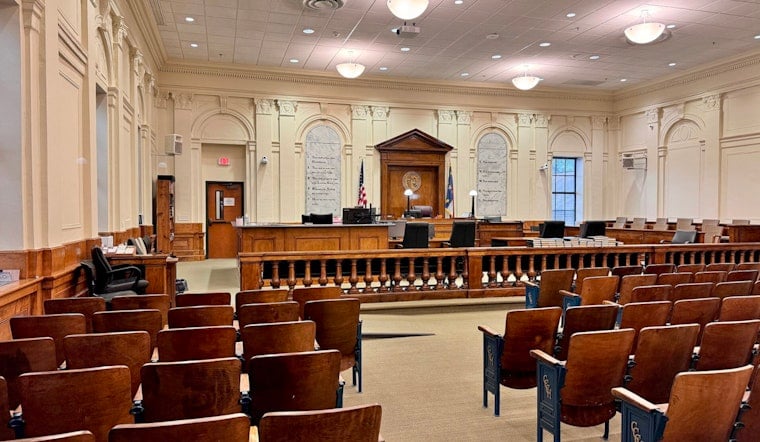
A young man accused of running what prosecutors described as a warehouse of sorts in Brooklyn, stocked with 2,000 pounds of marijuana, two kilos of cocaine, and a ghost gun, walked out of a Manhattan federal courthouse Thursday on a $250,000 unsecured bond. He will now live with his father in Queens while the case moves forward, under conditions that bar him from opening new bank accounts without approval from pre-trial services.
The bail fight played out in the U.S. District Court for the Southern District of New York's Magistrates Court, where the case, formally known as USA v. Knorr, landed before Magistrate Judge Moses, according to Inner City Press. The outlet, which covered the hearing directly, reported that the defendant came to the United States from France in 2008 and told the court he works for a windows company. An assistant U.S. attorney argued that his money created a risk of flight, pointing to his having been seen driving a Ferrari between Manhattan and Brooklyn.
Prosecutors said the young man bought the Ferrari by trading in a Maybach along with cash, according to the same report, and Judge Moses noted that a pre-trial services report indicated he also rents out luxury cars. The judge ultimately described the flight-risk argument as either speculation or common sense, before releasing him on the unsecured bond. The case carries docket number 1:26-mj-3520.
What an Unsecured Bond Actually Means
The $250,000 figure attached to the release has led some to assume the defendant handed over a small fortune to walk free, but that is not how the arrangement works. Under 18 U.S.C. § 3142(c), a federal magistrate judge can order an unsecured bond that allows a defendant to leave custody without posting any cash or collateral upfront, with the money only coming due if he fails to appear in court or violates the conditions of his release, court procedure explains.
That distinction matters because of the scale of the case against him. Under federal law, possessing with intent to distribute 1,000 kilograms or more of marijuana, a threshold the 2,000-pound allegation clears, triggers a mandatory minimum of 10 years in prison, up to life, under 21 U.S.C. § 841(b)(1)(A)(vii). The two kilos of cocaine alleged in the case separately exceed the 500-gram threshold that triggers its own five-year mandatory minimum under federal drug statutes.
Ghost Gun Adds Separate Mandatory Prison Time
The ghost gun recovered in the case carries its own legal weight. Under 18 U.S.C. § 924(c), possessing a firearm in furtherance of a federal drug trafficking crime carries a mandatory minimum five-year sentence that must run consecutively, not concurrently, with any sentence for the underlying narcotics charges.
Taken together, that statutory exposure is significant enough that the Bail Reform Act, under 18 U.S.C. § 3142(e), creates a rebuttable presumption that no set of release conditions can reasonably assure a defendant's appearance in court or the safety of the community once drug charges carry a potential 10-year-or-more sentence. That presumption helps explain why prosecutors pushed back against release and why the judge's decision has been characterized as a close call. Federal Rule of Criminal Procedure 5 requires that anyone arrested on federal charges receive an initial appearance before a magistrate judge without unnecessary delay, which is the posture that brought the case before Judge Moses in the first place.
Part of a Broader Pattern in Brooklyn
Large unlicensed marijuana operations have repeatedly surfaced in the borough even though New York legalized recreational cannabis in 2021. Just last October, federal and city law enforcement raided seven luxury condominium units in Dyker Heights, seizing nearly 1,000 pounds of illegal marijuana, $500,000 in cash, two illegal firearms, and five vehicles — a bust Hoodline previously covered when it led to six arrests and a child placed in ACS care.
Statewide, the New York State Office of Cannabis Management and local enforcement divisions have executed nearly 2,000 inspections and seized more than $125 million in illicit cannabis products as of the 2024-2025 enforcement period. In New York City specifically, the joint Operation Padlock to Protect task force sealed more than 1,000 illegal cannabis locations and confiscated over $68 million in illicit product during its first year of operations through mid-2025, according to figures reported by the city.
Ghost guns like the one found in this case have also become a recurring target for investigators. City officials have reported that law enforcement agencies seized more than 1,400 untraceable ghost guns between 2022 and early 2026 as part of citywide anti-gun initiatives, underscoring why weapons without serial numbers draw heightened scrutiny once they turn up alongside major narcotics stashes.
It remains unclear whether prosecutors will seek to appeal the release order to a U.S. District Judge or whether a grand jury will hand up a formal indictment adding an explicit § 924(c) firearm charge. For now, the defendant is set to remain with his father in Queens under pre-trial supervision as the case against him proceeds through the Southern District of New York.





