

























































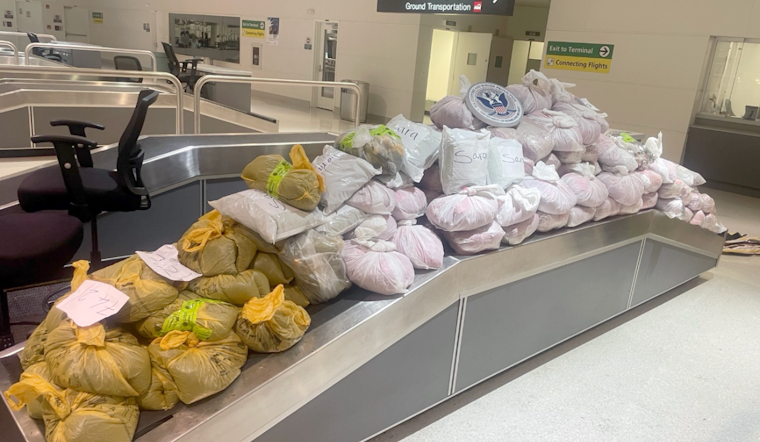
Customs officers at Baltimore/Washington International Thurgood Marshall Airport pulled off two major drug interdictions in the span of two days, seizing more than 1,250 pounds of khat, a plant-based stimulant, in incidents that began with an abandoned duffel bag and ended with a pair of travelers hauling a dozen suitcases stuffed with the leafy substance. Neither traveler has been criminally charged, though both were questioned and released pending further investigation.
The saga started on August 11, when U.S. Customs and Border Protection officers discovered five duffel bags left behind at a baggage carousel following a flight from London, according to WBFF. Inside, officers found what appeared to be a large quantity of tea leaves, which field tests later identified as khat, or catha edulis. The five bags contained 412 pounds, 4 ounces of the plant, and officials were unsuccessful in contacting the traveler directly or through the airline. A sixth bag connected to the same shipment arrived on August 12, adding another 81 pounds of khat and pushing that first haul to more than 400 pounds total. Baggage tags eventually allowed officials to identify the traveler tied to the shipment, though CBP did not name that individual, and the earlier shipment carried an estimated value of $50,000.
A Second, Larger Load Arrives Two Days Later
Just two days after the first bags turned up, on August 13, two U.S. citizens from New York arrived at BWI on a flight from London, according to U.S. Customs and Border Protection. The pair was referred to secondary inspection, where officers discovered each traveler was carrying six soft-sided suitcases filled with khat. Combined, the 12 suitcases held 846 pounds, 9 ounces of the drug, with an estimated street value of approximately $100,000. Between the two incidents, the seizures amounted to more than 1,250 pounds of khat moving through BWI in a matter of days.
CBP did not identify the two travelers from New York, and both were released pending an investigation rather than facing immediate charges. The agency has not said whether the two incidents are connected beyond both originating on London flights, and it remains unclear whether federal prosecutors intend to pursue formal charges once lab results and any broader investigation conclude.
Why Smugglers Even Try This
CBP Baltimore Area Port Director Adam Rottman said that while agents routinely encounter substantial amounts of khat hidden in commercial freight, attempting to move more than 800 pounds of it inside passenger baggage is unusual and doesn't offer smugglers a higher rate of success. The agency's own operational guidance notes that travelers abandon luggage on carousels for a range of reasons — rushing for a connecting flight, wrongly assuming a bag will transfer automatically, or spotting customs officers and deliberately putting distance between themselves and the contraband.
London's role as a transit hub for flights out of East Africa helps explain why both BWI-bound khat shipments originated there, since khat is primarily grown in East Africa and the Arabian Peninsula. Khat leaves are commonly chewed for their stimulant effects, and the plant, also known as Abyssinian tea or African salad, can also be dried and boiled into tea. It carries an amphetamine-like effect on users, and health authorities warn its toxicity can trigger severe blood pressure spikes, rapid heart rate, delusions, paranoia, difficulty breathing, and long-term exhaustion, according to CBS News. The World Health Organization formally classified khat as a drug of abuse in 1980, citing its potential for physical and psychological dependence.
The Legal Gray Zone Behind the Charges
The legal case against khat smuggling hinges on chemistry as much as weight. Under the Controlled Substances Act, cathinone — the compound found in freshly harvested khat leaves — is a Schedule I controlled substance, but it begins breaking down into cathine, a Schedule IV stimulant, roughly 48 hours after the plant is harvested. That rapid degradation makes fast field testing and lab confirmation critical for federal prosecutors building a case, which may help explain why neither traveler has yet been formally charged.
Nationally, the BWI seizures are a small slice of a much larger enforcement effort. CBP officers and agents seized approximately 46,000 pounds of khat nationwide during fiscal year 2025, and nearly 19,000 pounds more across the first nine months of fiscal year 2026. Just weeks earlier, on June 4, CBP officers at Washington Dulles International Airport seized 139 pounds of Ethiopian khat hidden inside an air cargo shipment of mixed spices bound for Sacramento, California, according to ABC10. The largest known khat bust in recent memory dwarfs both BWI incidents combined: in 2020, CBP officers and Coast Guard personnel in Seattle seized 10 tons of khat falsely labeled as tea inside a shipping container from Kenya.
CBP says it will continue to seize khat and other dangerous drugs when encountered, and that it will work with law enforcement partners to hold smugglers accountable. The agency's statement echoes its posture following an earlier BWI bust in April, when officers intercepted 247 pounds of marijuana headed the opposite direction toward London — a reminder that outbound drug seizures at the airport are far from rare.





