

























































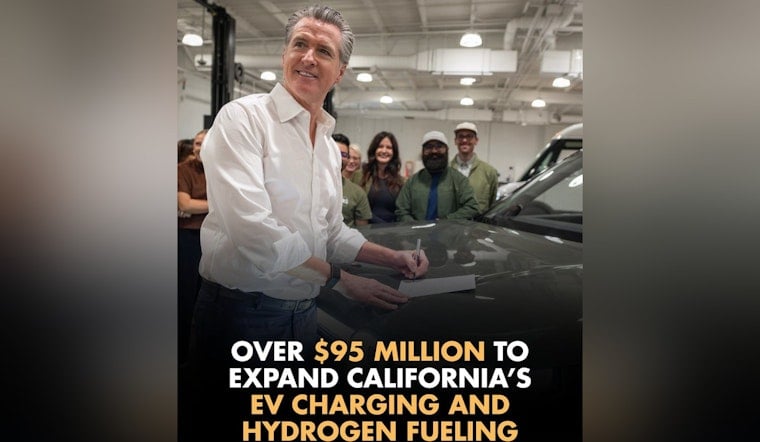
California is putting another $95.2 million toward zero-emission vehicle infrastructure, funding new EV charging stations, hydrogen refueling sites, and workforce training programs for cars, trucks, and buses across the state. Governor Gavin Newsom announced the plan Tuesday after the California Energy Commission approved it, timed to a moment when the state's electric vehicle sales are climbing even as its long-troubled hydrogen fueling network keeps losing ground.
The plan targets light-, medium-, and heavy-duty vehicles, with state officials projecting additional allocations running through the 2028–2029 fiscal year, according to the Office of Governor Gavin Newsom. The state agency CalEPA framed the investment as central to its mission to restore, protect and enhance the environment while ensuring public health and economic vitality, posting on social media that California is “taking the wheel instead of abandoning its future economy” by continuing to build out zero-emission vehicle infrastructure.
Charging Network Keeps Expanding Statewide
California has already installed more than 216,455 publicly accessible and shared private EV charging ports, alongside 68 operational hydrogen refueling stations statewide, according to data tracked by Veloz in partnership with the state. That buildout is happening alongside strong consumer demand: Californians bought 86,857 new zero-emission vehicles in the second quarter of 2026 — 75,597 battery electrics, 11,179 plug-in hybrids, and just 81 hydrogen fuel-cell vehicles — accounting for 19.1% of all new light-duty vehicle sales in the state, per the California Energy Commission.
That growth comes even as national EV sales have remained largely flat at around 5.8% following changes to federal tax credits. To keep pushing adoption, California introduced the $270 million “MyFirstEV” incentive program this month, pairing $135.5 million in state funding with automaker matching to offer first-time buyers point-of-sale discounts of $3,500 on new EVs and $1,750 on used ones, priced up to $50,000 and administered by the California Air Resources Board.
Regulatory Deadlines Are Driving the Buildout
The state's charging expansion is unfolding against a hard legal backdrop. Under the California Air Resources Board's Advanced Clean Cars II regulations, 100% of new light-duty passenger cars, pickup trucks, and SUVs sold in California must be zero-emission by 2035, with mandatory annual quotas that already require 35% zero-emission models for the current model year. A separate Advanced Clean Fleets rule requires state and local government fleets — including agencies like Caltrans, which manages more than 12,000 fleet vehicles — to make 50% of new vehicle purchases zero-emission starting in 2024, rising to 100% by 2027, a mandate Hoodline detailed in its coverage of Caltrans's fleet electrification earlier this year.
California reached 2.5 million cumulative zero-emission vehicle sales in 2025, supported by an estimated 800,000 residential EV chargers installed in private homes, according to the California Energy Commission — a milestone that expanded cumulative ZEV sales by more than 300% between 2019 and 2025. Since 2008, the commission's Clean Transportation Program, formerly the Alternative and Renewable Fuel and Vehicle Technology Program, has awarded more than $2.7 billion in grants for clean transportation infrastructure and workforce training, investing up to $100 million annually.
Hydrogen's Uphill Economics
Not every part of the state's zero-emission push is scaling at the same pace. Fuel cell passenger vehicles represented less than 0.1% of all zero-emission vehicle sales in the second quarter of 2026, and hydrogen fuel for light-duty vehicles now costs roughly four times more than gasoline per mile, according to the Los Angeles Times. That cost gap has pushed several fuel producers to shift their focus away from passenger vehicles and toward the power generation sector instead, more than two decades after the state first set out to build a statewide “hydrogen highway” under then-Governor Arnold Schwarzenegger in 2004.
The tension raises questions among analysts and industry advocates about whether state funding should continue flowing toward hydrogen refueling systems or concentrate more heavily on battery electric networks, per the same Times report. Separate from the state's direct grants, the California Electric Vehicle Infrastructure Project, administered by the Center for Sustainable Energy, has reserved and issued more than $196 million in incentives, funding over 8,600 public charging ports across all 58 California counties, with a heavy focus on Level 2 and direct-current fast chargers in low-income and disadvantaged communities.
The new $95.2 million plan builds on a pattern of large state investments in transportation infrastructure, including the $5 billion transportation overhaul California announced last year emphasizing sustainability and job creation. Whether hydrogen keeps its place in that funding mix, or cedes ground to battery electric charging, remains an open question as the state races toward its 2035 zero-emission sales mandate.


