

























































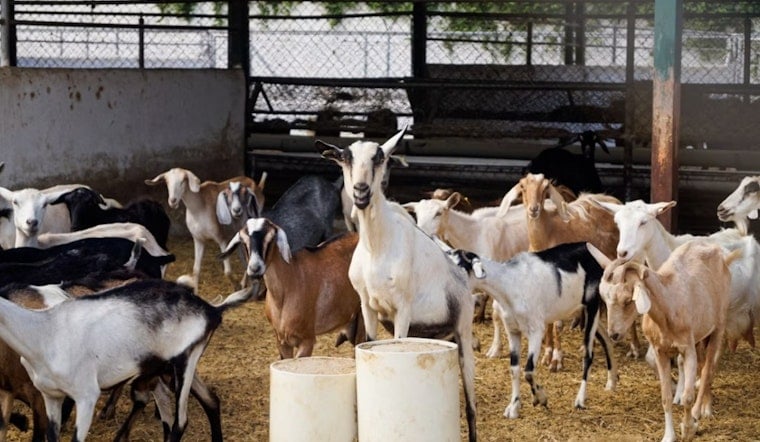
California’s goats have been quietly doing the dirty work of wildfire prevention, chewing through brush, grass and even prickly starthistle. But after a temporary wage provision expired July 1, goat-grazing companies say the cost of keeping a herder on call could jump from roughly $4,938 a month to about $20,000, putting a popular fire-mitigation tool in a serious bind.
The stakes are bigger than a few ranching companies’ payrolls. Targeted grazing is increasingly used in vineyards, orchards, solar farms, parks and communities near the wildland-urban interface, and the state’s SB 143 study says at least 20% of California’s 500,000 sheep and 125,000 goats are involved in that work, with the share rising.
The timing is unusually tight. Under the 2026 legislative calendar, lawmakers return Monday from summer recess, and the final deadline for passing bills is Aug. 31.
According to The Sacramento Bee, the California Wool Growers Association has hired a lobbyist to seek another change when lawmakers reconvene. Operators are hoping the political pressure generated before the August session can persuade legislators to restore wage parity for goat and sheep herders before businesses start selling animals or abandoning contracts.
How A Temporary Fix Became A Six-Figure Problem
California has long allowed range herders who live with animals and remain on call around the clock to receive a special monthly wage instead of being paid as if every hour were a standard hourly shift. The SB 143 text temporarily extended that arrangement to goat herders after state officials determined in 2022 that the existing provision applied only to sheep herders.
That temporary extension expired July 1, 2026. Without a new law, goat herders fall under the general wage and overtime rules rather than the special monthly system, a legal switch that can make the economics of a 24-hour, seven-day-a-week job look more like a payroll nightmare than a grazing contract.
The state’s wage chart lists the 2026 alternative minimum at $3,004.50 in regular monthly pay plus $1,933.71 in required overtime, for a total of $4,938.21. A recent analysis in California Agriculture estimated that applying standard hourly rules to an on-call goat herder could push the minimum toward $20,000 per month, or roughly $240,000 a year.
Ranchers Say The Math Could Empty The Herds
For companies already dealing with transportation, housing, food, equipment and visa expenses, the potential increase is not an abstract labor-policy debate. The Sacramento Bee reported that Tim Arrowsmith, owner of Western Grazers in Red Bluff, said he could be forced to sell his goats by the end of 2026 if lawmakers do not act.
Andrée Soares, president of Star Creek Land Stewards and a third-generation rancher, told the newspaper that the future of her grazing business is uncertain. Other operators say they may switch from goats to sheep, reduce the number of animals they keep or leave the vegetation-management business altogether.
Goats are not interchangeable with sheep in every field. Goats eat a broader range of plants, including starthistle after it becomes prickly, while sheep are more likely to target the weed during its earlier growth stages.
The Worker-Protection Question Is Still In The Pen
The state study found that ranchers and worker advocates disagree sharply about what should happen next. Ranchers want the alternative monthly wage reduced, while advocates argue that workers who are effectively on duty around the clock should not lose overtime protections.
The report also found that most H-2A herders are men from Peru and Mexico, and that more than 90% of California’s sheep and goat herders work under the temporary visa program. Enforcement agencies found relatively few reported violations, but worker advocates told researchers that herders may be reluctant to complain because they depend on employers for their jobs and immigration status.
That tension is the heart of the policy fight: How can California keep a vulnerable, isolated workforce from being underpaid without making a wildfire-prevention industry financially impossible? The study says stakeholders agreed that sheep and goat herders do similar and overlapping work, but lawmakers still have to turn that consensus into a permanent rule.
Why Fire Officials Are Watching The Capitol
California’s wildfire strategy has increasingly embraced prescribed and targeted grazing as one tool for reducing combustible vegetation. The state’s grazing guidance describes livestock treatment as an increasingly recognized way to manage high fuel loads, while a 2026 state wildfire project in San Diego County includes 300 grazing goats.
For now, the goats are still working and the political clock is running. California’s lawmakers have a narrow August window to decide whether the state’s fire-eating herds get a permanent wage structure, another temporary reprieve or a future that is considerably less bleat and considerably more brush.





