

























































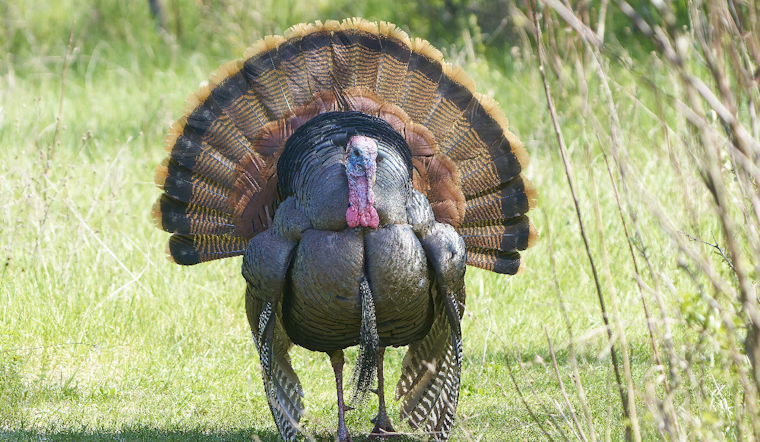
Residents of Cambria have been jolted awake by the same strange culprit again and again this summer: wild turkeys. PG&E has confirmed that the birds, which have taken to perching on power lines and roosting in trees close to them, caused at least six short early-morning power outages in the small Central Coast town since mid-July. Each outage has lasted roughly an hour, disrupting homes, businesses, and people who depend on medical equipment.
The pattern has become familiar enough that Cambria residents can practically set a clock by it, according to The Sacramento Bee, which first reported on the recurring blackouts. PG&E has said an animal made contact with a power line and triggered the recent outages, and PG&E spokesperson Stephanie Magallon confirmed there had been six outages since July and that wild turkeys caused them. She urged residents to have patience while the utility worked to address the problem.
Local flocks appear to be getting bigger, and the birds seem drawn to power infrastructure at the worst possible moments. The outages have consistently struck around daylight, a detail that lines up with turkey behavior: recently fledged young birds may have insufficient distance judgment to avoid power lines, and when a flock takes off, their wings can cause the lines to swing and contact one another.
Why a Few Seconds of Bird Contact Means an Hour Without Power
The outages are brief in cause but long in consequence because of the safety technology PG&E relies on to prevent wildfires. The utility's Enhanced Powerline Safety Settings are designed to detect hazards caused by contact between power lines, animals, or tree branches, and they shut off power within one-tenth of a second of detecting a problem. PG&E evaluates wildfire risk every day to determine when those enhanced settings should be switched on.
That speed comes at a cost for restoration time. Utility technicians are required to physically patrol an entire powerline circuit before restoring service after one of these fast-trip outages, according to PG&E. That mandatory patrol process, meant to ensure no hidden fire hazard or physical damage remains on the line, is why a momentary bird strike can leave an entire neighborhood dark for roughly an hour rather than a few seconds.
The program itself has a track record of reducing fire risk. PG&E first piloted the Enhanced Powerline Safety Settings in 2021 across 11,500 miles of high-fire-risk distribution lines and recorded a 65 percent reduction in powerline-related ignitions on enabled circuits by 2024, per the California Public Utilities Commission. The tradeoff is outages like the ones now plaguing Cambria, where the fire-prevention benefit and the inconvenience of frequent, if short, blackouts collide.
Not Cambria's First Turkey-Related Outage
Cambria's turkeys have a history with the power grid. According to The Cambrian, a flying turkey hit a power line and caused an outage in the town in September 2021. Wild turkeys knocking out electricity is not unique to the Central Coast, either — in March 1986, a flying flock struck a 12,000-volt PG&E line near Cottonwood in Shasta County, cutting power to 2,000 residents, according to the Los Angeles Times. Bird collisions remain a significant nationwide issue, ranking as the second-leading animal cause of power outages in the U.S. and triggering 2,506 recorded public outages in 2023.
PG&E crews have already taken one engineering step to address the problem in Cambria, increasing the spacing between power lines to prevent bird-caused contact, per a PG&E statement issued earlier this month. That kind of fix echoes broader industry standards set by the Avian Power Line Interaction Committee, which establishes line-spacing adjustments, perch guards, and equipment insulation meant to protect birds while keeping the grid reliable, according to the U.S. Fish and Wildlife Service.
A Population Problem Bigger Than Any Single Wire
Part of what makes Cambria's situation persistent is the birds themselves. Wild turkeys are not native to California; the state's population of more than 250,000 birds traces back to reintroduction programs run between 1959 and 1999, when wildlife managers released thousands of non-native Rio Grande wild turkeys at more than 200 locations to establish hunting opportunities. A native prehistoric turkey species, Meleagris californica, went extinct in California roughly 10,000 years ago, with fossils preserved at the La Brea Tar Pits — a reminder that today's flocks are a modern, human-engineered presence rather than a holdover from the past.
That modern presence has only grown more concentrated near Cambria homes. In February, California Department of Fish and Wildlife officials warned the Cambria Community Services District board that residents feeding local wildlife were artificially swelling wild turkey and deer populations and escalating human-animal conflicts, according to Citizen Portal. Supplemental feeding tends to alter natural foraging behavior and keeps large birds concentrated near homes and overhead utility lines, precisely the dynamic now playing out along Cambria's power grid.
Under state law, wild turkeys are classified as an upland game bird, with regulated fall and spring hunting seasons open to licensed sportspeople holding valid upland game validations from the California Department of Fish and Wildlife. That legal framework offers one avenue for managing turkey numbers, but it does little to resolve the immediate conflict between backyard bird feeding and the sensitive safety settings PG&E now relies on to prevent wildfires. For now, Cambria residents are left waiting out roughly hour-long outages whenever the local flock decides to make its move.





