

























































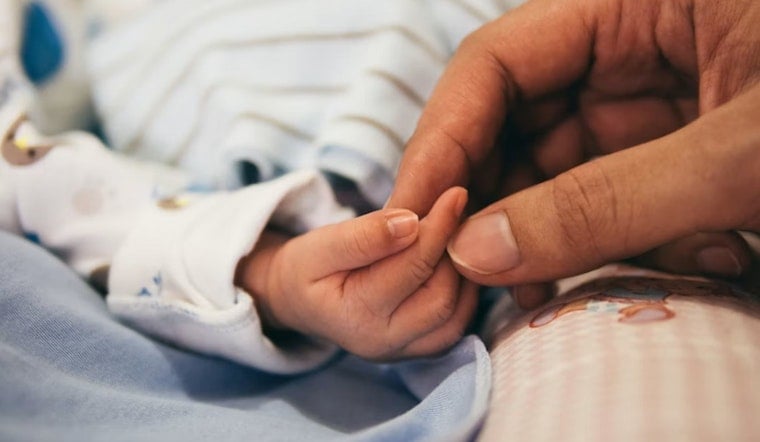
Doctors told the family of Delaney Holian, an infant in a Carlsbad Navy household, that she might survive only 48 hours after birth. Eight months later, she is still here — laughing with her three older siblings and reaching developmental milestones her parents were once warned she might never see.
Delaney was born with hypertrophic cardiomyopathy, a condition in which the heart muscle becomes abnormally thick, according to NBC 7 San Diego. A 37-week ultrasound had revealed serious complications, and doctors induced labor immediately once the severity of her condition became clear. Doctors gave her about a 20% chance of reaching her first birthday, and she was not considered a candidate for a heart transplant. She went on to spend six weeks in the neonatal intensive care unit before her family could take her home.
Her mother, Erin, describes Delaney as a happy baby, and the outlet's report notes she has striking blue eyes, while her parents have brown eyes. Delaney was also born deaf. Hypertrophic cardiomyopathy makes it difficult for babies to breathe and eat, and the same report notes that Noonan syndrome has affected both her heart and her overall health.
An Ultra-Rare Mutation With No Approved Treatment
According to a GoFundMe campaign the family launched, titled “Save Delaney: A Race to Fund a Miracle AI Gene Therapy,” Delaney carries a specific PTPN11 gene mutation associated with Noonan syndrome with Multiple Lentigines — a variant in the RASopathy disease family that directly triggers severe hypertrophic cardiomyopathy. Her father, Daniel Holian, is an active-duty U.S. Navy service member, and the family's fundraiser describes her diagnosis as causing rapid thickening of her heart muscle. Delaney has an extremely rare form of Noonan syndrome, and her family's report notes there is no approved treatment specifically available for it.
Noonan syndrome overall is one of the most common non-chromosomal genetic conditions linked to congenital heart defects, affecting an estimated 1 in 1,000 to 1 in 2,500 live births worldwide, according to Cincinnati Children's Hospital. But Delaney's specific presentation is far rarer and more severe: hypertrophic cardiomyopathy occurs in roughly 20% of Noonan syndrome cases, while pulmonary valve stenosis, the most common cardiac abnormality tied to the syndrome, affects 50% to 80% of patients, per the same hospital's research. Beyond the heart, Noonan syndrome frequently causes sensorineural hearing loss, short stature, characteristic facial features, feeding difficulties, and motor delays, according to News Medical Life Sciences — which helps explain why Delaney was born deaf and faced early feeding and developmental obstacles alongside her cardiac symptoms.
Why Reaching Eight Months Is Considered a Milestone
A study based on Pediatric Cardiomyopathy Registry data, published in the journal Circulation, found that 26% of infants diagnosed with Noonan syndrome-associated hypertrophic cardiomyopathy before six months of age die within one year, and nearly a third die within five years. Separate registry research published in Circulation in 2018 found that the highest risk of death or heart transplantation for children with pediatric hypertrophic cardiomyopathy occurs within the first year after diagnosis, when 14% of patients reach that combined endpoint — context that helps explain why a heart transplant was not considered a viable path for an infant in Delaney's condition, given the severe post-surgical risks and shortage of infant donor organs.
Delaney's future remains uncertain, but her family continues searching for answers and more time with her, as she keeps reaching developmental milestones. To find another path forward, her family has turned to artificial intelligence — working with Thesis, an AI bioengineering team based in Rancho Santa Fe that specializes in genetic conditions. Thesis used Delaney's genome to map her specific mutation and designed an individualized genetic therapy tailored to her heart, according to NBC 7 San Diego's reporting.
Mount Sinai Researcher Joins the Search
Delaney's family is also working with Dr. Bruce Gelb at Mount Sinai, described as a leading researcher in Noonan syndrome. Her family and Gelb are exploring how AI could identify potential treatments for her condition. Recent translational research co-authored by Gelb and published in Circulation in August 2026 showed that targeted small-molecule inhibitors, including rigosertib and MEK inhibitors such as trametinib, can reverse hypertrophic cardiomyopathy in preclinical models of Noonan syndrome — work that targets the same Ras/MAPK cell signaling pathway implicated in Delaney's mutation, where overactive signaling drives the excessive cardiac cell growth that thickens heart muscle walls.
Turning that kind of computational modeling into an actual treatment for one infant is a far more complicated process than mapping a mutation. The U.S. Food and Drug Administration maintains draft guidelines and expanded access pathways for single-subject “N-of-1” customized gene therapies aimed at ultra-rare or unique mutations that lack any commercially approved treatment, according to Life Science Leader. Those single-subject protocols require demonstrating biological plausibility and safety tailored to the individual patient, and because bespoke therapies like Delaney's fall outside standard commercial drug pipelines, they generally aren't covered by traditional health insurance.
To cover the cost of manufacturing and administering Delaney's customized therapy, her parents launched a GoFundMe campaign, “Save Delaney: A Race to Fund a Miracle AI Gene Therapy.” The family is relying on that non-traditional fundraising because single-patient gene therapies of this kind sit outside the usual channels that fund drug development.
The Holians' story unfolds in a region deeply tied to military life. San Diego County is home to more than 110,000 active-duty military personnel and over 350,000 defense-related jobs, with the military sector contributing more than 22% to the region's gross regional product, according to the Times of San Diego. It's within that community, and a Navy family's daily rhythm, that Delaney continues to grow — described by those close to her as a happy baby who loves to laugh and spend time with her three older siblings, even as her family keeps pushing for the treatment that could give her more time.





