

























































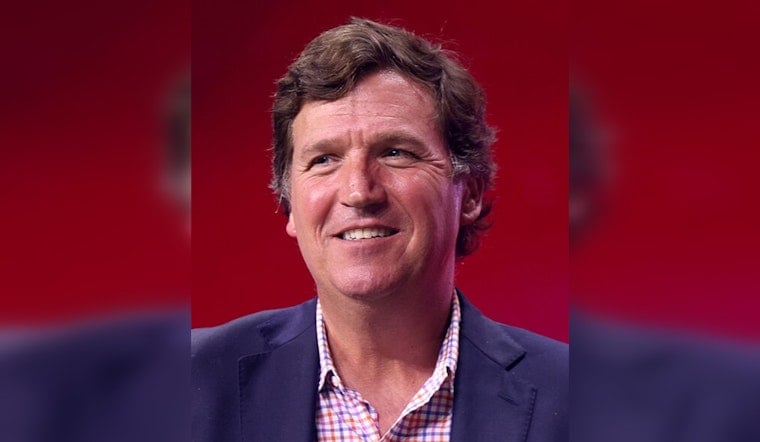
Tucker Carlson hosted a strategy meeting at his Maine home this week that could reshape the conservative movement, bringing together former Rep. Marjorie Taylor Greene, Rep. Thomas Massie, and former counterterrorism official Joe Kent to plot the launch of a new third political party built around opposition to foreign military intervention. The gathering, which produced a 10-point manifesto outlining the group's worldview, marks the most concrete step yet in a growing rebellion among MAGA-aligned figures who say President Donald Trump has abandoned his own anti-war promises.
According to Axios, the Wednesday sit-down was the clearest signal yet that Carlson's camp intends to formalize a breakaway movement rather than simply criticize the GOP from the sidelines. As News Radio 1200 WOAI reports, the plan would need candidates on the ballot in all 50 states to have any real shot at unseating Republicans and Democrats, and a new party would eventually have to put forward its own presidential candidate. Carlson has said he does not plan to run for president himself.
A MAGA Split Years in the Making
Greene's presence at the meeting caps a dramatic political transformation. She resigned from Congress effective January 5, 2026, following a public break with Trump over foreign military interventions and the administration's withholding of Jeffrey Epstein-related documents, according to CBS News. Greene was previously one of Trump's most prominent congressional allies, making her departure especially notable within the MAGA coalition — a shift Hoodline covered as tensions built during her earlier Cobb County town hall.
Joe Kent's path to the Maine gathering followed a similar break. He resigned as director of the National Counterterrorism Center on March 17, 2026, citing opposition to U.S. military involvement in Iran and declaring that Tehran posed no imminent threat to the country, as reported by The Guardian. His exit marked the first high-level departure from the Trump administration over the Middle East conflict. Rep. Thomas Massie, the libertarian-leaning Kentucky Republican who represents the state's 4th Congressional District, has long opposed foreign military aid and intervention, placing him among a vocal minority of anti-war conservatives in Congress, according to Responsible Statecraft.
What The Manifesto and the Rhetoric Say
Per the WOAI report, Greene said Donald Trump betrayed supporters of the anti-foreign-war position, and declared that the movement has begun, describing its commitment as America First for Americans across the political spectrum. She said the movement opposed more foreign wars and had supported Trump specifically because of his promise to pursue that position. Carlson, for his part, said he will not vote for politicians who put a foreign country above their own citizens, and said he cannot support a party that is not loyal to the United States or puts a foreign country's interests above its citizens.
Carlson has already stopped voting for Republicans, per the same account. Matt Gaetz has also joined Carlson in planning to launch the third party, according to the report's headline. Hoodline previously reported on Carlson's escalating feud with establishment figures in his piece on his clash with Ted Cruz over Israel and Iran policy.
The Steep Climb to the Ballot
Bill Pascoe, a longtime member of the Tea Party Patriots in Washington, D.C., told WOAI that starting a new political party from scratch is difficult, and said third-party movements are very difficult to establish. He said placing a third-party candidate on ballots is a massive legal and financial undertaking, and that Carlson and Greene may not have fully considered the plan. Pascoe added that Carlson and Greene may face more difficulty than they can handle in launching the party.
The numbers back up that skepticism. Securing presidential ballot access across all 50 states and Washington, D.C., as an independent or third-party candidate requires gathering between 800,000 and over 1 million legally validated signatures from voters nationwide, according to CBS News. Mounting a nationwide signature drive for third-party ballot access routinely costs between $12 million and $50 million, based on estimates and expenditures from modern independent campaigns such as Robert F. Kennedy Jr.'s 2024 effort, per The Washington Post. Established major parties, by contrast, automatically receive ballot placement in all 50 states, while launching a third party requires enough support and backing to actually defeat Republicans and Democrats, along with substantial work and money.
History and the Appetite for an Alternative
The United States has lacked a significant third-party movement since the 1996 election. The last non-major-party candidate to win ballot access in all 50 states was independent Ross Perot, who secured 18.9% of the popular vote in 1992 — nearly 19.7 million votes — but failed to win a single electoral vote, according to The American Presidency Project. That history illustrates how Electoral College mechanics can blunt even a popular third-party bid.
Still, the political appetite for something new appears real. An October 2025 Gallup survey found 62% of U.S. adults believe the two major parties do such a poor job that a third major party is needed, though 50% expressed concern about wasting their vote on a losing candidate. Separately, Gallup polling released in January 2026 found a record 45% of U.S. adults identified as political independents throughout 2025, while Republicans and Democrats each accounted for just 27% — the highest share of independents recorded since Gallup began tracking in 1988.
That detachment from the two-party system isn't unique to the Carlson-Greene effort. Hoodline recently reported on a similarly independent bid in Colorado, where a Boulder long shot spent $1.1 million attacking both parties in a Senate race. Conservative media analyst Mark Halperin said in August 2026 that if Carlson appeared on general election ballots as a third-party presidential candidate, it would cause fatal electoral damage to the Republican Party, according to TheWrap — a sign of just how seriously some in the GOP are taking the threat from Carlson's anti-interventionist wing of the base.
Whether the Maine meeting produces an actual 50-state ballot campaign or functions mainly as a pressure tactic aimed at the 2026 midterms and the 2028 presidential primaries remains an open question that reporters covering the effort have yet to resolve.



_(cropped_2).jpg)