

























































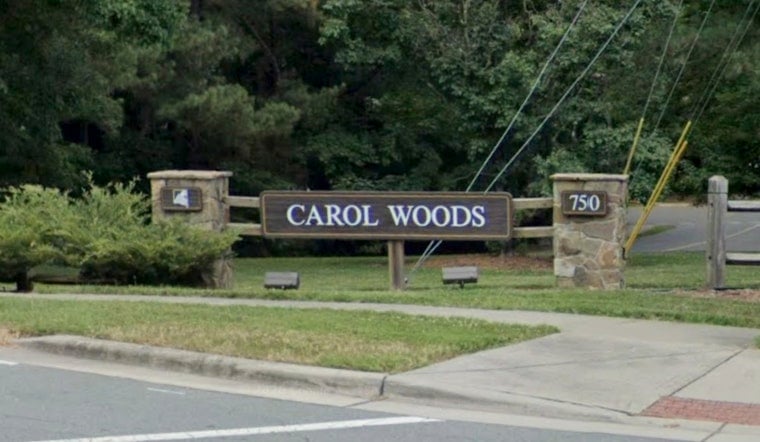
Carol Woods, the nonprofit continuing care retirement community that has occupied a 119-acre campus off Weaver Dairy Road since 1979, wants to add more than 330 new housing units over the coming decades. The plan calls for taller buildings, up to eight units per acre, five new three- and four-story structures with elevators and underground parking, and 60 independent-living carriage homes — a scale of change that has already drawn pushback from neighbors worried about trees, traffic and stormwater.
The retirement community, located at 750 Weaver Dairy Road in Chapel Hill, is seeking a conditional zoning permit for the first phase of the project, according to The News & Observer. That first phase covers eight acres and has no set timeline yet for the broader main-campus redevelopment, which the paper reports could eventually add 30 new buildings across the property. Carol Woods president and chief executive officer Marianne Ratcliffe said the community aims to plan for “a visionary and grounded future,” per the same report.
A Campus Built for an Aging County
Carol Woods currently serves roughly 485 residents, about 400 of whom live independently across 314 one-story cottages and apartments housed in two- to four-story buildings, along with 119 health care units. It is one of two continuing care retirement communities in Chapel Hill, and it has selective admission — independent living and early acceptance applicants wait nearly 12 years on average to get in, the outlet reports. More than 2,000 people currently sit on a priority waitlist.
That demand tracks with broader demographic shifts in Orange County, which had 152,498 residents in 2025, more than 18 percent of them age 65 or older — a population that has grown roughly 15 percent since 2020, according to the same News & Observer report. Carol Woods does not offer traditional affordable housing; a studio apartment entry fee ran $106,000 last year, with monthly costs starting at $2,787, while a two-bedroom duplex cottage entry fee reached $622,400 and a duplex with a den and sunroom cost $7,920 a month. The community does offer financial assistance for residents who outlive their savings, and it partners with PACE, a comprehensive medical and social services program for older adults who qualify for Medicare and Medicaid.
Neighbors Want the Brakes Applied
Future construction on the main campus could ultimately replace 74 one-story cottages and add 274 new units, though the paper notes that timeline depends on resident demand, financial conditions, market conditions and other factors. Main-campus development is also constrained by steep slopes, five streams and required landscaping buffers, and the proposed plan includes removing some older housing units built near streams before modern stormwater rules existed.
Neighbors have raised concerns about building size and scale, along with stormwater, flooding, traffic and the surrounding environment, and they have asked the town to delay the proposal while they meet with Carol Woods officials, the project team and town staff. They also plan to hire independent experts to review engineering and planning issues, according to the News & Observer's reporting. A traffic study remains pending.
Carol Woods officials have said preserving the mature tree canopy is a priority. That commitment carries extra weight here: the campus holds a Level II Arboretum accreditation, one of only four continuing care retirement communities nationwide to hold that environmental designation, according to Carol Woods. The community's stormwater plans include up to a dozen retention ponds designed to handle runoff from a 100-year storm, along with replacing some traditional pavement with pervious surfaces. Existing greenway trails would be extended to serve the new housing.
Zoning Rules and Neighborhood Growth Collide
The timing of Carol Woods' request follows Chapel Hill's adoption of comprehensive Land Use Management Ordinance updates in January 2026, which eliminated townwide mandatory parking minimums and streamlined the conditional zoning process, per the Town of Chapel Hill. That process allows the town council to negotiate customized design standards and environmental buffers directly with developers — likely to be the central mechanism for resolving neighbors' technical objections.
Carol Woods isn't the only major project reshaping this stretch of road. The Chapel Hill Town Council voted 8-1 in February 2026 to approve a 735-unit mixed-use development at 860 Weaver Dairy Road, directly adjacent to the retirement community, according to Triangle Blog Blog. Neighborhood groups, including those around Carol Woods and the nearby Coventry community, have previously raised joint concerns over tree buffers and traffic density along the corridor. Chapel Hill also announced plans this month to demolish Fire Station No. 4 for affordable homes along the same road, part of the town's broader push to add housing in the area.
Carol Woods has its own history with affordable housing efforts nearby. The community previously partnered with Habitat for Humanity of Orange County on the Weavers Grove project off Sunrise Road, an intergenerational development approved by Chapel Hill that pairs affordable homes with senior living, according to Weavers Grove. Carol Woods also contributes $175,000 annually to Orange County to support its Master Aging Plan, with $75,000 of that going toward the county's Department on Aging operating budget.
Financial Footing Behind the Growth Push
The community's expansion ambitions come against a mixed financial backdrop. S&P Global Ratings affirmed Carol Woods' A+ issuer credit rating on $28.8 million in total debt in May 2024 but revised its outlook from stable to negative, citing balance sheet cash-on-hand pressures despite high occupancy, per S&P Global Ratings. Carol Woods remains one of the few continuing care retirement communities nationwide with an S&P rating of A+ or higher, having been upgraded to that level in 2019.
Statewide oversight of communities like Carol Woods has also tightened. The North Carolina General Assembly enacted Session Law 2025-58 in July 2025, modernizing statutory regulation under Article 64A of Chapter 58 to strengthen Department of Insurance oversight and operating reserve monitoring for continuing care retirement communities. State law requires these communities to maintain operating reserves equal to at least 50 percent of annual operating costs.
Carol Woods has also been building out its sustainability infrastructure, having maximized its current solar power production and now exploring battery backup solar storage along with more rooftop solar panels. Its Early Acceptance Program, which lets local residents within 15 miles use campus amenities and services before moving on-site, had 202 enrolled participants as of the end of 2025 — a model Carol Woods says was the first approved of its kind in North Carolina. Ratcliffe said the town's review process will offer additional opportunities for public input as the project moves forward, per the News & Observer.



