

























































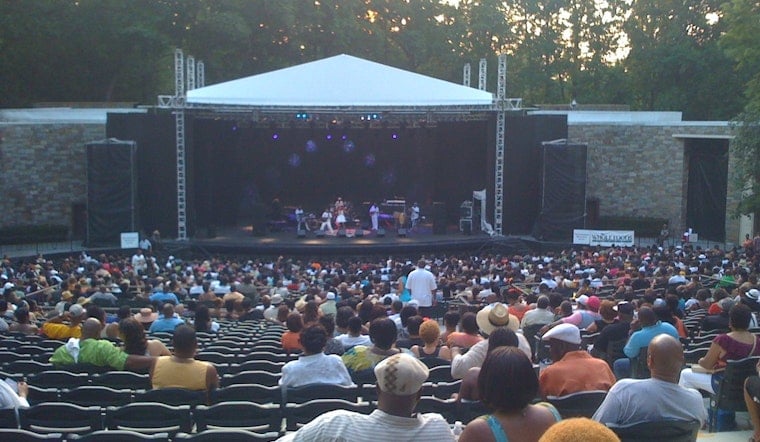
For the first time in nearly a decade, music is filling the hillside bowl of the Carter Barron Amphitheater in Rock Creek Park. Concerts running Thursday, Friday and Saturday nights mark the historic venue's first live performances since a 2016 season that turned out to be its last full one, with organizers relying on a temporary stage built over the first several rows of seats to work around structural problems that have kept the original stage closed for years.
The amphitheater, which historically held more than 4,000 attendees, has sat largely dormant since a February 2017 structural engineering inspection found that its stage substructure couldn't safely support the 150 pounds per square foot required for performers and equipment, according to WTOP. That finding, first detailed by DCist, forced the National Park Service to shutter the venue rather than risk a structural failure beneath performers and crews. This week's shows sidestep that hazard entirely, with a portable stage positioned away from the compromised original structure and the concerts leaning on portable restrooms and other temporary infrastructure since the venue still lacks permanent facilities.
Rock Creek Conservancy, which is leading the pop-up return, teamed up with the DC Jazz Festival and Washington Performing Arts to book acts including Black Alley and Sylver Logan Sharp, both of whom have performed at Carter Barron before. Organizers expect more than 1,500 people each night, with the venue capped at limited capacity, and general admission tickets priced at $15 to keep the shows accessible.
A Stage That Once Hosted Ella Fitzgerald and Duke Ellington
Dan Puskar, who leads Rock Creek Conservancy, said the temporary reopening lets the venue open on a limited basis for people to hear D.C. music again. He noted that some of the biggest acts in the nation came through Rock Creek Park and Carter Barron over the decades, a roster that included Ella Fitzgerald, Duke Ellington and Chuck Brown, among others cited in the same WTOP report.
The amphitheater's musical pedigree stretches back to its earliest years. It was built in 1950 for Washington's 150th anniversary celebration and, according to Ghosts of DC, opened on August 4, 1950, as the Sesquicentennial Amphitheatre before President Harry S. Truman formally dedicated it in May 1951 and renamed it for Carter T. Barron, a film executive and commission vice chair who had advocated for an integrated venue but died shortly after its completion. Truman delivered the dedication address alongside actor Walter Pidgeon, and the venue was one of three Washington locations that were not segregated when it opened. Designed by National Capital Parks architect William M. Haussmann using native limestone built into a natural hillside, the amphitheater cost $563,676.90 to construct and debuted with Paul Green's pageant play Faith of Our Fathers, per the same historical account.
Springsteen's Rain-Soaked Nights on the Hillside
Bruce Springsteen brought his Born to Run tour to Carter Barron for a three-night stand in July 1975, and the venue is where he premiered Born to Run live. During one of those shows, monitored by U.S. Park Police because of rain, Springsteen sat on the edge of the stage and debuted a rare live arrangement of The Drifters' Up On The Roof, according to the Brucebase Wiki. Radio host Donald “Cerphe” Colwell emceed those 1975 shows, part of the string of legendary performances that has fed the current push to see the amphitheater return to full strength.
That decline from marquee venue to shuttered landmark didn't happen overnight. The Washington Post has noted that while Carter Barron drew sold-out crowds throughout the 1950s and 1960s, its status as Washington's premier outdoor stage began slipping in the 1970s as larger regional venues like Wolf Trap in Northern Virginia and Merriweather Post Pavilion in Maryland drew audiences away, allowing deferred maintenance to pile up as the amphitheater's competitive position eroded.
Fundraising and a Long Road to Full Restoration
Puskar has been clear that the quest to reopen Carter Barron truly is not over, and this week's concerts are intended to build support for a larger restoration effort now being developed with the National Park Service. That effort goes well beyond fixing the original stage: the agency's rehabilitation plan calls for overhauling the sub-stage dressing rooms, modernizing electrical and plumbing systems, and bringing front-of-house box office areas up to 21st-century universal accessibility standards, according to the National Park Service.
To help pay for that work, Rock Creek Conservancy established the Carter Barron Alliance in June 2022 to rally local support and secure private funding, raising more than $2 million toward a $5 million goal by late 2025, per Maryland Bay News. Alliance members include local music institutions such as Blues Alley and CapitalBop. In August 2025, Rock Creek Park and the conservancy also marked the site's 75th anniversary with ranger-led history talks, memory sharing and a screening of the film DC's Heartbeat: A Carter Barron Amphitheater Story, an event tied to the 75th anniversary of the start of construction during D.C.'s 150th anniversary year.
This week's concerts follow the model of Summer in the Parks, a National Park Service initiative dating to the late 1960s that connected D.C. residents to nature through low-cost music and cultural programming, according to Rock Creek Conservancy. Organizers kept ticket prices at $15 to honor that arts-for-all mission. Separately, the National Park Service has designated $1.02 million in federal Inflation Reduction Act funds to restore native grasslands and strengthen forest resilience in the surrounding parkland, part of a broader $195 million national climate resilience package, the conservancy notes.
For now, the original stage remains structurally deficient, and audiences returning this week are doing so on borrowed infrastructure rather than a fully repaired venue. But for organizers like Puskar, hearing D.C. music echo through Rock Creek Park again after nearly a decade of silence is being treated as proof of concept for the fuller reopening still to come.



