

























































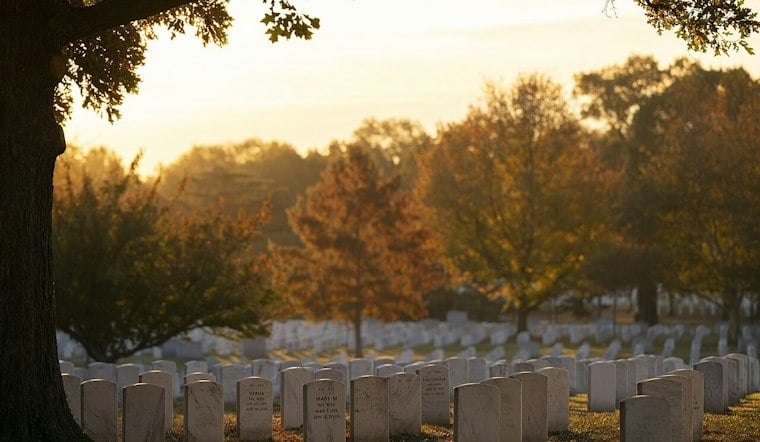
At Section 31, Grave 472 inside Arlington National Cemetery, a headstone marks the resting place of Army Specialist Richard McKinley, who died at age 27 in one of the strangest and most dangerous accidents in American military history. McKinley, an operator at the SL-1 reactor in Idaho, was killed on January 3, 1961, when a control rod was pulled too far during an attempt to restart the reactor, triggering an intense steam explosion. More than six decades later, his remains are still radioactive, and his grave sits under layers of concrete and lead built specifically to contain him.
According to WJLA, Arlington National Cemetery curator Roderick Gainer confirmed that McKinley's remains are, in fact, radioactive, though he said the grave remains safe. The U.S. Army had used SL-1, short for Stationary Low-Power Reactor Number One, as an experimental prototype, with plans to eventually build similar reactors in the Arctic. McKinley and two fellow service members were trying to bring the reactor back online after an 11-day holiday break when the accident occurred, according to the outlet's account.
A Blast That Killed Three Men Instantly or Within Minutes
The explosion was catastrophic. WJLA reports that the man on top of the reactor was killed instantly, as was one of the men standing next to him, while McKinley died while being taken to the hospital after suffering severe head injuries and blast damage. Fire crews did not enter the reactor chamber until hours after the explosion, the station reports, underscoring how dangerous the scene remained in the aftermath.
What happened next made the men's remains uniquely hazardous. The station's report states that the bodies of all three men were injected with highly radioactive particles, forcing autopsies to be performed at a secure location behind lead walls, using mechanical arms to limit exposure. Those details help explain why McKinley's eventual burial required such extraordinary engineering.
A Grave Built Like a Vault
Per WJLA, McKinley's wife wanted him buried at Arlington, and on January 25, 1961, he was placed in a double lead-lined casket, encased in concrete, and surrounded by a metal vault before being lowered into a ten-foot-deep grave topped with still more concrete. The funeral itself lasted only eight minutes, with McKinley's family standing 20 feet away throughout the service, the outlet reports. Local News 8 similarly describes the gravesite as a specially constructed, deep, concrete-lined vault, and reports that McKinley's headstone carries an unusual instruction: “Do not exhume: Contact the Department of Energy.”
That warning is not just for show. WJLA reports that the Nuclear Regulatory Commission and the Department of Energy require permission before McKinley's remains can ever be removed. Separately, a general provision under 32 CFR § 553.25 states that interments are permanent and that requests for disinterment are exceptions to that policy, generally addressed to the Executive Director with specified supporting materials. The other two men killed in the accident were buried in their hometowns using the same lead-and-concrete method, according to WJLA.
What Actually Caused the Explosion Remains Disputed
More than sixty years on, investigators still disagree about why the accident happened in the first place. Gainer told WJLA that the cause of the accident remains a mystery. Local News 8 reports that the final investigative report, which took more than two years to complete, concluded the cause was accidental and found no evidence of foul play. But a separate account from researcher L. Flank states that the Atomic Energy Commission's investigation concluded the accident had most likely been an odd murder-suicide. The two conclusions remain in direct conflict, and neither has been resolved in the dossier of reporting reviewed for this story.
Popular Mechanics notes that future reactor designs would not rely on just one control rod to produce such an excess of power, a direct design lesson drawn from what went wrong at SL-1. WJLA reports more broadly that safety upgrades were made to nuclear reactors after McKinley and his colleagues died, specifically aimed at preventing a recurrence of the SL-1 accident.
Why the Accident Faded From Public Memory
Despite being the first fatal nuclear reactor accident in U.S. history, SL-1 never became a household name the way later incidents did. A paper by Darren Bradley in Thetean argues that the accident did not have a long-term or wide-reaching impact on American memory or public opinion of nuclear power, pointing to the remote location of the testing station, the military nature of the operation, limitations in media coverage at the time, and the broader cultural timing of the event.
The technology that killed McKinley has not entirely disappeared from military planning, even if today's designs look different. The Pentagon's Project Pele is developing a small, transportable reactor meant to power military operations far from any electrical grid, according to Military.com. The outlet reports that the program's specialized fuel arrived at the Idaho lab in late 2025, with assembly and testing expected to follow there. Unlike SL-1's water-cooled design, Project Pele uses a high-temperature gas-cooled reactor, a distinction the outlet says sets the modern program apart from the technology that killed McKinley and his colleagues.
For now, McKinley's grave remains a singular site at Arlington, a place where military ritual and nuclear caution intersect. Gainer told WJLA that the nation will always do its best to honor those who die in service to the country, a sentiment reflected in the reinforced vault built to hold McKinley safely for as long as it stands.





