

























































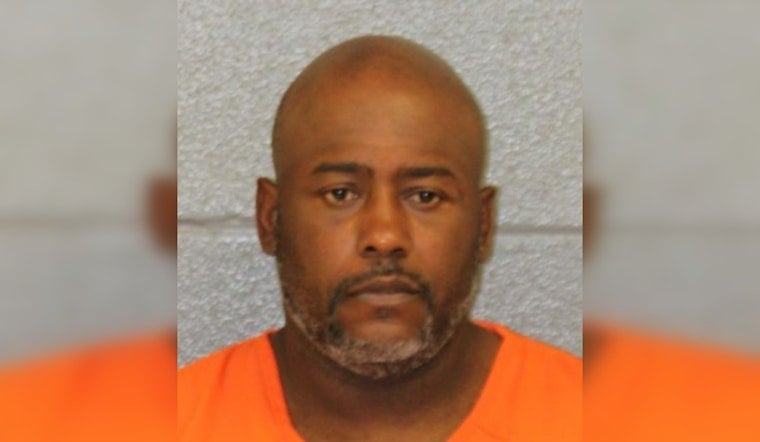
A 52-year-old Charlotte man will spend the rest of his life in prison for shooting his girlfriend's adult son inside a Southwest Charlotte apartment in June 2023, then trying to clean up the crime scene before fleeing. Lawrence Arnold Jackson was found guilty of first-degree murder and possession of a firearm by a convicted felon after a trial that opened more than three years after the killing.
According to court records cited by Queen City News, Jackson shot 33-year-old Justin Johnson once in the side of the head around 10:30 p.m. on June 9, 2023, inside an apartment off Peppervine Lane where Johnson lived with his mother and Jackson. Jackson was in a dating relationship with Johnson's mother at the time. Johnson had reportedly been preparing to move out of the apartment.
Court records show Jackson attempted to clean up Johnson's blood from the floor and moved his body before leaving the apartment. He was arrested on June 11, 2023, at a motel off Brookshire Boulevard, where officers found him asleep in his car, the outlet's report notes.
Body Discovered a Day Later During a Welfare Check
Johnson's body remained inside the Peppervine Lane apartment overnight and into the next day. Per the same account, Johnson's family asked a neighbor to check on him, and that neighbor opened the apartment's unlocked door and found him. At least three people reportedly saw the body before Charlotte-Mecklenburg Police Department officers responded and pronounced Johnson deceased at the scene.
Detectives who executed a search warrant at Jackson's apartment recovered multiple live rounds of .380 ammunition, which matched the type of bullet pulled from Johnson's body, the report states. Investigators also recovered suspected blood from the lid of a washing machine, and a forensics analyst later determined it matched Johnson's blood — physical evidence that undercut Jackson's apparent attempt to erase the scene.
Trial Delayed Three Years, Then Moved Quickly
Jackson's trial did not begin until August 17, 2026, more than three years after his arrest, largely because he remained in custody while the case worked through the court system. As reported by WSOC-TV, Jackson asserted his constitutional right to a speedy trial before proceedings started, a move that finally pushed the long-pending case to a jury verdict.
Superior Court Judge Reggie E. McKnight presided over the trial. The jury found Jackson guilty of first-degree murder and of possessing a firearm as a convicted felon, and the Mecklenburg County District Attorney's Office announced his sentence afterward. Jackson was denied any possibility of parole.
No Sentencing Discretion Once the Verdict Came Down
Under North Carolina General Statutes § 14-17, first-degree murder is a Class A felony carrying a mandatory sentence of either death or life imprisonment without parole for adult defendants, according to the North Carolina General Assembly. Since the state did not seek the death penalty, Judge McKnight had no discretion in sentencing once jurors returned their verdict. Separately, under North Carolina General Statutes § 14-415.1, possessing a firearm after a prior felony conviction is a Class G felony punishable by up to 47 months in prison, per statutory context provided by the Powers Law Firm, though that charge was secondary to the murder conviction that drove Jackson's sentence.
North Carolina law also creates a rebuttable presumption of premeditated first-degree murder in certain killings involving cohabitants or domestic partners with specified prior domestic offense convictions, per the state statute governing homicide in the same household context. Jackson lived in the apartment and was in a romantic relationship with Johnson's mother, placing the case within that broader legal framework for domestic and household violence.
A Familiar Bench for High-Profile Murder Cases
Judge McKnight was elected to North Carolina's Judicial District 26 in Mecklenburg County in November 2018 after more than two decades as a trial attorney handling complex federal and state criminal cases, according to the Mecklenburg Bar Association. He was admitted to the North Carolina State Bar in 1997. This is not his first life-without-parole sentence for a first-degree murder conviction: in November 2025, McKnight sentenced Trevor Powell to life without parole in Mecklenburg County Superior Court for a fatal 2020 ambush shooting of an Uber passenger, as reported by WCNC.
Part of a Broader Pattern in Charlotte's Homicide Numbers
Johnson's killing occurred in 2023, a year in which homicides in Charlotte actually dropped 11% compared to 2022, while the Charlotte-Mecklenburg Police Department maintained an 80% five-year homicide clearance rate, according to the Charlotte-Mecklenburg Police Department. That same year, CMPD officers seized 3,400 firearms as evidence, a 10% increase in gun confiscations over the prior year — a detail that echoes Jackson's own conviction for illegally possessing a handgun as a felon.
Still, the broader trend line in Charlotte points upward. The city averaged 106 homicides annually between 2020 and 2024, double the annual average of 53 homicides recorded between 2010 and 2014, according to WFAE. Local community leaders have pressed city council to prioritize homicide reduction alongside broader quality-of-life initiatives amid that sustained rise.
Jackson's case joins a string of similar Mecklenburg County Superior Court verdicts. Hoodline has previously covered a 2021 apartment murder that also ended in a life-without-parole sentence, part of a pattern of domestic and household killings moving through the same courthouse in recent months.





