

























































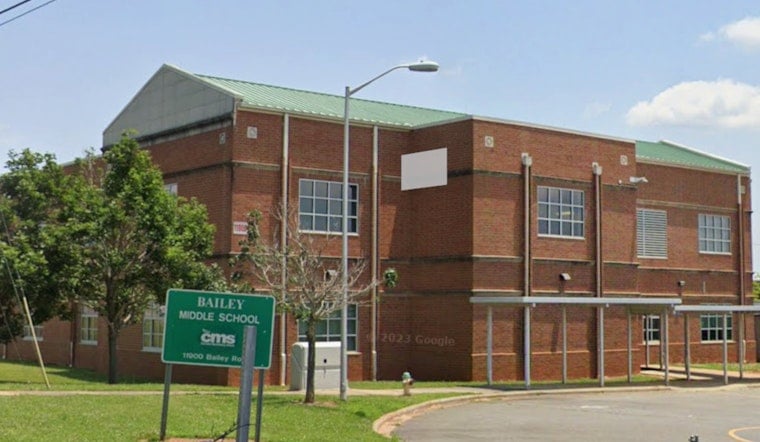
A Charlotte mother has filed a federal lawsuit accusing Charlotte-Mecklenburg Schools of allowing her disabled son to be severely bullied for years, then punishing him for reacting to the abuse instead of disciplining the students responsible. Jessica Martin says her son, identified in court documents as A.P., attended Davidson K-8 School and Bailey Middle School, where classmates allegedly threw rocks at his head hard enough to cause profuse bleeding, hit him with gumballs, wrote demeaning messages about him on a classroom board, and made disparaging comments about his disabilities.
According to WBTV, A.P. has multiple disabilities and health conditions and was covered by both a Section 504 plan and an Individualized Education Program, which are meant to guarantee him disability-related accommodations and support services. The lawsuit claims school officials failed to provide those legally required accommodations and instead relied on outdated plans from years prior. Martin filed a formal complaint against an art teacher and also filed a complaint with the U.S. Department of Education's Office for Civil Rights on Feb. 21, 2025, according to the station's report.
Suspended for Reacting to Bullying
Court filings cited by WBTV describe a pattern in which A.P. was suspended multiple times for reactions to bullying, while the students who tormented him faced no discipline. In one incident, he was suspended for five days after becoming upset when students hit him with gumballs and insulted him, the lawsuit claims. The same filings allege students involved in a separate gumball incident were not disciplined at all, according to the lawsuit.
In another episode described in the suit, students made false complaints about A.P.'s behavior, and he was suspended the day after a mediated meeting held in late February. The district itself later found that A.P.'s behavior was a manifestation of his disabilities in that instance, per the same account, while in a separate case the district found his behavior should not have resulted in discipline at all. Martin has said she contacted school administrators repeatedly about the bullying and requested changes to his accommodations, including a quiet room, but the district ignored those requests, the lawsuit claims.
Handcuffing Incident and Teacher Conflict
The lawsuit also details a career fair at which A.P. injured himself while being handcuffed, and a separate confrontation with an art teacher who attempted to pursue a juvenile petition against him after alleging he shoved her. Martin has said A.P. accidentally bumped into the teacher while she blocked his path, the lawsuit states. The teacher reportedly later said she should have stopped engaging with A.P. and waited for him to calm down instead of escalating the encounter.
On another occasion, A.P. wandered into an empty classroom and sat in a corner, an incident the lawsuit cites as evidence of the anxiety he was experiencing at school. Martin's family says A.P. experienced constant anxiety attacks and physical illness as a result of the bullying and the district's response to it. The lawsuit claims the district refused to implement basic safety measures and ignored repeated reports of physical and verbal bullying, ultimately failing to protect A.P. from harmful staff conduct.
Legal Claims and What's at Stake
The lawsuit accuses Charlotte-Mecklenburg Schools of violating both the Americans with Disabilities Act and Section 504 of the Rehabilitation Act. Under federal guidance from the U.S. Department of Education updated in July 2022, public school districts must evaluate students and hold a Manifestation Determination Review before imposing any disciplinary removal exceeding 10 cumulative school days, to determine whether the misconduct stemmed from a student's disability or the district's failure to implement required accommodations. Separately, North Carolina General Statute § 115C-391.1, the Deborah Greenblatt Act, restricts physical restraint in public schools to emergencies involving imminent threat of harm, self-defense, or securing weapons, and explicitly bans restraint for discipline or staff convenience.
This is not the district's first brush with federal scrutiny over these exact obligations. Under a January 2017 resolution agreement with the Department of Education's Office for Civil Rights, Charlotte-Mecklenburg Schools was required to conduct district-wide staff training on Section 504 evaluation duties, addressing disability-based harassment, and conducting manifestation determination reviews before disciplinary placements. Federal guidance issued by the Office for Civil Rights in 2014 also makes clear that unaddressed peer harassment of a disabled student can itself violate Section 504 and Title II of the ADA if it creates a hostile learning environment.
Representation and District Response
Martin is represented by Charlotte Center for Legal Advocacy and the firm Seyfarth Shaw LLP. The nonprofit, which has served the Charlotte region since 1967 and provides civil legal services to more than 10,000 low-income and vulnerable residents annually, expanded its education law team in July 2025 by integrating the Education Law Program previously housed at the Council for Children's Rights, bringing four specialized education attorneys into its advocacy portfolio.
Martin's family says it has suffered lost educational opportunities, emotional distress, out-of-pocket costs, and lost wages as a result of the district's alleged failures, though the exact damages she is seeking remain unclear as of publication. Charlotte-Mecklenburg Schools had not responded to WBTV's request for comment on the pending lawsuit as of publication. The case unfolds against a backdrop of enrollment strain for the district, which data from the North Carolina Department of Public Instruction show fell to 139,476 students for the 2025–2026 school year, its lowest level since 2012.





