

























































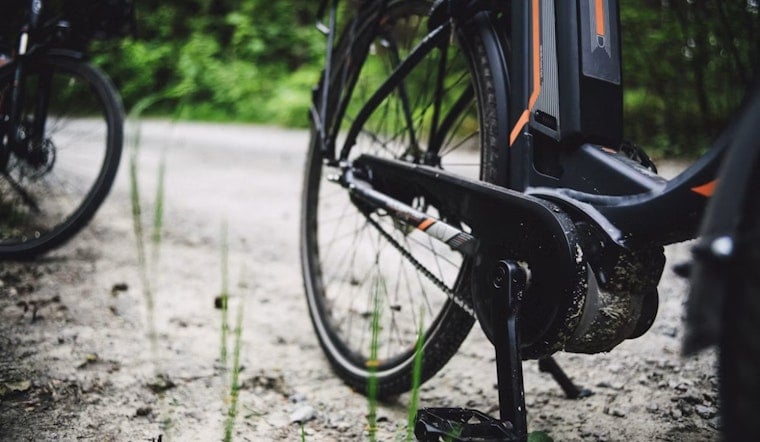
Robert Schwartz noticed the no-e-bike sign at the Dahlia Street trailhead and decided he'd had enough. The 78-year-old retired geriatrician and Cherry Hills Village resident has since reached out to city leaders asking them to reconsider a rule that bars e-bikes from the town's stretch of the High Line Canal Trail, a 71-mile former irrigation ditch mostly owned by Denver Water that cuts through 11 jurisdictions across the metro area.
Schwartz argues the ban limits exercise options for older people who rely on pedal-assist bikes to stay active, according to The Denver Post. So far, he hasn't received a response from city leaders. Cherry Hills Village forbids motorized vehicles on its trails outright, with an exception only for people with disabilities using e-bikes for mobility assistance, and the city maintains at least two no-e-bike signs along its section of the canal path.
The frustration is sharpened by geography. E-bikes are permitted on most of the High Line Canal Trail, including in neighboring Greenwood Village and Denver, where riders just have to stay under a posted 15-mph speed limit. Cross into Cherry Hills Village, though, and the same bike that was legal a few blocks earlier becomes prohibited, even though the city itself sets a 15-mph speed limit on its portion of the trail for everyone else.
Why One Small City Holds the Line
Denise White, a Cherry Hills Village official, said the citywide motorized-vehicle rule reflects trail safety considerations rather than any specific incident. Cherry Hills Village police have not cited anyone for illegal e-bike use on the trail in the past year, White said, and officers often issue a warning for a first offense rather than a ticket. The city's Parks, Trails and Recreation Commission plans to review e-bike regulations early next year, White said, and could recommend changes to the municipal code for City Council to consider.
That timeline isn't fast enough for Schwartz, who hopes the city will take up the ban sooner than 2027. He said six months matters a great deal when it comes to preserving older people's mobility. Richard Spritz, a 75-year-old Cherry Hills Village resident and pediatrician, echoed that concern, saying e-bikes help riders overcome physical difficulty that might otherwise keep them off the trail entirely.
Advocates Push for Speed Limits Over Outright Bans
Pete Piccolo, executive director of Bicycle Colorado, advocates enforcing a speed limit regardless of what kind of bike a rider is on. Piccolo said trail safety depends more on speed and behavior than on the type of bike involved, and he added that e-bike bans disproportionately affect older riders and people with disabilities who depend on the assist to keep pedaling.
State law generally allows Class 1 and Class 2 e-bikes, which top out at 20 mph, on multi-use paths by default, while Class 3 e-bikes can reach 28 mph. But that default explicitly leaves room for local governments to impose stricter rules, which is the exact mechanism Cherry Hills Village has used to keep its ban in place, according to Ebike Oracle. The city's municipal code broadly defines banned motor vehicles to include anything propelled even partly by an electric engine, as Westword has reported, while other suburbs along the canal have rewritten similar codes to carve out pedal-assist bikes.
The patchwork isn't limited to Cherry Hills Village. At Waterton Canyon, the trail's southern origin point in Douglas County, e-bikes aren't permitted at all except as an approved mobility accommodation on the first stretch of Denver Water property — the U.S. Forest Service considers the Waterton Canyon path a non-motorized route, according to spokesperson Travis Thompson. More than 500,000 people use the High Line Canal Trail annually, per Westword, a volume that makes the rule changes at each jurisdictional border more than a theoretical headache for regular riders.
A Rule Cherry Hills Village Has Revisited Before
This isn't the first time the city has looked at the issue. Cherry Hills Village's Parks, Trails & Recreation Commission previously reviewed the trail's motorized-vehicle rules in 2021 at the direction of City Council, but resident feedback at the time opposed legalizing e-bikes over concerns about trail crowding, pedestrian safety, and longer stopping distances on natural-surface paths, according to city records. Those same worries appear to still underpin the city's position five years later.
Meanwhile, e-bike adoption keeps climbing regionally and nationally. U.S. e-bike sales reached nearly $3.8 billion last year and are expected to top $4 billion this year, according to Mordor Intelligence, with projections reaching nearly $5.8 billion by 2031. The Colorado Energy Office has leaned into that growth, announcing a relaunch of its e-bike rebate program offering $1,000 discounts toward new purchases and targeting more than 2,800 income-qualified residents over the next year — part of a broader statewide push that has also included Denver's own voucher program, which Hoodline covered in its e-bike cash dash report.
For now, Cherry Hills Village's ban stands, and riders like Schwartz and Spritz are left waiting to see whether the city's commission takes up the issue before its planned review next year. Until then, the High Line Canal Trail — sometimes called one of the longest continuous urban trails in the country, according to the High Line Canal Conservancy — will keep functioning as a corridor where the rules for e-bikes change block by block, city by city.





