

























































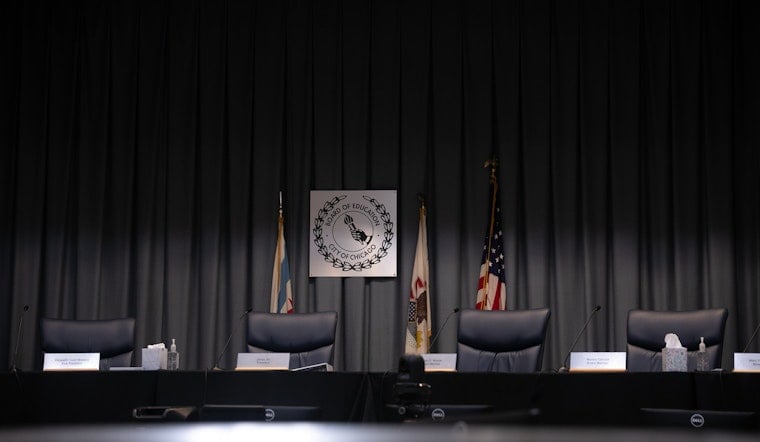
The Chicago Board of Education is racing the clock to decide whether Chicago voters will see a millionaires tax question on their November ballots, with a special meeting scheduled for Thursday to settle the matter just days before the local elections deadline. The board is weighing two advisory referendums — one asking whether the state should impose a new tax on high earners to fund schools, and another involving financial penalties on owners of undeveloped city land. Neither question would carry any legal force, since both are strictly non-binding.
According to ABC7 Chicago, the school board — a majority of whose members were appointed by Mayor Brandon Johnson — met this week to consider adding the two questions to the November ballot. Johnson has publicly backed a new tax on the state's wealthiest earners, and the millionaires tax question specifically would ask voters whether such a levy should help fund Chicago Public Schools. The board must finalize its decision quickly: the Chicago Board of Elections requires referendum language locked in by August 17 for it to appear on the fall ballot.
That timeline is even tighter than it might first appear. As reported by Chalkbeat, the board scheduled a special meeting for Thursday specifically to vote on the referendums so it can meet the elections deadline. The district is relying on a 2011 Illinois law that lets a school board place public policy questions before voters with a simple majority vote — a statute Chalkbeat reports district officials have invoked internally to fast-track the measures without needing Chicago City Council sign-off.
A Detour Around City Council
That workaround exists because the City Council already said no. The school board's maneuver follows a July setback in the council chambers, where opponents of Mayor Johnson blocked his attempt to place a similar 3% millionaires tax advisory question on the citywide November ballot, according to WTTW News. Blocked at the city level, the mayor's allies on the school board appear to be pursuing the same policy question through a different governing body entirely.
Cook County voters, meanwhile, will already see a version of this question this fall regardless of what Chicago's school board decides. Hoodline previously reported that county commissioners approved a non-binding advisory referendum asking whether Illinois should impose a 3% income tax surcharge on annual earnings over $1 million, with revenue split evenly between education and residential property tax relief.
A $10 Billion Budget Built on a Guess
The urgency behind the school board's ballot push traces back to the district's finances. In July, the board passed a $10 billion budget for the 2026-2027 school year on an 11-7 vote that included a last-minute amendment assuming $150 million in uncommitted state revenue from Springfield, per WTTW News. Board members adopted that assumption specifically to avoid the teacher layoffs that district administrators had recommended.
The numbers behind that gamble are stark. Chicago Public Schools meets only 73% of its calculated adequate funding level for fiscal year 2026, down from 81% in fiscal year 2024, leaving an estimated $985 million shortfall against state adequacy targets, according to the district's own figures. That gap widened after nearly $3 billion in federal COVID-19 relief funds fully expired at the start of the fiscal year.
Why a Ballot Win Wouldn't Change the Tax Rate
Even if voters overwhelmingly approve the millionaires tax question, nothing about Illinois's tax code would change automatically. The state constitution requires that individual income be taxed at a single flat rate, currently 4.95%, according to the Illinois Department of Revenue — meaning any real millionaires tax would require amending the constitution itself, not just passing a local advisory question.
Illinois voters have been down this road before, and it did not go well for tax-hike advocates. In November 2020, the statewide “Fair Tax” constitutional amendment, which would have allowed graduated income tax rates, failed with 53% of voters opposed despite $58 million in campaign funding from Governor JB Pritzker, according to Ballotpedia. Chicago voters have also rejected a more recent, more local tax measure: the “Bring Chicago Home” real estate transfer tax referendum lost by a margin of 53.7% to 46.3% in March 2024, per Illinois Policy, after losing support in several South and West Side precincts.
State lawmakers are aware of that history. Illinois House Speaker Emanuel “Chris” Welch said in August that while he supports a statewide millionaires tax for education, a binding constitutional amendment could not reach voters until 2028 at the earliest, since Illinois's May legislative filing deadlines have already passed for this cycle, according to Capitol News Illinois. That leaves the school board's referendum — like the county's — as a purely symbolic gesture aimed at pressuring Springfield ahead of the legislature's upcoming veto sessions, rather than a mechanism that can deliver new dollars on its own.




